ETF Tracker Newsletter For February 24, 2017

Ulli ETF Tracker Contact

ETF Tracker StatSheet

https://theetfbully.com/?p=18573&preview=true

Last Hour Buying Pushes Dow To 11th Record In A Row

[Chart courtesy of MarketWatch.com]
  1. Moving the Markets

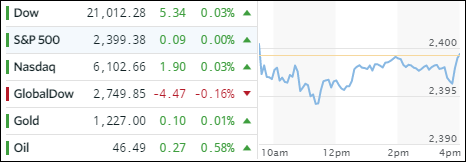
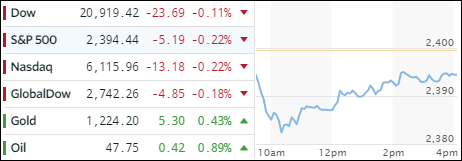
I simply had to laugh out loud when I saw the above chart right after the close. The indexes had spent all day below the unchanged line and it looked like a down day was in the making. The Dow was in danger of seeing its 10 day record streak come to an end when, with only 17 seconds left, as if by magic, sudden buying pushed the index barely into the green and to its 11th record close in a row, its longest streak in 30 years.

Of course, we all know that in this “new normal” stock market nirvana, markets are no longer allowed to close red into the weekend. Seeing this obvious manipulation, as the algos continued to play financial ping-pong, I just can’t help being facetious about it…

In the bigger picture, the Dow has now closed up 3 weeks in a row, the S&P 500 and Nasdaq had their 5th up week in a row, but Small Caps did not fare so well and saw their biggest weekly pullback in 5 weeks. Hat tip goes to ZH for some of these stats.

The tech sector suffered its biggest decline of the year, financials had their worst day in 5 weeks, and the Big Banks were all red on the week. Bonds were up for the 5th day in a row as yields dropped and precious metals were the leaders with Gold reclaiming its $1,250 level, while Silver has been up now for 9 weeks in a row and has conquered its 200 DMA, a sign of strong upward momentum. The dollar slipped, which was its 7th weekly drop out of the last 9.

Read More

Weekly StatSheet For The ETF Tracker Newsletter – Updated Through 02/23/2017

Ulli ETF StatSheet Contact

ETF Data updated through Thursday, February 23, 2017

Methodology/Use of this StatSheet:

  1. From the universe of over 1,800 ETFs, I have selected only those with a trading volume of over $5 million per day (HV ETFs), so that liquidity and a small bid/ask spread are assured.
  2. Trend Tracking Indexes (TTIs)

Buy or Sell decisions for Domestic and International ETFs (section 1 and 2), are made based on the respective TTI and its position either above or below its long-term M/A (Moving Average). A crossing of the trend line from below accompanied by some staying power above constitutes a “Buy” signal. Conversely, a clear break below the line constitutes a “Sell” signal. Additionally, I use a 7.5% trailing stop loss on all positions in these categories to control downside risk.

  1. All other investment arenas do not have a TTI and should be traded based on the position of the individual ETF relative to its own respective trend line (%M/A). That’s why those signals are referred to as a “Selective Buy.” In other words, if an ETF crosses its own trendline to the upside, a “Buy” signal is generated. Since these areas tend to be more volatile, I recommend a wider trailing sell stop of 7.5% -10% depending on your risk tolerance.

If you are unfamiliar with some of the terminology, please see Glossary of Terms and new subscriber information in section 9.


  1. DOMESTIC EQUITY ETFs: BUY — since 4/4/2016
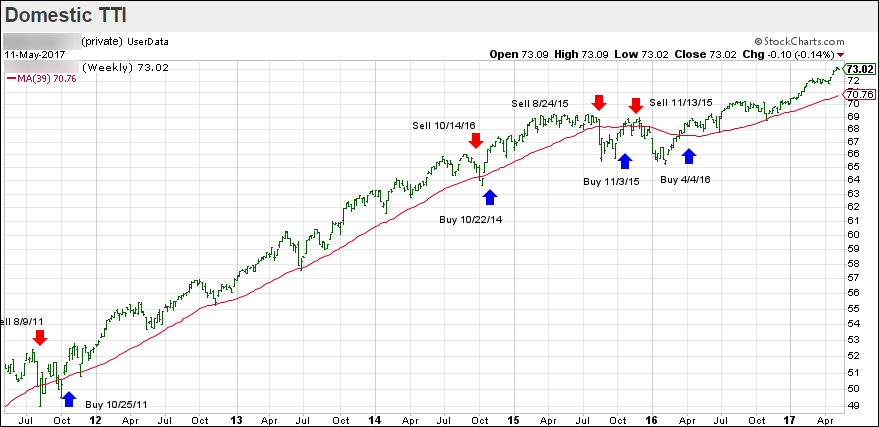
Click on chart to enlarge

Our main directional indicator, the Domestic Trend Tracking Index (TTI-green line in the above chart) is positioned above its long-term trend line (red) by +2.97% after having generated a new Domestic Buy signal effective 4/4/2016 as posted.
Read More

Gold Jumps and Dollar Dumps

Ulli Market Commentary Contact

[Chart courtesy of MarketWatch.com]
  1. Moving the Markets

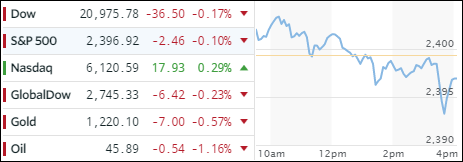
Thursday turned into a whip-saw kind of a day with the three major indexes vacillating above and below their respective unchanged lines but, in the end, the algos managed to push 2 out of 3 back into positive territory. Only the Nasdaq closed in the red, predominantly caused by weakness in Tesla.

Contributing to the uncertainty were statements by Treasury Secretary Mnuchin trying to throw some reality in this perceived economic nirvana that more details on the promised tax reform are not yet available. More importantly, he caught many of guard with his view that “new policies will have at best a limited impact in 2017,” and that he “doesn’t expect to see growth until 2018,” which are facts that I commented on two days ago. We will now have to wait and see if this disappointment carries over into the markets.

In summary, ZeroHedge explained it best: The market may soon pull a Wile E. Coyote—having scrambled too far, too fast, only to find itself suddenly with no firm ground below it, and the realization that any hope for a Trump tax plan to validate the recent move, will not be forthcoming for a long time.

Read More

Fed Minutes Keep Markets Mixed

Ulli Market Commentary Contact

[Chart courtesy of MarketWatch.com]
  1. Moving the Markets

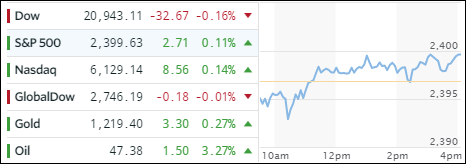
To much shock and surprise all three major indexes opened down this morning—by a gigantic -0.3%. Since in this new normal, a larger downside margin is no longer allowed, so a rebound materialized and up we went, but only the Dow managed to close in the green. Of course, I am being facetious here, but that seems to be the mode of operation of the past year or so in that the downside is “protected” and only unlimited upside moves, warranted or not, are permitted.

The Dow managed to add another record close; it’s 9th in a row, which made it its longest streak since 1987. The index index is now 2,000 points above its 200-day moving average, which is quite a large margin and begs the question as to when the overdue correction will finally occur. On the other hand, that spread is less than 10%, which is below the 12-14% historically critical level that marks a statistically overbought market. That means, theoretically, there is more room to run…

The Fed stepped on the breaks again after the minutes indicated that “it may be appropriate to raise interest rates again ‘fairly soon,’ depending on jobs and inflation data.” Translated, it means that, even after Yellen’s recent hawkish statements, a rate hike in March maybe not be forthcoming after all. Go figure…

Read More

Dow Scores 8th Gain In A Row

Ulli Market Commentary Contact

[Chart courtesy of MarketWatch.com]
  1. Moving the Markets

Last week’s record setting pace continued today as all three major indexes powered higher led by the S&P 500 with a gain of +0.60%. The fact that concerns remain about excessive valuation did not matter; in the end all of the S&P’s 11 sectors closed up with even defensive areas like real estate, utilities and consumer staples joining the party.

In regards to valuations, Reuters writes that the S&P is trading at 17.8 times estimated earnings for the next 12 months, which is above the long-term average of 15 times. That means that there is no doubt that the market is overextended and is overdue for a pullback, especially in view of the fact that we have now gone 50 days in a row without a 1% move.

So, what might derail this rally? Absent of a whole slew of external global events, I believe that Trump’s agenda, as well meaning as it is, may not be able to be implemented within the time frame the market expects. While his recent announcement in regards to major tax cuts, due out soon, has accelerated upward momentum, no details have emerged yet, so all is based on hype and hope. If he delivers as expected, we may see this run continue for a while, however, if he falls short of these heightened expectations, bearish forces may come into play again.

Read More

One Man’s Opinion: Global Bond Markets – Skydiving Without a Parachute

Ulli Market Review Contact

By Greenwich Endeavors

After almost 10 years of unprecedented accommodative monetary policy both in the US and abroad, the fixed-income markets are trading at lofty levels never before seen in history.  Let that sink in for a moment.  Never before.  Not during world wars, not during global depressions, never.

If you think this is a case of scare mongering or me doing my best Chicken Little imitation, it’s not.  One third of global fixed-income bonds were recently trading at a negative yields!  The global bond market has never been in a more perilous position, and I am surprised that there are so few publications ringing the alarm bells.  We are reminded on a daily basis of such trivial risks that have no bearing on our everyday.  But it’s tough to understand why there is such limited press highlighting such glaring risks.  This is especially alarming since we lived through a fixed-income debacle in 2008 and know how devastating it was for those unprepared.

Read More