One Man’s Opinion: QE Unwind Starts Oct. 1. Rate Hike In Dec. Low Inflation, No Problem.

Ulli Market Review Contact

By Wolf Richter

The two-day meeting of the FOMC ended on Wednesday with a momentous announcement that has been telegraphed for months: the QE unwind begins October 1. It marks the end of an era.

The unwind will proceed at the pace and via the mechanisms announced at its June 14 meeting. The purpose is to shrink its balance sheet and undo what QE has done, thus reversing the purpose of QE.

Countless people, worried about their portfolios and real estate investments, have stated with relentless persistence that the Fed would never unwind QE – that it in fact cannot afford to unwind QE.

The vote was unanimous. Even no-rate-hike-ever and cannot-spot-housing-bubbles Neel Kashkari voted for it.

The Fed also telegraphed that it could raise its target range for the federal funds rate a third time this year, from the current range of 1.0% to 1.25%. There is only one policy meeting with a press conference left this year: December 13, when the two-day meeting ends, remains the top candidate for the next rate hike.

This has been the routine since the rate hike last December: The FOMC decides to change its monetary policy at every meeting with a press conference: December, March, June, today, and December.

Read More

ETFs On The Cutline – Updated Through 09/29/2017

Ulli ETFs on the Cutline Contact

Below please find the latest High Volume ETFs Cutline report, which shows how far above or below their respective long-term trend lines (39 week SMA) my currently tracked ETFs are positioned.

This report covers the HV ETF Master List from Thursday’s StatSheet and includes 366 High Volume ETFs ETFs, defined as those with an average daily volume of more than $5 million, of which currently 283 (last week 278) are hovering in bullish territory. The yellow line separates those ETFs that are positioned above their trend line (%M/A) from those that have dropped below it.

Take a look:

The HV ETF Master Cutline Report            

In case you are not familiar with some of the terminology used in the reports, please read the Glossary of Terms.

If you missed the original post about the Cutline approach, you can read it here.

ETF Tracker Newsletter For September 29, 2017

Ulli ETF Tracker Contact

ETF Tracker StatSheet

https://theetfbully.com/2017/09/weekly-statsheet-etf-tracker-newsletter-updated-09282017/

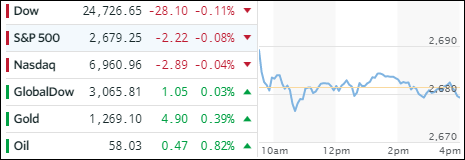
ENDING THE MONTH AND THE QUARTER ON A POSITIVE NOTE

[Chart courtesy of MarketWatch.com]
  1. Moving the Markets

Equities closed out the week, month and quarter on a positive note with the S&P, Nasdaq and Russell 2000 ending not only at their highs of the session but also setting new records in the process. In terms of milestones for 2017, it’s noteworthy that the S&P 500 closed at a record for the 39th time this year, while the Nasdaq topped that number by notching 50 record closing highs. Most of the buying was based on the fact that Trump finally announced his long-awaited tax reform plan and that some of it might finally be implemented, although it’s unclear as to how much of this is based on relief rather than political reality.

Despite a slow start, our ETF holdings picked up steam late in the session with all of them closing solidly in the green. Emerging Markets (SCHE) took top billing, after a couple of slow days, with a gain of +1.13%, which was followed by the high flying Semiconductors (SMH) with +0.93%. The low man on the totem pole was the Dividend ETF (SCHD), which managed to eke out +0.06%.

Interest rates rose with the 10-year bond yield gaining 2 basis points to end the day at 2.33%. We saw sliding interest rates during July and August (hitting a low of 2.05%), but September proved to be a reversal month with rates ascending. Investors in the 20-year bond (TLT) saw losses pile up as “risk was on” and equities were the place to be.

The US dollar (UUP) had a good week by adding about 1%, which was its biggest weekly gain since last December; it was higher for the month as well but only by a fraction of a percent. The intermediate trend is up, but the long-term trend remains down.

Read More

Weekly StatSheet For The ETF Tracker Newsletter – Updated Through 09/28/2017

Ulli ETF StatSheet Contact

ETF Data updated through Thursday, September 28, 2017

Methodology/Use of this StatSheet:

  1. From the universe of over 1,800 ETFs, I have selected only those with a trading volume of over $5 million per day (HV ETFs), so that liquidity and a small bid/ask spread are assured.
  2. Trend Tracking Indexes (TTIs)

Buy or Sell decisions for Domestic and International ETFs (section 1 and 2), are made based on the respective TTI and its position either above or below its long-term M/A (Moving Average). A crossing of the trend line from below accompanied by some staying power above constitutes a “Buy” signal. Conversely, a clear break below the line constitutes a “Sell” signal. Additionally, I use a 7.5% trailing stop loss on all positions in these categories to control downside risk.

  1. All other investment arenas do not have a TTI and should be traded based on the position of the individual ETF relative to its own respective trend line (%M/A). That’s why those signals are referred to as a “Selective Buy.” In other words, if an ETF crosses its own trendline to the upside, a “Buy” signal is generated. Since these areas tend to be more volatile, I recommend a wider trailing sell stop of 7.5% -10% depending on your risk tolerance.

If you are unfamiliar with some of the terminology, please see Glossary of Terms and new subscriber information in section 9.


  1. DOMESTIC EQUITY ETFs: BUY — since 4/4/2016
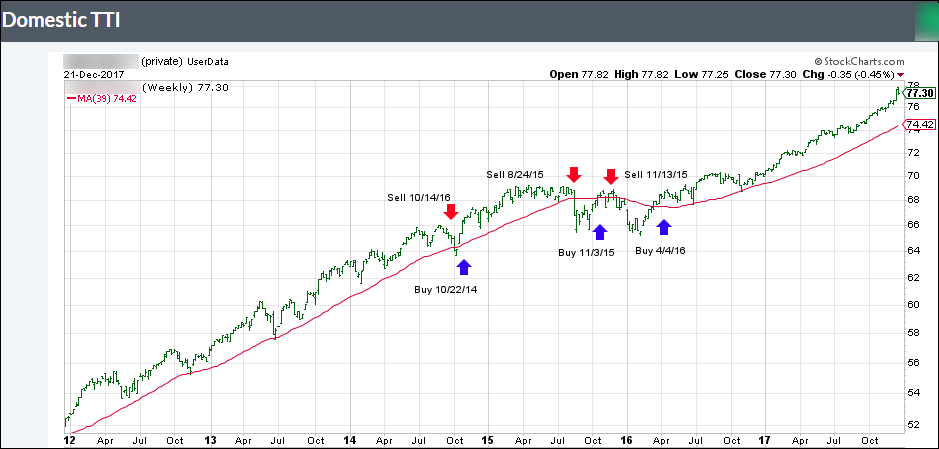
Click on chart to enlarge

Our main directional indicator, the Domestic Trend Tracking Index (TTI-green line in the above chart) is positioned above its long-term trend line (red) by +2.78% after having generated a new Domestic Buy signal effective 4/4/2016 as posted.
Read More

Grinding Higher

Ulli Market Commentary Contact

[Chart courtesy of MarketWatch.com]
  1. Moving the Markets

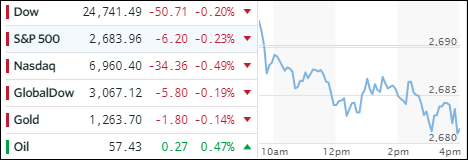
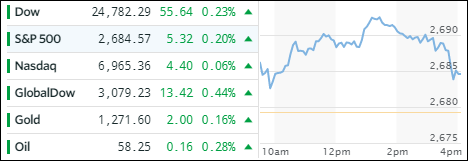
After an early slide, the major indexes managed to do a repeat pattern of what we’ve seen for the last year or so and that is to slowly crawl back to conquer the unchanged line. Today was no different, as worries about the complexity of the new tax code, concerns over deficits and the impact of special interest groups to derail the plan kept a lid on bullish euphoria and limited any advances. In the end, the trading range was tight with stocks, bonds and gold registering green numbers.

In regards to ETFs, we saw mainly positive numbers with the exception being Aerospace & Defense (ITA) showing a loss of -0.72% and Emerging Markets (SCHE) with -0.15%. On the plus side, International SmallCaps (SCHC) ruled with a gain of +0.68%, which was closely followed by Semiconductors (SMH) with +0.64%; a nice performance considering the Nasdaq ending flat.

The yield on the 10-year bond was unchanged at 2.31%, but that did not help the 20-year bond price (TLT). It slipped again, today by -0.30%, and has now surrendered 2/3 of its gains from its recent rally (August to early September).

After 3 days of advances, the US Dollar (UUP) pulled back -0.29% while spending the day in a tiny trading range.

Read More

Dow Snaps Losing Streak; Smallcaps Notch Record Close

Ulli Market Commentary Contact

[Chart courtesy of MarketWatch.com]
  1. Moving the Markets

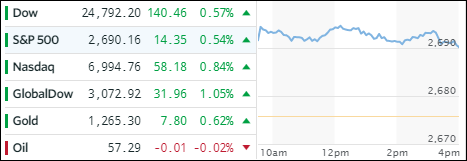
At least according to today’s performance, much confidence was given to Trump’s advertised sweeping tax reform, as the Russell 2000 notched not only a record close but also showed its biggest gain since the election. Strangely enough, the Fed’s Bullard came out and jawboned that “equity valuations may be stretched,” making me wonder if that is an admission that the stock market is in a bubble?

In regards to equity ETFs, we saw plenty of green. Leading the charge were Semiconductors (SMH), which surged +2.25% with SmallCaps (SCHA) taking second place with a solid gain of +1.57%. Ending up modestly in the red were Emerging Markets (SCHE) with -0.45%.

When there are winners, there must be losers. Bond yields rose sharply with the 10-year gaining 7 basis points to 2.31%. This is in striking distance of its 200-day M/A (2.33%). Any break above could indicate that the 2 month bond rally (lower rates) has run its course, and we’re back to an environment of higher yields. As a consequence, the 20-year bond price (TLT) gapped lower and lost -1.51%.

The threat of higher yields powered the US Dollar index (UUP) off its early September lows and above its 50-day M/A. On a daily chart, it still looks like a dead cat bounce, but continuously rising rates could certainly breathe new life into the for dead declared dollar—at least for the time being.

Read More