ETF Tracker Newsletter For November 24, 2017

Ulli ETF Tracker Contact

ETF Tracker StatSheet

https://theetfbully.com/2017/11/weekly-statsheet-etf-tracker-newsletter-updated-11222017/

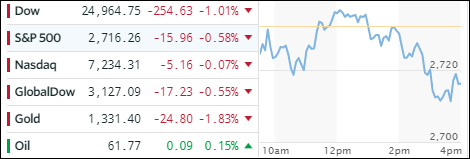
CLOSING AT NEW ALL-TIME HIGHS

[Chart courtesy of MarketWatch.com]
  1. Moving the markets

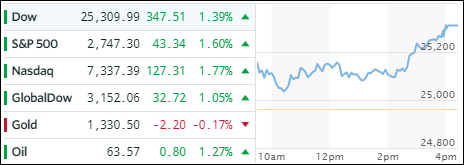
Despite this being a Holiday shortened week, 2 of the 3 major indexes (S&P 500 and Nasdaq) managed to close at new records with the S&P booking a gain of +0.9% over the past 4 sessions. Retailers were obviously in focus, but the retail ETF (XRT) closed down -0.43%, however, we will have to wait and see if Black Friday really turns into the game changer the industry has been hoping for.

Across the ETF space, we saw predominantly gains but also some losses. Closing solidly in the green were Semiconductors (SMH +0.83%), followed by International Equities (SCHF +0.73%) and International SmallCaps (SCHC +0.49%). On the downside, we saw Emerging Markets (SCHE -0.28%) and Transportations (IYT -0.05%).

Interest rates were mixed but the 10-year bond yield rose 2 basis points to end the week at 2.34%. Oil rallied, gold pulled back and the US Dollar (UUP) took another dive and gapped down -0.45% to lows last seen in September.

Read More

Weekly StatSheet For The ETF Tracker Newsletter – Updated Through 11/22/2017

Ulli ETF StatSheet Contact

ETF Data updated through Wednesday, November 22, 2017

Methodology/Use of this StatSheet:

  1. From the universe of over 1,800 ETFs, I have selected only those with a trading volume of over $5 million per day (HV ETFs), so that liquidity and a small bid/ask spread are assured.
  2. Trend Tracking Indexes (TTIs)

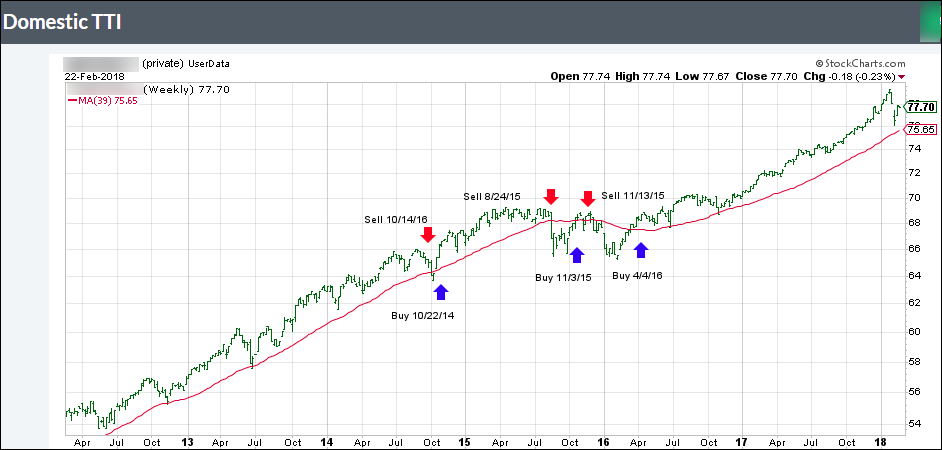
Buy or Sell decisions for Domestic and International ETFs (section 1 and 2), are made based on the respective TTI and its position either above or below its long-term M/A (Moving Average). A crossing of the trend line from below accompanied by some staying power above constitutes a “Buy” signal. Conversely, a clear break below the line constitutes a “Sell” signal. Additionally, I use a 7.5% trailing stop loss on all positions in these categories to control downside risk.

  1. All other investment arenas do not have a TTI and should be traded based on the position of the individual ETF relative to its own respective trend line (%M/A). That’s why those signals are referred to as a “Selective Buy.” In other words, if an ETF crosses its own trendline to the upside, a “Buy” signal is generated. Since these areas tend to be more volatile, I recommend a wider trailing sell stop of 7.5% -10% depending on your risk tolerance.

If you are unfamiliar with some of the terminology, please see Glossary of Terms and new subscriber information in section 9.


  1. DOMESTIC EQUITY ETFs: BUY — since 4/4/2016

Click on chart to enlarge

Our main directional indicator, the Domestic Trend Tracking Index (TTI-green line in the above chart) is positioned above its long-term trend line (red) by +3.41% after having generated a new Domestic Buy signal effective 4/4/2016 as posted.

Read More

A Slow Pre-Holiday Session; Dollar Dumps And Gold Jumps

Ulli Market Commentary Contact

[Chart courtesy of MarketWatch.com]
  1. Moving the markets

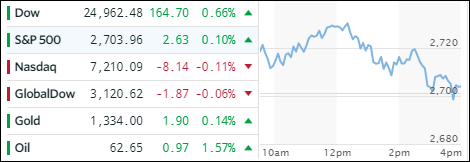
The major indexes presented a mixed picture with the Dow and S&P 500 slightly dipping while the Nasdaq managed to eke out another record—although a tiny one. The Fed minutes surprised traders in that they were very dovish (lower rates) ignoring inflation concerns with some officials opposing near-term rate hikes. That came as a surprise as a December increase was a foregone conclusion. Now we’ll have to wait and see if that will be reversed…

The more immediate result was that gold jumped and is again approaching its $1,300 glass ceiling. With the dovish stance of the Fed, the US dollar (UUP) dumped -0.78%, violating its 50-day M/A to the downside; it had its worst showing since early September. Interest rates dropped allowing the 20-year bond ETF (TLT) to rally +0.32% and reaching a level last seen 2 months ago.

In ETF space, we saw a mixed picture with winners and losers sharing center stage. International SmallCaps (SCHC) were in the limelight with a +0.49% gain followed by International Equities (SCHF) with a decent showing of +0.32%. On the downside, Semiconductors (SMH) gave back some of their huge YTD profits (-0.65%) while the Financials surrendered -0.49%.

This Friday, the markets will have an abbreviated session. In the meantime, I wish you a Happy Thanksgiving Holiday.

Read More

Squeezing The Shorts: Major Indexes Advance Deeper Into Record Territory

Ulli Market Commentary Contact

[Chart courtesy of MarketWatch.com] 

  1. Moving the markets

Never mind the political crisis in Germany. European equities started the day rallying sharply and then handed the baton to the US giving domestic stocks the opportunity to run towards the finish line, which they did assisted by the VIX, which got hammered to 9 (from its recent high of 12). That allowed the major indexes to score another win for the record books. The S&P 500 managed to kiss the 2,600 level for the first time and closed a tad below it.

The “most shorted stocks” had quite a run the past week as they soared over 6%, which was biggest squeeze since December 2016. Our ETF portfolios benefited from all this action and we closed solidly in the green again. Leading the charge with gains of over 1% were Emerging Markets (SCHE +1.36%), Aerospace & Defense (ITA +1.10%), Semiconductors (SMH +1.02%) and Transportations (IYT +1.01%). Low man on the totem pole was the financial sector (XLF) with +0.30%.

Interest rates were steady with the yield on the 10-year bond dropping 1 basis point to 2.36%. The High Yield sector (HYG), which was embroiled in a sharp sell off a few sessions ago, calmed down and rebounded another +0.18%. After gold’s massive sell-off yesterday, the yellow metal managed a small come back at the tune of +0.50%. The US Dollar (UUP) traded in a tight range again and lost a tiny -0.12%.

Read More

Continuing The Upward Path

Ulli Market Commentary Contact

[Chart courtesy of MarketWatch.com]
  1. Moving the Markets

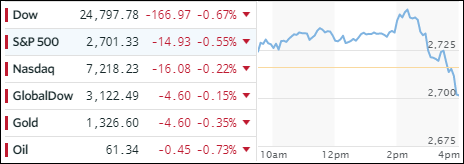
Friday’s strong rebound continued today although at a lesser pace. Nevertheless, the major indexes rose in unison as Wall Street traders kept the prospect for the tax cuts and corporate earnings in focus. Despite political upheaval in Germany, caused by Chancellor Merkel not being able to form a coalition government, equities on both sides of the Atlantic were not affected.

Our ETF portfolios performed better than the major averages thanks to nice advances in Semiconductors (SMH +1.21%), Aerospace & Defense (ITA +0.83%) and US SmallCaps (SCHA +0.61%). The gains were solid across the board with no red numbers in sight.

Interest rates rose with the yield on the 10-year bond adding 2 basis points to end the session at 2.37%. Last week’s volatility in the High Yield sector slowed down with HYG losing a tiny -0.04%. Oil dropped and gold got hammered early on as someone decided to dump a huge amount of futures contracts in an obvious attempt to stop gold from reclaiming its $1,300 level. The drop was almost $20, which caused a break below the 50- and 100-day M/As.

With the Euro plunging, thanks to uncertainty in Germany, the US Dollar (UUP) benefited and rallied +0.49% to stay above its 50-day M/A.

Read More

One Man’s Opinion: How Uncle Sam Inflates Away Your Life

Ulli Market Review Contact

Authored by MN Gordon via EconomicPrism.com,

“Inflation is always and everywhere a monetary phenomenon,” once remarked economist and Nobel Prize recipient Milton Friedman.  He likely meant that inflation is the more rapid increase in the supply of money relative to the output of goods and services which money is traded for.

As more and more money is issued relative to the output of goods and services in an economy, the money’s watered down and loses value. 

By this account, price inflation is not in itself rising prices.  Rather, it’s the loss of purchasing power resulting from an inflating money supply.

Indeed, Friedman offered a shrewd insight.  However, he also accompanied it with an opportunist mindset.  Friedman saw promise in the phenomenon of monetary inflation.  Moreover, he saw it as a means to improve human productivity and economic growth.

Read More