Yield Shock Takes Down Markets As The Bond Slaughter Continues

Ulli Market Commentary Contact


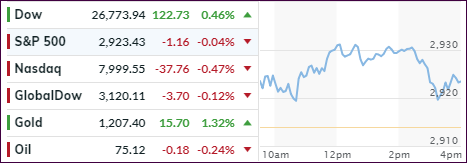
[Chart courtesy of MarketWatch.com]
  1. Moving the markets

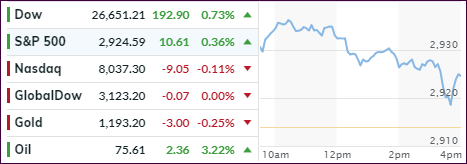
The was no question as to what the driver was to pull the markets down in no uncertain terms. As I cautioned just yesterday, surging bond yields will affect markets eventually, and that moment arrived today as the 10-year yield catapulted towards the 3.23% level, but it eventually settled at 3.19% up 3 basis points from yesterday’s close.

The major indexes slumped with the Dow at one point being down 357 points, or 1.3%, but buying set in and some of the mid-day losses were reversed. Nevertheless, red was the color of the day with the Nasdaq experiencing the brunt of the sell-off with -1.81%.

The spike in bond yields may not be over and “stock markets are entering the danger zone,” according to Bloomberg. What that means is that stocks can only handle yields rising to a certain point before being adversely affected. No one knows where that level is, but I think we’ll be soon finding out that moment of truth should bond yields rise further.

With the Nasdaq slumping the most, it comes as no surprise that the FANG stocks were hammered—not just today, but since the beginning of the month. Semiconductors followed suit with SMH dropping -2.25% and closing below its 5-month uptrend line. In the meantime, the US Dollar did a dump-and-pump and closed higher on the day.

Again, bond investors saw the widely held TLT lose another -0.71% and not just making a new low for 2018 but also increasing the YTD loss to -9.48%. Ouch!
Read More

Equities See-Saw; Bonds Get Slaughtered

Ulli Market Commentary Contact


[Chart courtesy of MarketWatch.com]
  1. Moving the markets

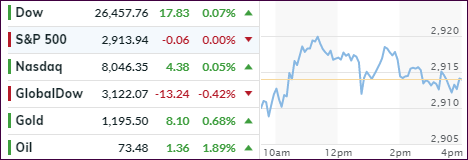
As we’ve seen in the recent past, an early rally ran into overhead resistance, as prices slipped for the remainder of the session. However, the major indexes were able to close in the green by a fraction of a percent as the Dow scored another intra-day record.

The turnaround came early afternoon when bond yields suddenly rallied strongly with the 10-year spiking 9 basis points to close at 3.16%, its highest level since June 2011, while all other maturities rallied in similar fashion. That turned out to be the kill shot for equities and south we went. Fortunately, we ran out of trading time before breaking the unchanged line to the downside.

The widely held 20-year bond ETF (TLT) got clobbered, as it not only traded in a wide range but also gapped down as the chart shows. YTD, TLT has now lost -7.88%, a hefty amount given the more subdued nature of bonds over the past bullish cycle, which appears to slowly come to an end. With today’s loss, TLT has taken out the May’s lows and has reached its lowest level for 2018.

SmallCaps managed to buck the trend and rebounded with SCHA gaining +0.78%. The Dollar Index surged along with the higher bond yields to a level last seen in early August, while Italy’s bond yield eased on hopes that negotiations regarding future deficits may turn out to be successful.

I keep harping on bonds, because higher bond yields will eventually end the stock market euphoria and ultimately push the bullish crowd over the edge into the bear market trap. However, we are not at this point yet, so take my view just as a word of caution.

Read More

Dow Scores 14th Record This Year; Smallcaps Collapse

Ulli Market Commentary Contact

[Chart courtesy of MarketWatch.com]
  1. Moving the markets

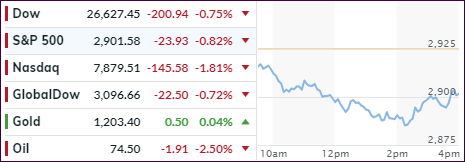
While the Dow managed to score not only a green close but also its 14th record of 2018, the S&P 500 and Nasdaq were the weaklings of the session and slipped slightly below their respective unchanged lines.

In other parts of the world, the activity was more bearish as the China ETF FXI lost -2.42%, despite China markets being closed for the “golden week.” In Italy, the country with the worst NPL loans as I pointed out yesterday, the markets went haywire by first diving sharply, after which panic buying ensured, which brought the price back to unchanged, as this chart from ZH shows. It’s odd and certainly not the sign of a healthy and sound environment when erratic moves like this occur.

While the Dow was enjoying its rise to a new record, the same can’t be said for SmallCaps (SCHA), which got spanked again after having broken a major support line, which had been in place since April. The 200-day M/A looks to be in striking distance now, and it would not surprise me to see this sector move into bear market territory.

Looking at it a different way, there is a major divergence between the Dow and the SmallCaps, which simply translates to the former outperforming the latter by a wide margin. As the chart shows, this divergence just came into play around the beginning of July.

What that means is that some sectors have rolled over and upward momentum is no longer broad based as you can see here. Big caps are holding up well, which is why I increased our exposure to them back in August. We’ll have to wait and see if this weakness will spread to other areas as well. It’s too early to tell, if Small- and MidCaps are resembling the proverbial canary in the coalmine.

Read More

U.S.-Canada NAFTA Deal Propels Markets

Ulli Market Commentary Contact

[Chart courtesy of MarketWatch.com]
  1. Moving the markets

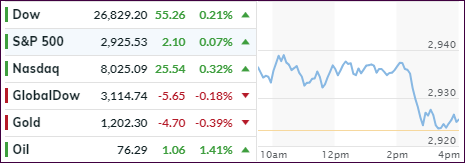
Right after the opening bells, the major indexes went into rally mode, as news of a surprise U.S.-Canada new NAFTA trade agreement pushed the S&P 500 within shouting distance of its intraday record. Finally, some good news on trade after months of haggling and infighting within the various parties.

The euphoric mood waned somewhat throughout the session with the Nasdaq giving back all early gains and slipping below its unchanged line, but the Dow and S&P, despite coming off their early highs, saved the day by closing in the green. But, SmallCaps had their worst day in over two months, so the rally was anything but broad.

Emerging markets were back in the spotlight, as not just the strong US dollar is wreaking havoc with their currencies but also a toxic mix of global tensions, rising US interest rates and now surging oil prices contribute to the overall misery. Take a look at this chart, which shows the YTD percentage change in oil prices in the various regions. Ouch!

India moved to center stage by announcing that it nationalized one of their banks caused by a surge in NPLs (non-performing loans), an unprecedented move that some analysts have put in the “panic” category. Of course, it’s well known that the leader of NPLs is Italy, which is in the middle of a collapsing banking system. But how do those two compare to the rest of the world? This chart below gives us the answer:

Read More

ETFs On The Cutline – Updated Through 09/28/2018

Ulli ETFs on the Cutline Contact

Below, please find the latest High-Volume ETF Cutline report, which shows how far above or below their respective long-term trend lines (39-week SMA) my currently tracked ETFs are positioned.

This report covers the HV ETF Master List from Thursday’s StatSheet and includes 366 High Volume ETFs ETFs, defined as those with an average daily volume of more than $5 million, of which currently 182 (last week 191) are hovering in bullish territory. The yellow line separates those ETFs that are positioned above their trend line (%M/A) from those that have dropped below it.

Take a look:

The HV ETF Master Cutline Report

In case you are not familiar with some of the terminology used in the reports, please read the Glossary of Terms.

If you missed the original post about the Cutline approach, you can read it here.

ETF Tracker Newsletter For September 28, 2018

Ulli ETF Tracker Contact

ETF Tracker StatSheet

https://theetfbully.com/2018/09/weekly-statsheet-for-the-etf-tracker-newsletter-updated-through-09-27-2018/

A Weak Close To A Positive Month

[Chart courtesy of MarketWatch.com]
  1. Moving the markets

The major indexes struggled to find some footing today, but in the end hugged the unchanged line after vacillating above and below it throughout the session.

Geopolitical tensions from Italy were back in focus after the Italian coalition decided yesterday on an “in your face” attitude towards the EU by simply widening their regulated budget deficit, which I mentioned yesterday. The verbal fireworks continued today and will sure be headline news in the following weeks.

In Argentina, the Peso plunged to new record lows, as the government hiked a major interest rate to 65%. Ouch! All this despite promises by the IMF to increase its bailout package. This is just the beginning of further deterioration in the Emerging Markets arena with a domino effect being a likely outcome that eventually will impact the developed nations as well.

Domestically, the major indexes had a mixed September but a strong quarter with the S&P 500 rising some 7%, its biggest quarterly advance sine 2013. This made it easy for investors, who tend to have very short-term memories, to not only forget the sharp market corrections of February and April but also appreciate the fact that US stocks are still outperforming the world’s indexes.

Makes you wonder how long that path can continue, especially given the fact that bonds had a bloodbath in September with yields ending at a much higher level than when they started the month. Rallying equities and rising bond yields are not a combination that will last for long.

Adding to that uncertainty was that true economic data points are decoupled from equity prices as this chart shows. Will the month of October be the big equalizer, as we’ve seen in the past? Who knows, but I am glad that we have an exit strategy in place, just in case reality bites the bulls in the butt.

Read More