ETFs On The Cutline – Updated Through 10/12/2018

Ulli ETFs on the Cutline Contact

Below, please find the latest High-Volume ETF Cutline report, which shows how far above or below their respective long-term trend lines (39-week SMA) my currently tracked ETFs are positioned.

This report covers the HV ETF Master List from Thursday’s StatSheet and includes 366 High Volume ETFs, defined as those with an average daily volume of more than $5 million, of which currently 60 (last week 152) are hovering in bullish territory. The yellow line separates those ETFs that are positioned above their trend line (%M/A) from those that have dropped below it.

Take a look:

The HV ETF Master Cutline Report

In case you are not familiar with some of the terminology used in the reports, please read the Glossary of Terms.

If you missed the original post about the Cutline approach, you can read it here.

ETF Tracker Newsletter For October 12, 2018

Ulli Market Commentary Contact

ETF Tracker StatSheet

https://theetfbully.com/2018/10/weekly-statsheet-for-the-etf-tracker-newsletter-updated-through-10-11-2018/

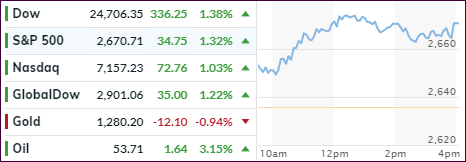
ENDING THE WEEK WITH PUMP, DUMP AND PUMP

[Chart courtesy of MarketWatch.com]
  1. Moving the markets

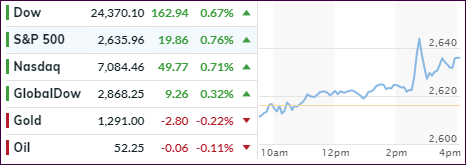
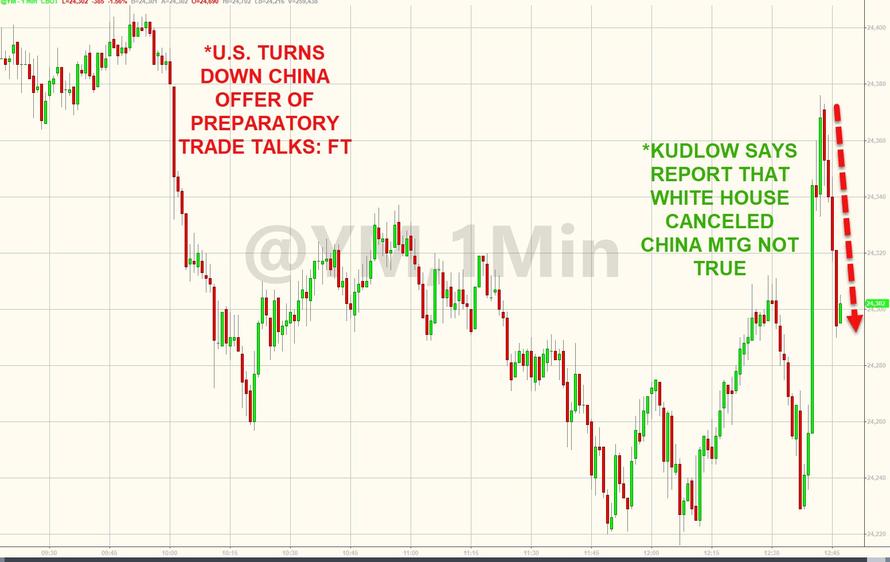
Today turned into another wild ride with the major indexes rebounding, then dropping, with the Dow turning negative after an early 400-point gain, after which buyers stepped in to pull equities out of the doldrums. In the end, we saw one of the worst weeks for stocks since March with the Dow surrendering -5.1%, while the S&P 500 and Nasdaq gave back -4.9% and -4.8% respectively.

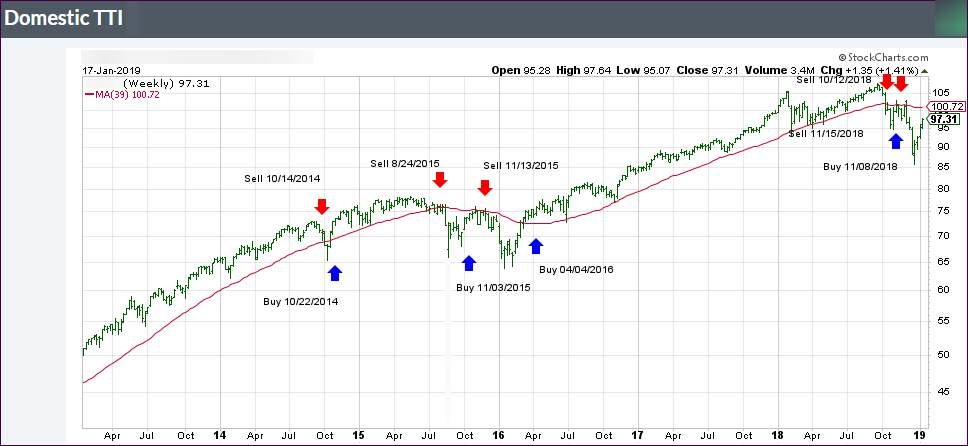
That kind of week was enough to send both of our Trend Tracking Indexes (TTIs) into bear market territory and generating “Sell” signals as posted. The International one is stuck deeply on the bearish side of its trend line. The decline was broad based, as shown in Thursday’s StatSheet, where only red numbers can be seen in the International ETF section confirming my current stance to not be invested in that arena.

Domestically, as I posted yesterday, I liquidated the bulk of our positions. The remainder was scheduled for today, but I held off as I saw the rebound in the making. Nevertheless, our Domestic TTI remains in bear market territory with the Nasdaq being at the precipice of a correction, which is defined as a drop of 10% from recent highs.

Today’s earnings for the banking sector were mixed at best, leaving the Financials (XLF) in no man’s land as far as trend direction is concerned. It remains to be seen if the upcoming earnings season can provide enough ammunition to pull these markets out of the dumps.

Given the still lofty valuations, and the rise in corporate borrowing costs due to higher yields, it becomes questionable in my mind whether bull market momentum can be sustained. Again, it appears that the US markets are finally catching down to the rest of the world in regard to equity performance.

ZH simply called this month carnage when reviewing these stats:

  1. Nasdaq 100 is on course for the worst month since November 2008
  2. Small Caps are on course for the worst month since September 2011
  3. S&P is on course for the worst month since August 2015 (China Devaluation)

Looking at the big picture, we must consider the possibility that this bearish momentum could continue, of course, not in a straight line but interrupted by hopeful bounces. If so, we will liquidate our remaining holdings as this picture becomes clearer.

If, on the other hand, this rebound is strong enough to support the bulls, then we will add to our current holdings once our Domestic TTI has crossed its trend line to the upside again. At all times, we must keep our main goal in mind, which is avoiding participating in portfolio disasters like we saw in 2000 and 2008.

Read More

Weekly StatSheet For The ETF Tracker Newsletter – Updated Through 10/11/2018

Ulli ETF StatSheet Contact

ETF Data updated through Thursday, October 11, 2018


Methodology/Use of this StatSheet:

  1. From the universe of over 1,800 ETFs, I have selected only those with a trading volume of over $5 million per day (HV ETFs), so that liquidity and a small bid/ask spread are assured.
  2. Trend Tracking Indexes (TTIs)

Buy or Sell decisions for Domestic and International ETFs (section 1 and 2), are made based on the respective TTI and its position either above or below its long-term M/A (Moving Average). A crossing of the trend line from below accompanied by some staying power above constitutes a “Buy” signal. Conversely, a clear break below the line constitutes a “Sell” signal. Additionally, I use a 7.5% trailing stop loss on all positions in these categories to control downside risk.

  1. All other investment arenas do not have a TTI and should be traded based on the position of the individual ETF relative to its own respective trend line (%M/A). That’s why those signals are referred to as a “Selective Buy.” In other words, if an ETF crosses its own trend-line to the upside, a “Buy” signal is generated. Since these areas tend to be more volatile, I recommend a wider trailing sell stop of 7.5% -10% depending on your risk tolerance.

If you are unfamiliar with some of the terminology, please see Glossary of Terms and new subscriber information in section 9.


  1. DOMESTIC EQUITY ETFs: SELL — since 10/12/2018

Click on chart to enlarge

Our main directional indicator, the Domestic Trend Tracking Index (TTI-green line in the above chart) is now positioned below its long-term trend line (red) by -2.59% after having generated a new Domestic “Sell” signal effective 10/12/18 as posted.

Read More

Battling For A Comeback—And Failing—Domestic TTI Confirms “Sell” Signal

Ulli Market Commentary Contact

[Chart courtesy of MarketWatch.com]
  1. Moving the markets

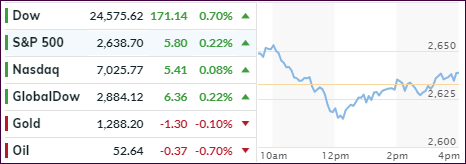
A meager attempt of an early bounce was rebuffed, and the major indexes continued to head south towards bear market territory. I pondered yesterday whether the sell-off was overdone and might produce a quick rebound, or whether we were heading much lower and ending this bullish cycle.

The latter transpired as bouts of selling were interrupted by hopeful bounces, but the bears did not let up, and we dove into the close, just a tad off the session’s low point, as the chart above shows.

It was not just the US showing red numbers. Europe got hammered while the Asia indexes got crushed losing more than -3%, as China took the downside lead with -5.22%. Adding insult to injury was the fact that trading in some 1,000 Chinese companies was halted due to them hitting the 10% limit down rule. Ouch!

All of this is not surprising, as our International TTI already had crossed into bear market territory with the Domestic one now joining in. See section 3 below for more details.

In my advisor practice, I took the opportunity to liquidate most of our holdings, with the remainder being scheduled for tomorrow, unless I see a sharp rebound in the making. In that case, I will hold off for another day.

The ‘red’ October has clearly exacted a heavy toll with Transportations, Nasdaq and SmallCaps being down 9%—in only 9 trading days! The S&P has its own problem by not only being down for the 6th straight day in a row, but it has also sliced through its 200-day M/A for the first time since April.

Clearly, most technical indicators have been violated for most of the major indexes as well as for most of the sector ETFs. Some are now showing negative returns YTD, while for others, gains are quickly evaporating.

Interest rates eased a tad with the 10-year bond yield sliding 2.6 basis points to close at 3.14%. Consequently, the 20-year bond ETF (TLT) managed to close +1.22%, finally throwing an assist to those investors who hold TLT as a “risk” manager in their portfolios.

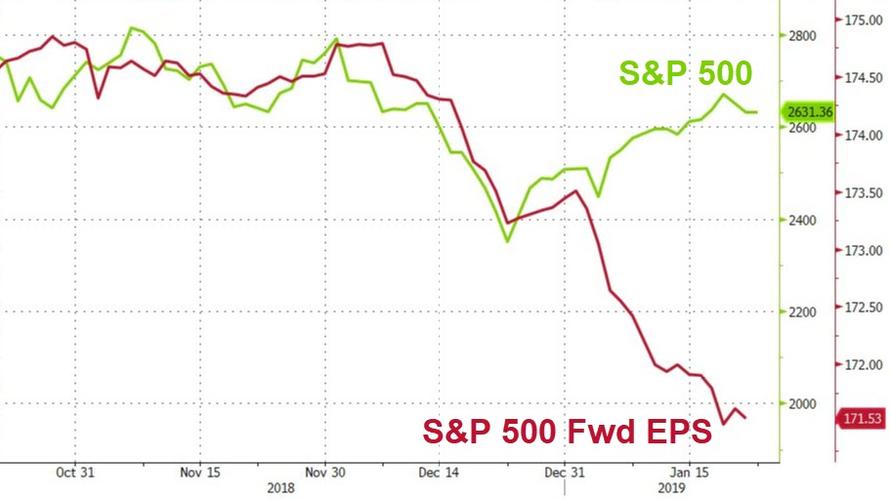
Does this mean that US markets are finally accepting reality by syncing up with the rest of the world? This chart seems to confirm that possibility, but if so, there is a long way to go.

The action of the past 2 days confirms the adage that “markets take the escalator up and the elevator down.” So, it’s quite possible that we will see a recovery, maybe by the end of this month that, after the mid-term elections, may very well accelerate and boost the S&P 500 to the 3,000 level by year-end as this fund manager seems to think.

Of course, before that happens, our Domestic TTI will have signaled a new “Buy,” which will let us participate in this year-end rally, should it materialize.

Read More

Markets Plummet as Red October Rattles Investors; International TTI Generates “Sell” Signal; Domestic TTI Settles Within Striking Distance

Ulli Market Commentary Contact

[Chart courtesy of MarketWatch.com]
  1. Moving the markets

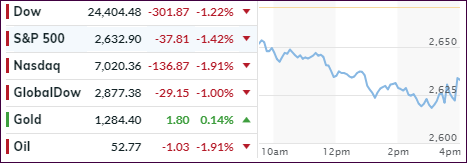
A slow deterioration of equity prices, which started last week, accelerated today with the broad markets plummeting, as the chart above shows. There was simply no place to hide and those investors, counting on the bond portion of their portfolios for safety, were disappointed as the 20-year bond ETF (TLT) dropped in sympathy with stocks bringing the YTD loss to over 10%.

Rising bond yields continue to be culprit causing uncertainty and extending this month’s losses while giving new meaning to the term “Red October,” The S&P 500 not only extended its slide for the 5th consecutive day but also fell below its 5-day M/A for the 4th session, creating doubt as to whether this level could serve as one of support.

The index has also reached a point that is only 20 points away from breaking through its 200-day M/A which, if broken, would very likely confirm more downside action and a return to bear market territory. What is concerning is that the magnitude of today’s correction, as opposed to the ones in February and March, happened in just one day.

Usually, you’d see some bobbing and weaving, along with a slow deterioration of prices, followed by more accelerated selling. Today, all happened at once which, to my way of thinking, could only mean 2 things:

  1. The sell-off was an outlier and simply overdone and is quickly followed by a rebound, or
  2. The bullish crowd just disappeared and computer algos will push this market lower and into bear market territory ending the current bullish cycle, which has only lasted this long due to the Fed’s QE and lower rates, both of which may now be a thing of the past

When looking at charts of the sectors that are fundamentally important for the economy, we see nothing but bearish trends in the following areas: Financials, Semiconductors, Home-builders, Autos, Materials, Copper, Lumber and credit markets. There is only one stock that appears to be holding up no matter what. This chart tells the story.

Our International Trend Tracking Index (TTI) went south again for the 4th day in a row and is now firmly entrenched on the bearish side of its trend line, thereby generating a “Sell” signal effective tomorrow.

The Domestic TTI just broke below its respective trend line today but only by a small margin. I will watch to see if the downward slide continues tomorrow but will for sure liquidate those positions that have triggered their trailing sell stops.

Be sure to see section 3 below for the exact positions of our Trend Tracking Indexes (TTIs).

Read More

Extending The Losing Streak

Ulli Market Commentary Contact


[Chart courtesy of MarketWatch.com]
  1. Moving the markets

The major indexes tried to get out of their foul mood by staging an early rally, which was rebuffed with the trend for the session being predominantly sideways. The S&P 500 not only extended its losing streak for the fourth day, but also bounced around its 50-day M/A leaving open the possibility that this might serve as a support level.

Keeping a lid on upward momentum were bond yields, which spiked again early on with the 10-year touching 3.26% before fading into the close at 3.20% and creating a bond rally. Despite this intra-session pullback, I think the cat is now out of the bag and higher rates and yields will be our future companions. That also means that these loftier yields, with bonds being perceived to be more risk-free than equities, will compete against them for investor dollars.

Of course, those having been invested in bonds during the lowest of rates are seeing plenty of red numbers, as bond prices got crushed with higher yields. Case in point is the widely held 20-year bond ETF (TLT), which finally bounced back today but still shows a YTD loss of -11.19%, hardly soothing for a “conservative” investment.

In the end, despite equities displaying some chaotic characteristics during this session, the major trend remains bullish based on our Domestic TTI (see section 3).

Read More