The See-Saw Bounce Continues

Ulli Market Commentary Contact

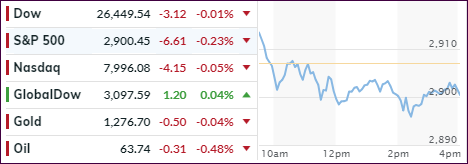
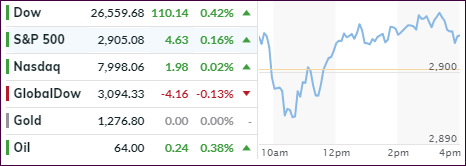
[Chart courtesy of MarketWatch.com]
  1. Moving the markets

The much-discussed mid-level US-China trade talks came to an end today with the warring factions jawboning about “being serious” coming to an agreement and that “progress has been made.” Both parties announced to release a “message” on Thursday.

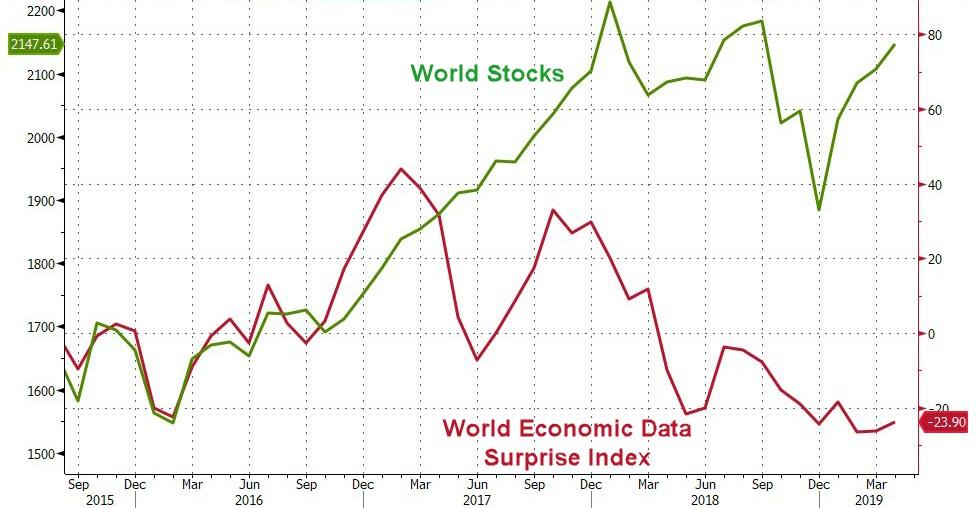
The market impact was minor but kept the major indexes in positive territory early on. All eyes were on the release of the Fed minutes where members of the FOMC showed some willingness to delay further rate hikes due to the volatility in financial markets while, at the same time, concern about global growth, or lack thereof, was foremost on their minds.

In the end, it seemed that future monetary policy would be more “cautious,” which goes along with Powell’s recent U-turn that the Fed would change policy swiftly if economic conditions warrant such a move. While these words seemed to calm the markets, the see-sawing continued but kept the major indexes in the green.

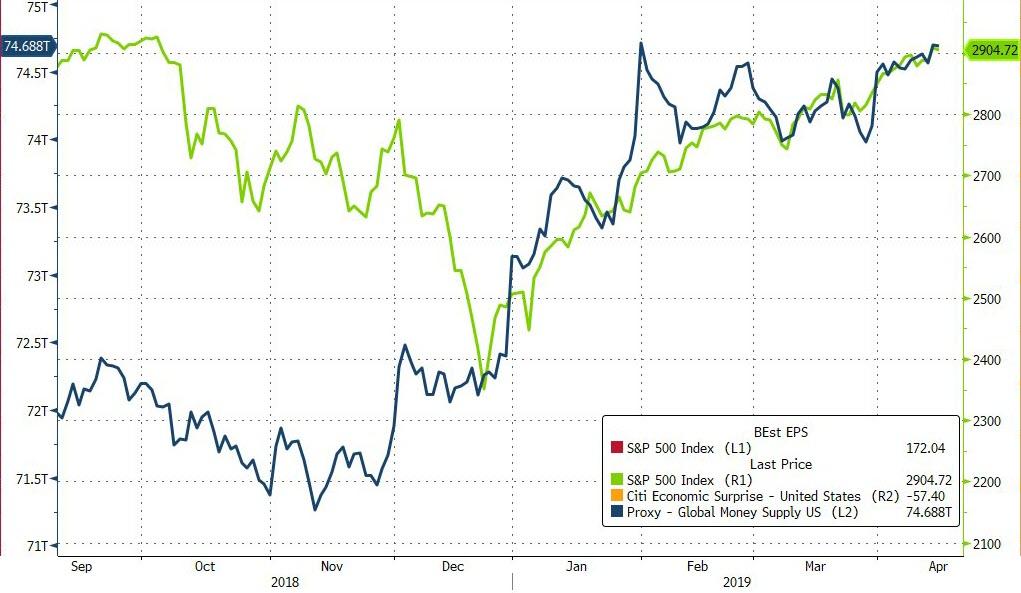
ZH added that during the last four days we have witnessed the biggest short-squeeze since March 2009, while China pumped and dumped and Europe extended its gains led by Italy. The US Dollar tumbled the most since last November to its lowest since September 2018.

Equities are now up 8 of the last 10 days, which translates into the best start to a year since 2010. As I keep mentioning, the most impressive rebounds and jaw-dropping dips happen while we are in a bear market.

The question remains, will there be enough staying power to lift our Domestic TTI back into bullish territory? Very possible. If the Fed continues to play ball the way the markets like it, and Trump gets an acceptable trade deal with China, we may very well see a new domestic Buy signal develop soon.

Read More

Trade Talk Hope Powers Markets

Ulli Market Commentary Contact

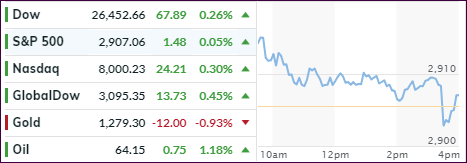
[Chart courtesy of MarketWatch.com]
  1. Moving the markets

The major indexes managed to string together a 3-day winning streak thanks to continued optimism over the status of US-China trade talks. In a show of good faith, the warring parties extended their discussions until Wednesday. Word has it that gradual progress is being made, however, a true and final deal appears to be not on the horizon.

But markets prefer to react to hope and wishful thinking so, after some early see-sawing, the major indexes managed to gain about 1 percent.

On the economic front, headlines were mixed, as the Labor market unexpected hit an air pocket with job openings, hires and quits all tumbling. This confirms that, along with many other data points of the recent past, the economy is slowing which, in my view, was one of the reasons Fed head Powell did a sudden U-turn last week and adopted a softer (dovish) stance towards interest rates.

Europe wasn’t any better regarding econ data, as powerhouse Germany saw its industrial production collapse; a good thing only when considering that the ECB won’t tighten as aggressively and may very well do their best imitation of Jerome Powell. No tightening equals higher stock prices in the bizarre world we are living in.

ZH posted the question “who will be right?” in this chart showing the divergence between interest rates and the S&P 500. Will bond yields rise or equities sink to get back in sync?

I am sure we’ll find out soon enough.

Read More

When Bad News Is Good News—Again

Ulli Market Commentary Contact

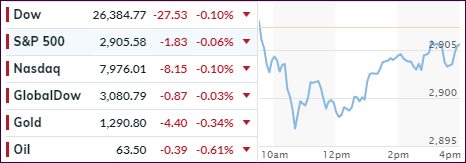
[Chart courtesy of MarketWatch.com]
  1. Moving the markets

At least for today, we’re back to the theme of last year when, on many occasions, bad news was good news and kept the bullish dream alive. I was reminded of that this morning when, after last week’s terrible manufacturing index (ISM) numbers, it was the US Service Economy’s turn to plummet (December data), as the index slipped from 60.7 to 57.6 vs. expectations of 59, and matching July lows.

Of course, in the whacked-out world of computer algos, this was good news, as it adds a glimmer of hope that the Fed will remain dovish and stay away from further interest rate hikes.

Helping the bulls to score another session in the green were reports that US-China talks resumed as ‘senior’ officials from China unexpectedly showed up for negotiations in Washington. That sparked some optimism in the markets, which will last exactly until news headlines refute that any progress has been made. But, maybe it’s different this time…

The major indexes closed modestly higher, after pulling back mid-day when Trump announced his address of the nation tomorrow. In the meantime, the spanking of the US Dollar continued to accelerate after Fed’s Powell U-turn from hawkishness towards dovishness.

In my advisor practice, we are and have been in cash on the sidelines since 11/15/18 with our Domestic TTI (see section 3) still lingering on the bearish side of its long-term trend line.

Read More

ETFs On The Cutline – Updated Through 01/04/2019

Ulli ETFs on the Cutline Contact

Below, please find the latest High-Volume ETF Cutline report, which shows how far above or below their respective long-term trend lines (39-week SMA) my currently tracked ETFs are positioned.

This report covers the HV ETF Master List from Thursday’s StatSheet and includes 322 High Volume ETFs, defined as those with an average daily volume of more than $5 million, of which currently 53 (last week 44) are hovering in bullish territory. The yellow line separates those ETFs that are positioned above their trend line (%M/A) from those that have dropped below it.

Take a look:

The HV ETF Master Cutline Report

In case you are not familiar with some of the terminology used in the reports, please read the Glossary of Terms.

If you missed the original post about the Cutline approach, you can read it here.

ETF Tracker Newsletter For January 4, 2019

Ulli ETF Tracker Contact

ETF Tracker StatSheet

https://theetfbully.com/2019/01/weekly-statsheet-for-the-etf-tracker-newsletter-updated-through-01-03-2019/

MARKET CHAOS CONTINUES—THE PENDULUM SWINGS THE OTHER WAY

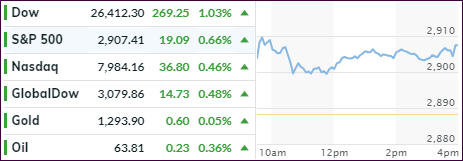
[Chart courtesy of MarketWatch.com]
  1. Moving the markets

After yesterday’s equity thrashing, the markets shifted into reverse, very similar as to what we witnessed prior to and after Christmas, with the pendulum now swinging in the bullish direction. All of yesterday’s issue were swept under the carpet as three new drivers emerged to propel the markets out of the doldrums.

First, the U.S. gained 312k new jobs in December, which was the biggest increase in hiring in three years, and it shattered the forecasts made by Wall Street experts (182k). However, the unemployment rate rose to 3.9% from 3.7%. Those headlines pushed the computer algos into overdrive and up we went.

Never mind that under hood, the jobs report revealed that the increase in average hourly earnings was the fastest since 2009. The consequence could be a threat to corporate profit outlooks, something we’ve just seen with Apple. Additionally, only old workers found jobs in December, which is not exactly an encouraging sign.

Second, Trump came out touting “the great jobs number” while is economic advisor Kudlow declared that there is “no recession is sight. The American economy is growing 3 percent, job gains are huge, and businesses are investing big time,” which was followed by “it’s a much better optimistic picture than what we’ve been getting in the last month or two.

And, thirdly, not to be outdone, Fed chair Powell did a dramatic U-turn and chimed in with dovish words like “we’re listening carefully to the market,” and “will adjust the balance sheet normalization policy ‘if needed’, and if it becomes an issue for the market and economy.

Well, you couldn’t have asked for any more assists, so panic buying and FOMO (Fear Of Missing Out) sent sending the Dow up almost 750 points and wiping out yesterday’s losses. This chart shows the market impact of the various actors chiming in, while traders welcomed the “new” Powell by interpreting his views as being sympathetic to their recent pain caused by collapsing asset prices.

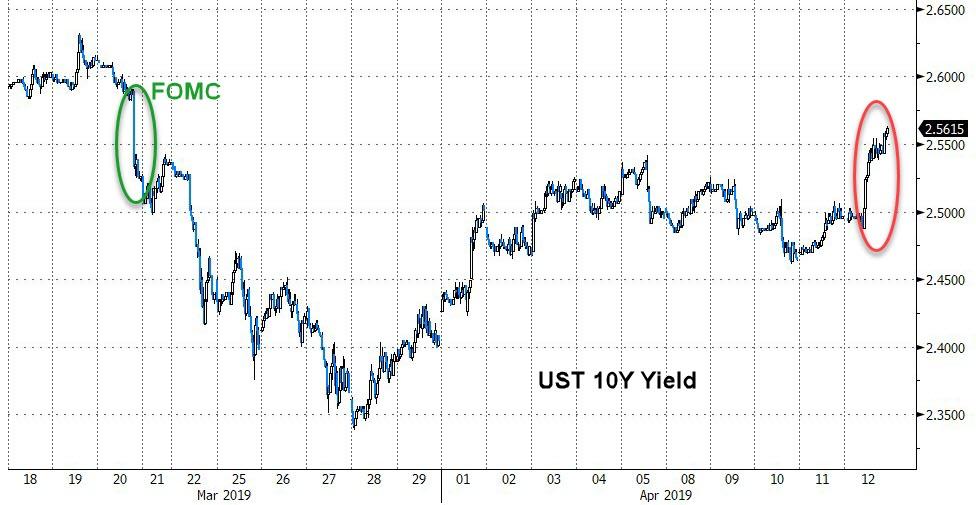
The bond market was rocked as yields shot up, after yesterday’s fall, with the 10-year yield surging from a low of 2.54% to as high as 2.67%, according to ZH. This was a 4.2% increase and the biggest jump in 2 years. As a result, bond prices, which move inversely to yields, were clobbered with the widely held TLT dropping -1.16%.

In the end, Powell’s statement was the most powerful one and, while he was not explicitly hawkish, the mere absence of it was enough to propel the major indexes higher, which brings up this question: Will Powell’s ‘softer’ tone be enough to keep the rally going next week, or will it be a one-day wonder?

Read More

Weekly StatSheet For The ETF Tracker Newsletter – Updated Through 01/03/2019

Ulli ETF StatSheet Contact

ETF Data updated through Thursday, January 3, 2019

Methodology/Use of this StatSheet:

  1. From the universe of over 1,800 ETFs, I have selected only those with a trading volume of over $5 million per day (HV ETFs), so that liquidity and a small bid/ask spread are assured.
  2. Trend Tracking Indexes (TTIs)

Buy or Sell decisions for Domestic and International ETFs (section 1 and 2), are made based on the respective TTI and its position either above or below its long-term M/A (Moving Average). A crossing of the trend line from below accompanied by some staying power above constitutes a “Buy” signal. Conversely, a clear break below the line constitutes a “Sell” signal. Additionally, I use a 7.5% trailing stop loss on all positions in these categories to control downside risk.

  1. All other investment arenas do not have a TTI and should be traded based on the position of the individual ETF relative to its own respective trend line (%M/A). That’s why those signals are referred to as a “Selective Buy.” In other words, if an ETF crosses its own trendline to the upside, a “Buy” signal is generated. Since these areas tend to be more volatile, I recommend a wider trailing sell stop of 7.5% -10% depending on your risk tolerance.

If you are unfamiliar with some of the terminology, please see Glossary of Terms and new subscriber information in section 9.


  1. DOMESTIC EQUITY ETFs: SELL — since 11/15/2018

Click on chart to enlarge

Our main directional indicator, the Domestic Trend Tracking Index (TTI-green line in the above chart) is now positioned below its long-term trend line (red) by -11.15% after having generated a new Domestic “Sell” signal effective 11/15/18 as posted.

Read More