Below, please find the latest High-Volume ETF Cutline
report, which shows how far above or below their respective long-term trend
lines (39-week SMA) my currently tracked ETFs are positioned.
This report covers the HV ETF Master List from Thursday’s
StatSheet and includes 322 High Volume ETFs, defined as those with an average
daily volume of more than $5 million, of which currently 267 (last week 244)
are hovering in bullish territory. The yellow line separates those ETFs that
are positioned above their trend line (%M/A) from those that have dropped below
it.
In case you are not familiar
with some of the terminology used in the reports, please read the Glossary of Terms.
If you missed the original
post about the Cutline approach, you can read it here.
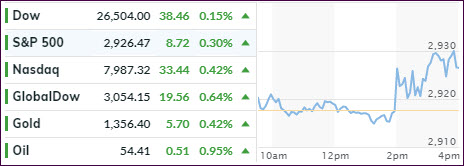
Quadruple
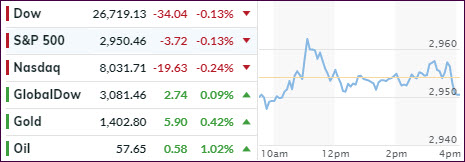
witching day occupied the traders on Wall Street, as the 3rd Friday
of every quarter can produce added volatility due to the simultaneous
expiration of single-stock options and futures and index options and futures.
A
mid-morning sudden spike was not caused by any option juggling but was merely a
reaction to VP Pence’s conciliatory comments about the trade meeting. It did
not take long for the Chinese to pour some cold water on his remarks via things
like “the Chinese side is concerned about the fairness of a trade deal,”
followed by “the US side must remove all newly imposed tariffs.”
This
took the starch out of the upward move, and the Pence
spike was erased in short order. The major indexes managed to tightly roam
around their respective unchanged lines for the remainder of the session, seemingly
unfazed by another set of weak econ data. A dive into the close pulled us back into
the red, but the losses were minor. However, for the week, the S&P 500
managed a gain of some 2.2%.
We
learned that existing home sales continued their downward spiral, as the rise
of 2.5% MoM in May does not tell the entire story. When looking at it longer term,
this data set has tumbled
YoY for the 15th month, which is the worst since the housing crisis.
At
the same time, US manufacturing (PMI) plunged to 10-year lows in June, with
both indexes (Manufacturing and Services) edging closer to contraction.
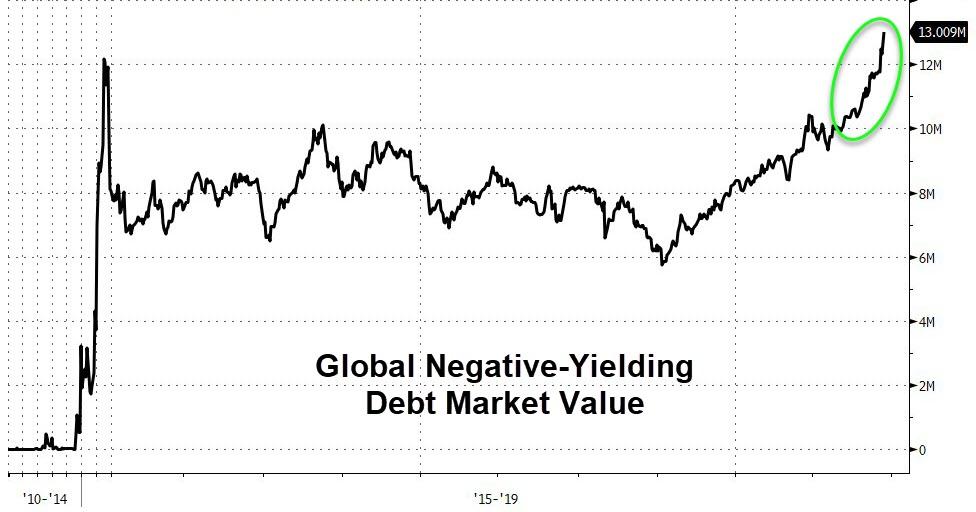
Since
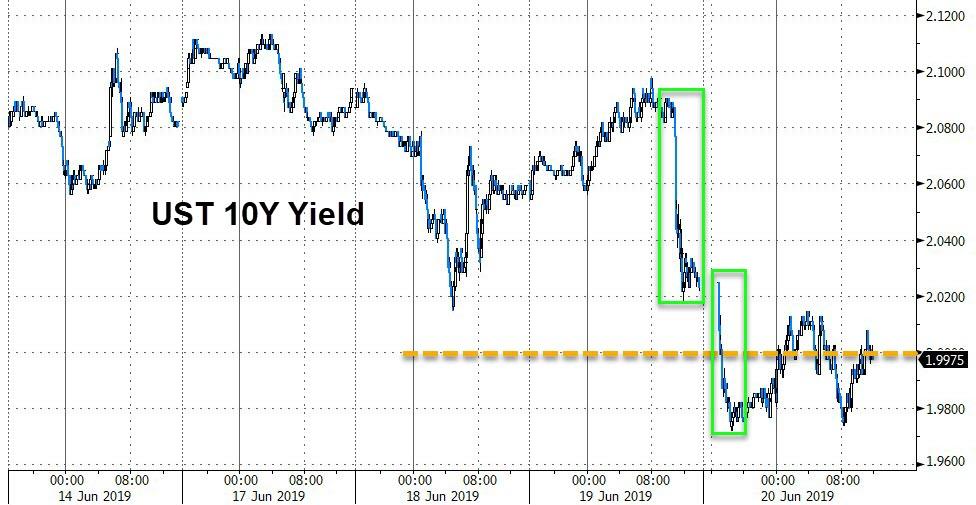
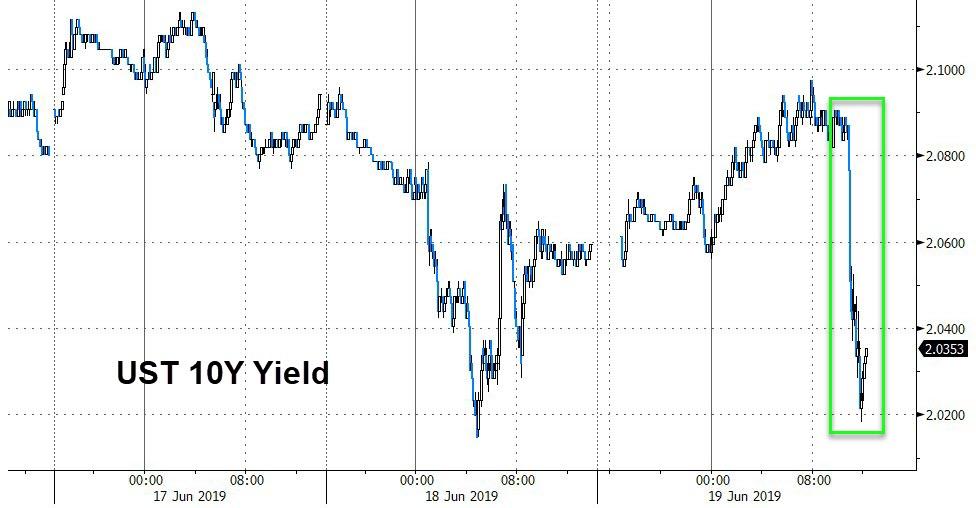
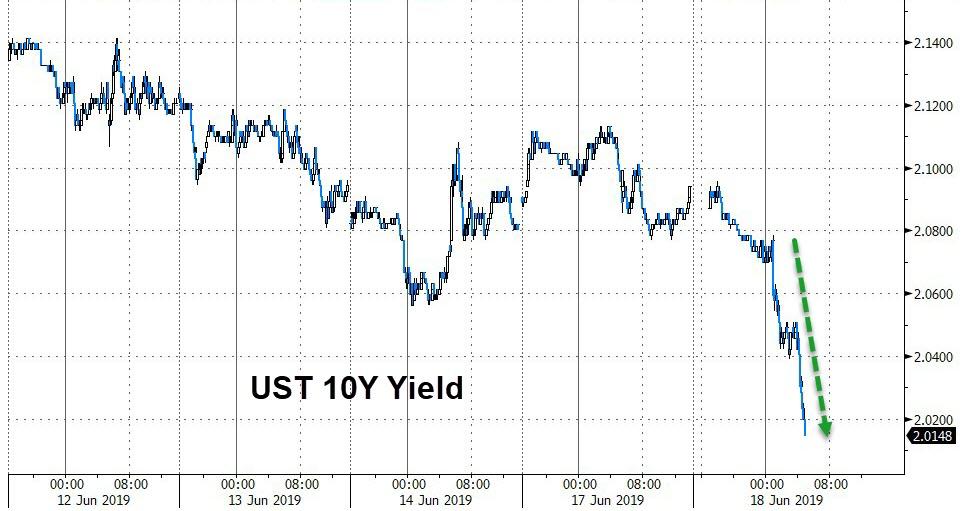
bond yields have been getting most of the attention lately, as the 10-year
is threatening to drop below the 2% level, worldwide, the picture looks even
gloomier. Global negative yielding debt soared by $700 billion in one day to a record
$13 trillion.
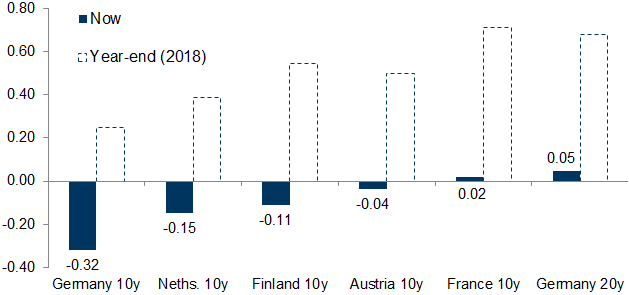
Look
at the yield
disaster that Europe is showing, especially when you review the comparative
data as of year-end 2018. This kind of a collapse in yields is not a bullish
indicator. It’s the opposite, as it clearly points to collapsing global growth
and a potential slide into a recession.
Makes
me wonder when the equity markets will figure this out…
In
the meantime, we will ride this trend until it ends, when it bends and our Trend
Tracking Indexes (TTIs) signal to get us out of equities and to the safety of
the sidelines.
1. From the universe of over 1,800 ETFs, I have selected only those with a
trading volume of over $5 million per day (HV ETFs), so that liquidity and a
small bid/ask spread are assured.
2. Trend Tracking Indexes (TTIs)
Buy or Sell decisions for Domestic and International ETFs (section 1 and
2), are made based on the respective TTI and its position either above or below
its long-term M/A (Moving Average). A crossing of the trend line from below
accompanied by some staying power above constitutes a “Buy” signal. Conversely,
a clear break below the line constitutes a “Sell” signal. Additionally, I use a
7.5% trailing stop loss on all positions in these categories to control
downside risk.
3. All other investment arenas do not have a TTI and should be traded
based on the position of the individual
ETF relative to its own respective trend line (%M/A). That’s why those signals
are referred to as a “Selective Buy.” In other words, if an ETF crosses its own
trendline to the upside, a “Buy” signal is generated. Since these areas tend to
be more volatile, I recommend a wider trailing sell stop of 7.5% -10% depending
on your risk tolerance.
If you are unfamiliar with some of the terminology, please see Glossary of Termsand new subscriber information in section 9.
1. DOMESTIC EQUITY ETFs: BUY
— since 02/13/2019
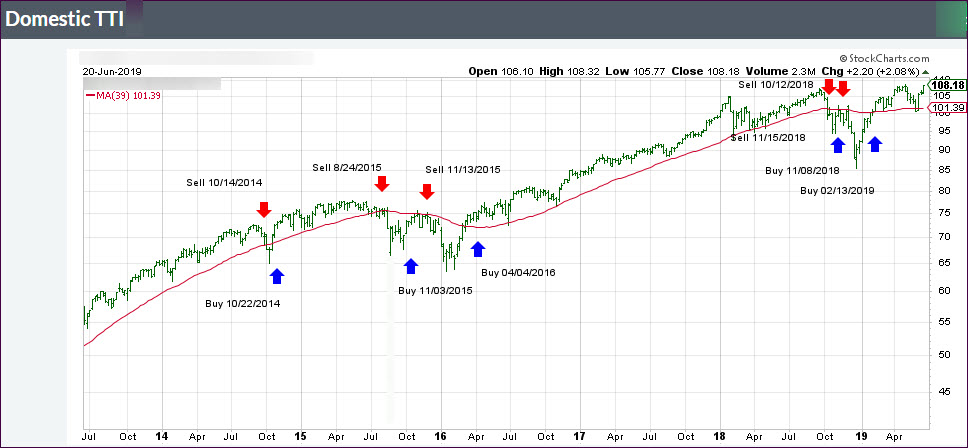
Click on chart to enlarge
Our main directional indicator, the Domestic Trend Tracking Index (TTI-green line in the above chart) is now positioned above its long-term trend line (red) by +6.73% after having generated a new Domestic “Buy” signal effective 2/13/19 as posted.
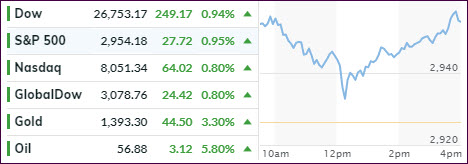
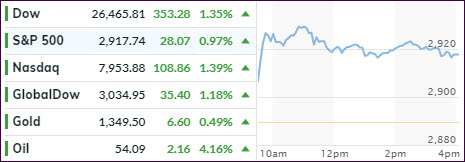
After sleeping on the Fed’s statement on interest rates,
Wall Street traders decided that the Fed left the door somewhat open to a rate
cut. As a result, expectations soared from 80% to 100% that the Fed will “cut”
in July.
That was enough for the major indexes to gap higher at
the opening with the S&P 500 setting a new intra-day
all-time high in the process, while taking another giant step towards conquering
its $3k milestone marker.
A mid-day dip did nothing but encourage more bulls to jump
aboard this pause in upside momentum, and up we went notching new highs for the
session prior to the close. Bond yields headed lower again, with the 10-year
barely hanging on to the 2% level, although it dipped below it intra-day.
While most of the attention was on the Fed, it’s important
to note that tomorrow is quadruple option expirations day, which can cause the markets
to move violently in either direction prior to expiration time. I think a great
deal of today’s upward ammo came from that looming deadline.
Also helping today’s bullish cause was a report that the
warring parties in the U.S.-China trade dispute have decided to get together again,
with the U.S. delegation traveling to Japan next week for “preliminary” meetings.
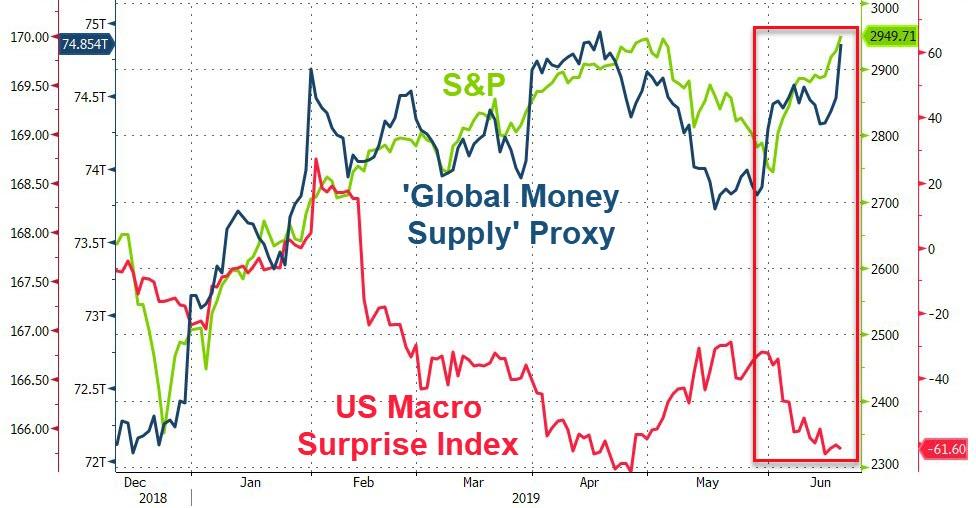
As I have posted before, the rise of the global money supply
has been a terrific indicator as to the overall direction of equities. It has surged
once again and has been a major contributor to rescuing the markets after the
very destructive month of May, during which the S&P 500 lost -6.6%.
One of the most eagerly watched events, namely the Fed’s verdict
on interest rates, came and went without much of a market hiccup. A gentle
early slide gave way to a modest bounce late in the session, with the major indexes
notching another green close and moving within striking distance of taking out
their old all-time highs.
The Fed decided to hold interest rates steady and motioned
that it’s unlikely that they would cut borrowing costs for the remainder of the
year. Of course, judging by their past actions, nothing is ever chiseled in
stone, and they left themselves a little wiggle room by pronouncing to “closely
monitor” inflation and growing “uncertainties.” The latter appeared
to be a jab at the escalating trade tensions between the U.S. and China.
In other words, if things change, they may change their mind…
While the White House might not be too pleased with this outcome
(Trump has been advocating an interest-rate cut for months), market reaction
was kind of muted, but we did zig-zag higher after the Fed announcement.
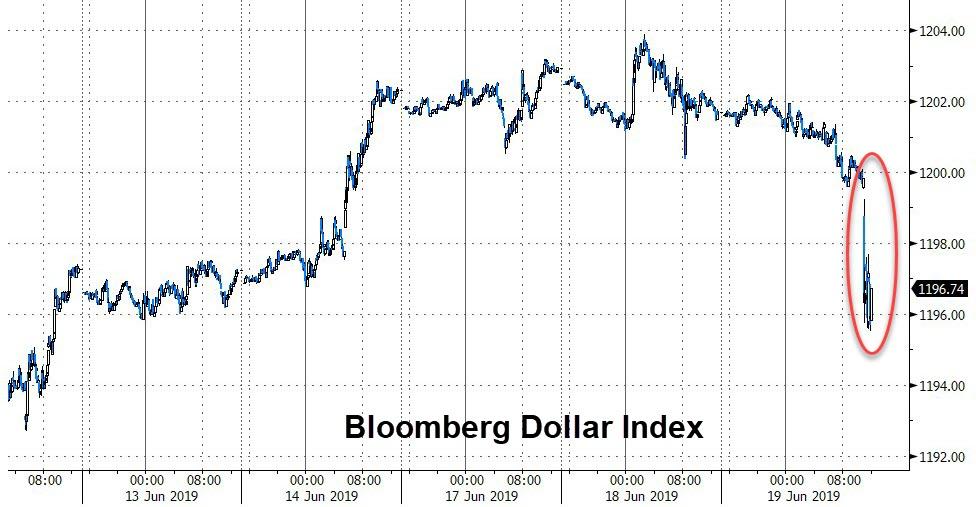
Bond yields were the beneficiary, as yields dropped with
the 10-year
heading towards the 2.01 level, while the U.S. Dollar tumbled
after the Fed released its statement.
Could the markets take off from here and push into record
territory? For sure, “if” at the upcoming G-20 meeting in Japan, Trump and his
Chinese counterpart Xi agree to a trade deal, or at least pronounce progress in
negotiations. That should do the trick and give a boost to the major indexes.
Trump got the markets pumping this morning after tweeting
that there will be an “extended meeting” with China’s Xi at the upcoming
G-20 meeting in Japan. Bloomberg also added that the two leaders had confirmed
a plan for meeting on the sidelines.
That was enough hype for the headline-scanning computer
algos to drive the markets out of last week’s trading range, with the S&P
500 now hovering within 1.25% of its record high. Never mind that various reports
later-on toned down the Trump/Xi meeting, but that no longer mattered. The bulls
were up and running.
The other positive for equities was what appeared to be a
policy turnaround, when the head of the European Central Bank (ECB), Draghi,
hinted at lower rates and more stimulus. I recall that, only a few weeks ago,
Draghi announced no policy changes in the foreseeable future. Hmm, things must
have really taken a turn for the worse…
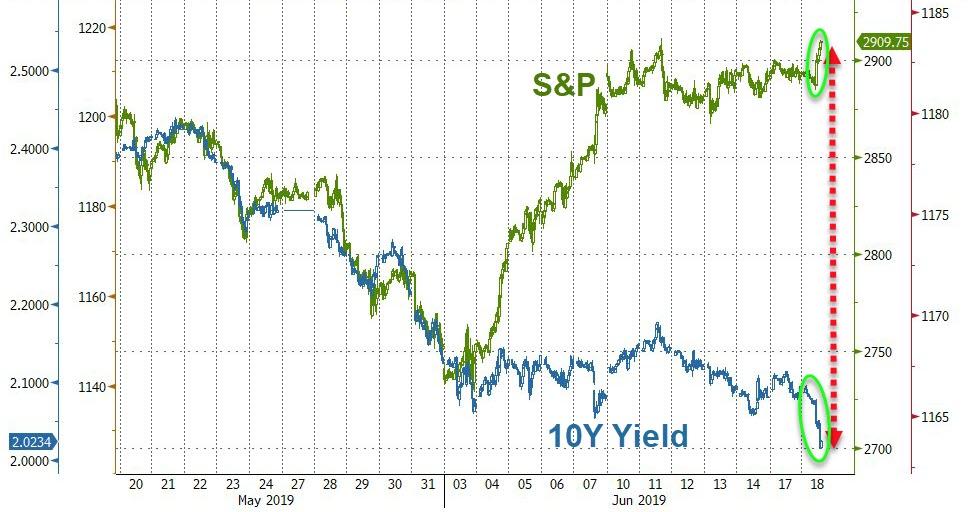
His dovishness was just what global traders wanted to hear
with the instant result that stocks pumped and yields dumped, widening the already
substantial divergence
between the S&P 500 and the 10-year yield.
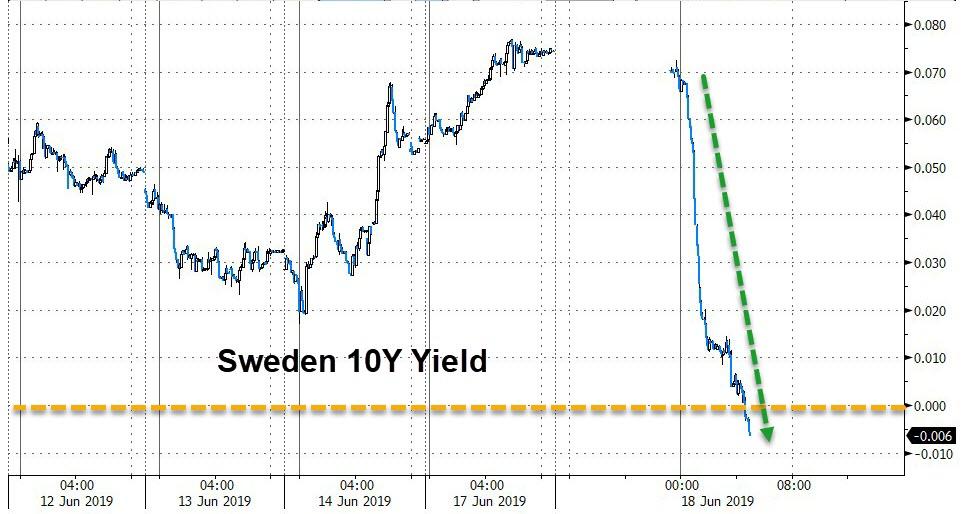
Bond yields crashed globally, as you can see here,
here
and here.
Other than the U.S., most bond yields on the face of this earth have now
slipped into negative territory. For example, if you invest in a German 10-year
bond (called ‘Bund’), your annual interest rate is now -0.32%. In other words, you
lose -0.32% every year for 10 years. How is that for insanity?
For further contemplation, ZH posted the question: Who’s
right? Global Bonds, Global Stocks or Global Macro?This
chart shows the divergence. Eventually, we will find out the answer to that
question.
My guess is that bonds will prove to be right, with
stocks ultimately having to correct down to fair value.