Weekly StatSheet For The ETF Tracker Newsletter – Updated Through 05/14/2020

Ulli ETF StatSheet Contact

ETF Data updated through Thursday, May 14, 2020
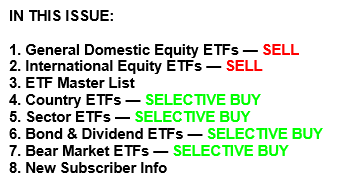
Methodology/Use of this StatSheet:

1. From the universe of over 1,800 ETFs, I have selected only those with a trading volume of over $5 million per day (HV ETFs), so that liquidity and a small bid/ask spread are assured.

2. Trend Tracking Indexes (TTIs)

Buy or Sell decisions for Domestic and International ETFs (section 1 and 2), are made based on the respective TTI and its position either above or below its long-term M/A (Moving Average). A crossing of the trend line from below accompanied by some staying power above constitutes a “Buy” signal. Conversely, a clear break below the line constitutes a “Sell” signal. Additionally, I use a 7.5% trailing stop loss on all positions in these categories to control downside risk.

3. All other investment arenas do not have a TTI and should be traded based on  the position of the individual ETF relative to its own respective trend line (%M/A). That’s why those signals are referred to as a “Selective Buy.” In other words, if an ETF crosses its own trendline to the upside, a “Buy” signal is generated. Since these areas tend to be more volatile, I recommend a wider trailing sell stop of 7.5% -10% depending on your risk tolerance.

If you are unfamiliar with some of the terminology, please see Glossary of Terms and new subscriber information in section 9.     

1. DOMESTIC EQUITY ETFs: SELL — since 02/27/2020
 

Click on chart to enlarge

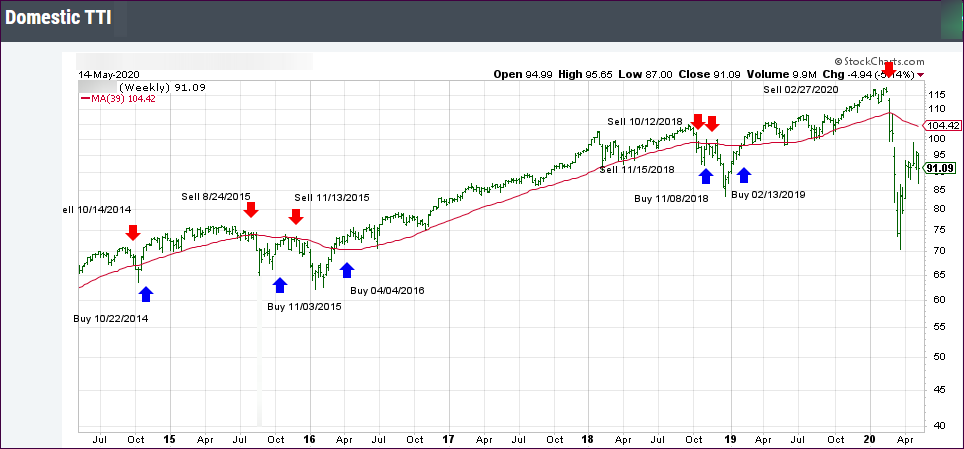
Our main directional indicator, the Domestic Trend Tracking Index (TTI-green line in the above chart) is now positioned below its long-term trend line (red) by -13.00% after having generated a new Domestic “Sell” signal effective 2/27/20 as posted.

Read More
Bounce Back Thursday

Ulli Market Commentary Contact

[Chart courtesy of MarketWatch.com]

  1. Moving the markets

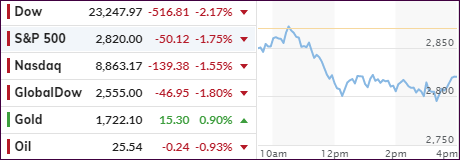
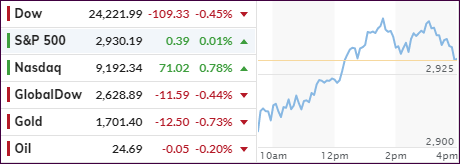
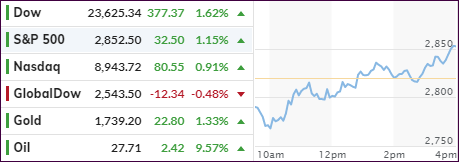
The Dow managed to recover from a sharp opening tumble of some 400 points to reverse and close higher by 377 points, which makes this an intra-day range of almost 800 points. The other two major indexes followed a similar pattern but lagged in magnitude and performance.

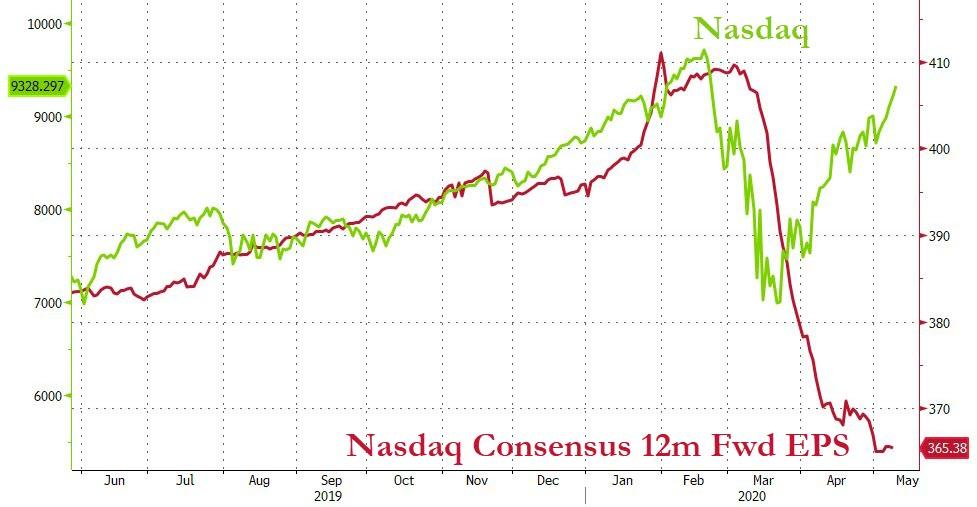
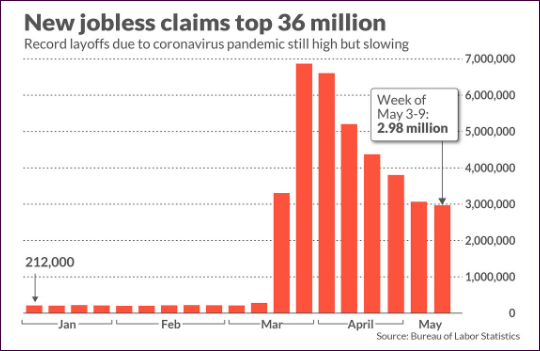
That means we’re back to where any news is good news, even as another 3 million people applied for unemployment last week bringing the total jobless claims to over 36 million while, during the same time period, the Nasdaq is up over 30%.

Apparently, the claims are slowing, which was enough to shift the computer algos into high gear thereby wiping out some of the sharp losses sustained over the last couple of days.

According to MarketWatch, the unemployment rate has likely reached 20% officially, government data suggest, and it’s likely to rise again in May, as many states are trying to reignite their economies, but so far it’s been a slow process.

None of the above matter, because the higher the jobless count, the better the stock indexes perform, or so it seems.

ZH summed it up like this:

This is the 7th week of the last 8 with massive job losses and gains for The Dow…

3/26 – 3.31mm jobless, S&P +6.24%, Dow +6.38%

4/02 – 6.87mm jobless, S&P +2.28%, Dow +2.24%

4/09 – 6.62mm jobless, S&P +1.45%, Dow +1.21%

4/16 – 5.24mm jobless, S&P +0.58%, Dow +0.12%

4/23 – 4.43mm jobless, S&P -0.04%, Dow +0.18%

4/30 – 3.84mm jobless, S&P -0.92%, Dow -1.17%

5/07 – 3.17mm jobless, S&P +1.15%, Dow +0.89%

5/14 – 2.98mm jobless, S&P +1.15%, Dow +1.62%

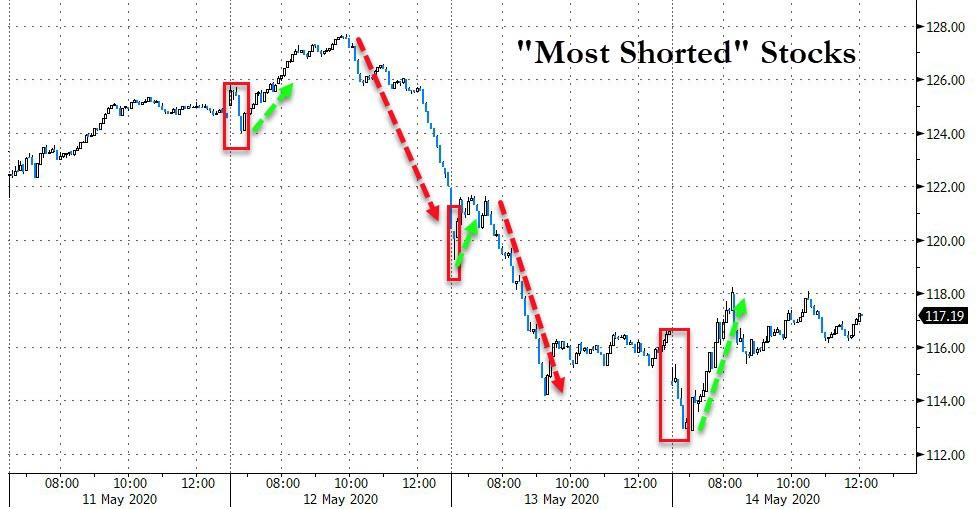
Helping the bullish theme was, after a two-day absence, a short squeeze, which some analysts claim was the entire force behind today’s run up.

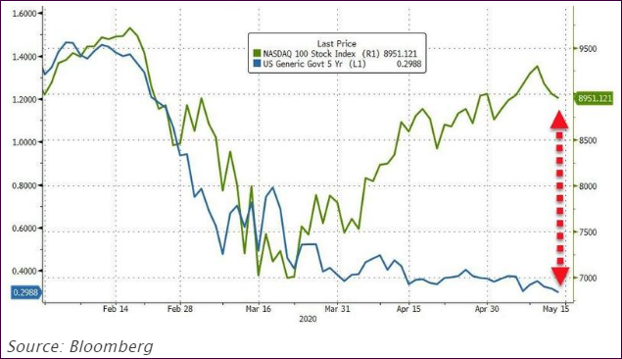
Throwing some water on today’s fiery move was the Fed’s Kashkari, who opined that he had “more confidence in the signal from the bond market than the stock market,” which prompted ZH to add “equity bulls better hope he’s wrong…

This chart makes that abundantly clear:

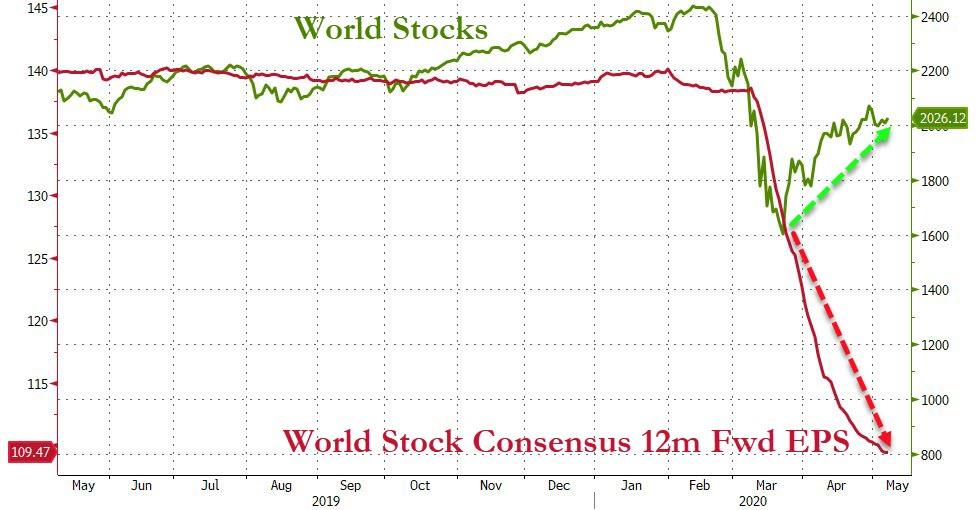
The divergence between stocks and bonds is as wide as ever, which makes me ponder: Who will eventually be right?

Read More

Slumping And Dumping

Ulli Market Commentary Contact

[Chart courtesy of MarketWatch.com]

  1. Moving the markets

An early market slump turned into a full-blown dump, as it appeared that the major indexes were struck by a dose of reality and, for a change, the headline scanning computer algos interpreted bad news as bad news. Even though we saw a last 30-minute pump, it only reduced the amount of damage done for the session.

Starting things on a bad note was the Fed’s Powell who said this during a webcast discussion:

“The scope and speed of this downturn are without modern precedent and significantly worse than any recession since World War II.

Additional government aid to household and businesses may be ‘worth it’ to keep lasting damage to the economy from developing.”

In the end, there was nothing new in his comments other than him contributing to the already sour mood in the markets, but more importantly, he confirmed and validated the fears many people had.

It’s now becoming more and more clear what I have said before, namely that you can’t just shut down a country’s economy, then flip a switch and expect everything to go back to normal in an instant. A recent poll confirmed that much, as almost 1/3 of the people interviewed responded that they would not go back to regular activities even if it were permitted to do so.

Throwing more gasoline on the fire was hedge fund guru David Tepper, who had this to say about the markets:

“While he suspects the bottom might already be in, there are simply too many areas in this market that are way too overvalued, and the legendary trader predicted more chaotic trading ahead. And speaking specifically about the Nasdaq, which has been on a surprising tear as just a handful of tech stocks carry the entire market, Tepper said the overvaluations were some of the worst he’s seen since 1999, the heyday of the dotcom bubble.”

Ouch! That was not what traders wanted to hear and down we went in a hurry. However, Tepper also suggested that “the Fed’s extraordinary backstop of financial markets could lead to further stock gains.”

So, there you have it. It looks to be a tug-of-war between a devasted economy on one side and the money pumping Fed on the other. Who will win?

There are many guesses and possibilities, but I believe that it’s wise, in terms of investment strategy, to let our Trend Tracking Indexes (TTIs) be our directional guide to issue a signal and let us know when a new entry point has arrived.

Read More

A Rally Morphs Into A Swan Dive

Ulli Market Commentary Contact

[Chart courtesy of MarketWatch.com]

  1. Moving the markets

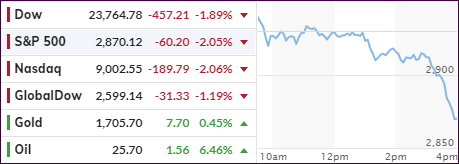
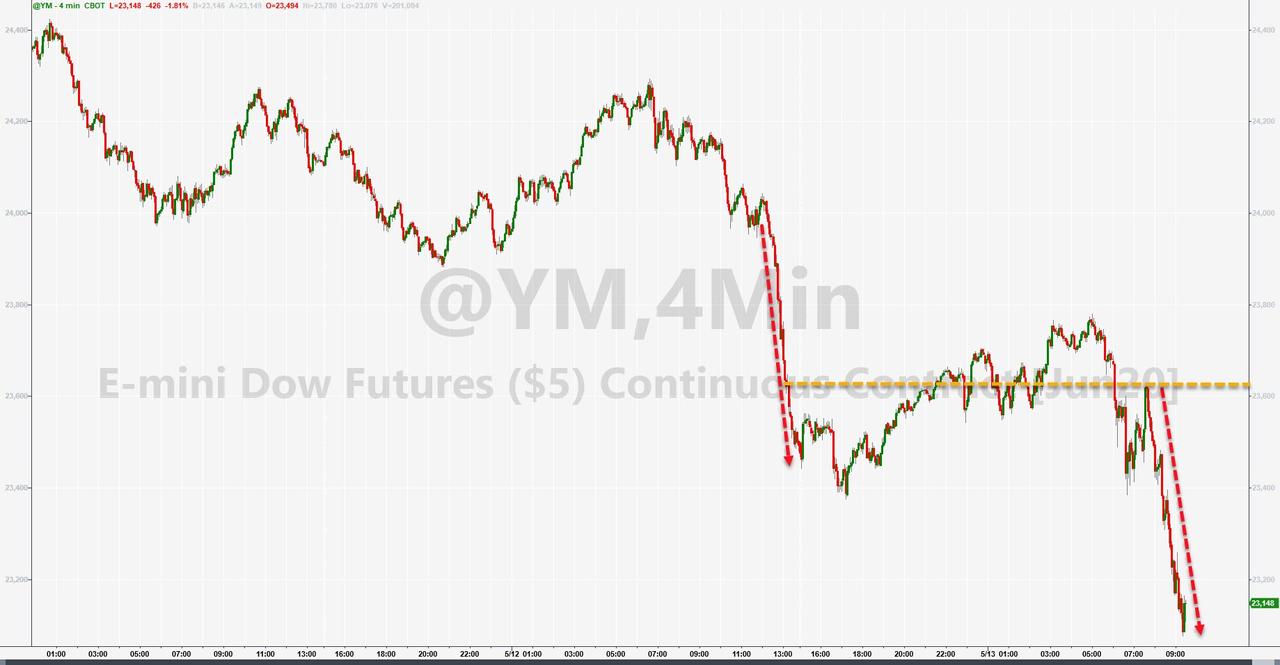
An early rally ran into trouble, reversed, accelerated, and got slammed down with the Dow dropping some 450 points, or -1.9%, with the other two major indexes scoring slightly worse.

The initial bounce was a result of positive interpretations of the partial reopening of the economy, despite many facts pointing to a disappointing return to business with many malls reporting hardly any customers.

To me, this means that the reckless consumerism of the past may have hit a brick wall. Nowadays, with record high unemployment, most people have more serious concerns than spending money they don’t have for things they don’t need. Should this attitude prevail, however, it will have serious ramifications, when you consider that about 70% of U.S. GDP comes from consumer spending.

Noted Global Macro Monitor:

“There will likely be an initial burst of economic activity due to a huge pent-up demand as America opens for business, but the long-term reality will be determined by how much damage and hysteresis the lock-down has inflicted.”

Hysteresis in the field of economics refers to an event in the economy that persists into the future, even after the factors that led to that event have been removed.

– Investopedia

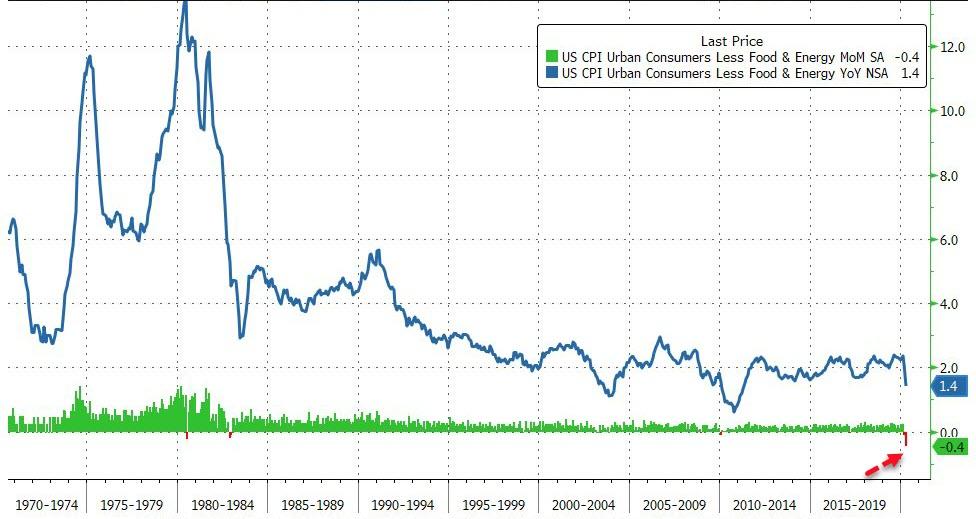
In terms of economic data, we learned that the Core CPI crashed the most on record, as ZH reported, but food costs soared while energy and apparel collapsed.

Helping the markets accelerate to the downside was a report that GOP senators have introduced a bill sanctioning China. The reaction was swift with Treasury yields extending their decline and stocks getting hammered.

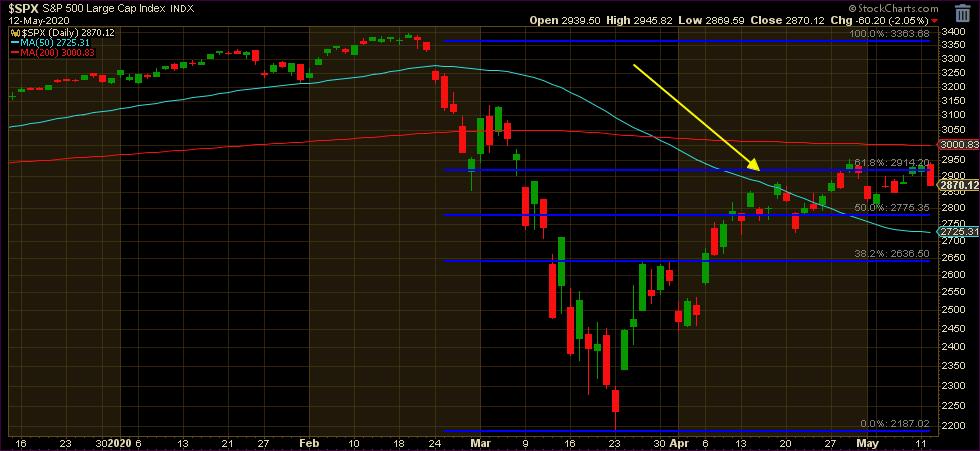
Technically speaking, the S&P 500 has now bounced off its overhead ceiling in the 2,920 area (yellow arrow) several times:

Should this level be solidly breached to the upside, we may be on our way to receiving a new domestic “Buy” signal, while the markets in general subsequently could be aiming to take out their previous all-time highs.

Like it or not, this would not be a function of a great economy, quite the opposite, it would be the result of reckless money printing, and the Fed buying up assets to support the bullish theme.

Read More

Going Nowhere

Ulli Market Commentary Contact

[Chart courtesy of MarketWatch.com]

  1. Moving the markets

An early drop was followed by a mid-day pop, then momentum faded, and the Dow dove back into the red. The S&P 500 ended just about unchanged, but the Nasdaq ruled and closed in the green despite a total collapse in earnings.

It appears that early optimism about the step-by-step re-opening of the country was met by skepticism in that more hurdles than expected remain, while a V-shape type of recovery at this point remains a pipe dream.

As Bloomberg notes:

“With a majority of companies having now reported earnings in Europe and the U.S., the figures have been poorer than expected; and the second quarter will likely be even worse, given the lockdowns, and a recovery in the rest of the year isn’t obvious.”

Author Bruce Wilds added these succinct comments:

It has become difficult to comprehend the size of the failure the political-financial complex has designed. This is partly because stocks have continued to soar with every announcement of rising unemployment and even as businesses continue to fail or file for bankruptcy. Bad news is not good news. The sick idea that poor spending habits are the answer to achieving a faster-growing economy is absurd and twisted. This is not new; politicians seem unable to grasp the fact economic growth does not necessarily bring about economic strength or long-term prosperity.

With Saxo Bank summing it up like this:

Investors continue to buy the reopening story, with markets remaining completely detached from fundamentals and the real economy.

In other words, it’s no longer a secret that markets are out of sync with economic realty. However, should this relentless push higher continue, it’s certain that our Trend Tracking Indexes TTIs) will trigger a new “Buy” signal, which we will then use as a new entry point.

Right now, we are still watching the developments from the sidelines.

Read More

ETFs On The Cutline – Updated Through 05/08/2020

Ulli ETFs on the Cutline Contact

Below, please find the latest High-Volume ETF Cutline report, which shows how far above or below their respective long-term trend lines (39-week SMA) my currently tracked ETFs are positioned.

This report covers the HV ETF Master List from Thursday’s StatSheet and includes 322 High Volume ETFs, defined as those with an average daily volume of more than $5 million, of which currently 75 (last week 60) are hovering in bullish territory. The yellow line separates those ETFs that are positioned above their trend line (%M/A) from those that have dropped below it.

Take a look:                                                                   

The HV ETF Master Cutline Report

In case you are not familiar with some of the terminology used in the reports, please read the Glossary of Terms. If you missed the original post about the Cutline approach, you can read it here.