
Have We Reached The Point Of Maximum Financial Risk?

Ulli Uncategorized Contact

I found a very interesting article that was written almost exactly one year ago. The main focus is on a chart, see below, which shows the range of emotions investors go through when holding a fully invested portfolio through a bear market.

It covers the entire spectrum of extremes from the “Point of Maximum Financial Risk” all the way to the opposite, called the “Point of Maximum Financial Opportunity.”


I believe that this chart is timeless, and I am certain that we will see the various stages repeated at some point in the future. Unfortunately, many investors will be able to identify themselves at the various points of the chart, if they stayed invested during 2000-2003.

If you were one of them, hopefully, you will have learned from the experience by planning on using a different approach the next time around.

From The Archives: The Pros And Cons Of ETFs?

Ulli Uncategorized Contact

Judging by a number of e-mails I received last week, some readers are still confused about how ETFs work and what their pros and cons are. While many articles have been written on the subject, including one I wrote a few years ago, here’s one I found that may help increase your knowledge.

Among other things, it also talks about how ETFs are created and addresses some of their tax-efficiencies as opposed to mutual funds.

However, I must caution you that you should not hold on to an ETF, or any investment for that matter, for only tax reasons. The money you might save could be more than offset by a trend reversal which has the power to do some severe damage to your portfolio.

ETF/No Load Fund Investing: All REITs Are Not Created Equal

Ulli Uncategorized Contact


A question came up in my advisor practice as to whether REITs are still a good investment given the current market climate.

If you look at the sector section of my latest StatSheet, you’ll notice that all domestic Specialty Real Estate ETFs are listed at the bottom based on their 4-wk performance figures as shown below (double click to enlarge):

My managed account clients currently have no holdings in any of these funds since we sold our positions when our sell stop got triggered on 3/6/2007.

As you can see, all momentum figures are very negative, and, if you follow trends, there is no reason to be involved in any of the above at this time.

However, that does not mean this applies to all Real Estate funds. If you look at the international market place, the picture looks different. The chart below shows a comparison between VNQ and EGLRX, a REIT that invests only outside the U.S.:

You can clearly see the “disconnect” between the domestic and the international market. It appears that the divergence took place right after the one-day meltdown on 2/27/2007 after which the domestic Real Estate market never recovered.

I am not sure why this happened, but the fact is that it did happen. Given the above momentum figures, I can’t see any reason that supports an argument for a domestic investment. I would consider the international market with a small portion of “new money”, but currently we have not yet established a position.

In Case You Missed It: Warren Buffet’s View On ETFs

Ulli Uncategorized Contact

ETFs are not for everybody. I remember an experience from last year when I set up a retired client’s portfolio with several ETF positions along with no load mutual funds.

Even though his holdings were in accordance with our long-term investment approach via trend tacking, the client couldn’t help but watch the minute-by-minute ETF price changes on his favorite financial site—every day. He simply couldn’t control himself and finally asked me to sell the ETFs and replace them with equivalent no load funds.

I was reminded of this when I read a story on the Motley Fool website what Warren Buffett thinks about ETFs. Seems like he has some concerns in that most people may tend to become traders rather than remain investors with a long-term goal in mind.

Additionally, he fears that investors may face pressure from their brokers, who benefit from any kind of trading activity.

The bottom line is that ETFs are a great tool and here to stay, however, they still need to be used appropriately so that they can peacefully co-exist with your long-term goals.

No Load Fund/ETF Tracker updated through 5/18/2007

Ulli Uncategorized Contact

My latest No Load Fund/ETF Tracker has been posted at:

http://www.successful-investment.com/newsletter-archive.php

Another notch in the bedpost for the bulls.

Our Trend Tracking Index (TTI) for domestic funds/ETFs now sits +5.57% above its long-term trend line (red) as the chart below shows:


The international index has now moved to +10.03% above its own trend line, as you can see below:

For more details, and the latest market commentary, as well as the updated No load Fund/ETF StatSheet, please see the above link.

From the ETF/No Load Fund Files: Active vs. Passive Investing

Ulli Uncategorized Contact

I came across another article (thanks to reader Nitin) in the NYT called “In Investing, Passive Beats Active.”

It’s the same old story, which makes the case for lower cost index funds beating actively managed mutual funds—most of the time. Sure, all things being equal, if I were a Buy-and-Hold investor, it would make sense to use a less expensive ETF over a more costly no load fund. If performance is very close, the lesser expensive vehicle would come out ahead over time.

However, as I said before, articles like this can create a false sense of security, in that an investor only looks at bull market performance and doesn’t realize that both vehicles will go down sharply in a bear market.

To give you a different perspective, and to add a dose of reality, I have included some of my actual Trend Tracking data for the past 6.5 years. The period covers our Buy and Sells from 10/13/2000 to 3/30/2007. However, I am obliged to state that past performance is no guarantee of future results.

Here’s the performance for the above 6.5 year period:

S & P 500: +3.41%
FDGRX: -12.53%

I used the widely held FDGRX fund as an example. You can plug in any fund you wish and see what answer you come up with. The data used for FDGRX were the adjusted closing prices as listed in Yahoo Finance.

This result obviously supports those in favor of index investing.

Next, I was curious to see if the extremely meager S&P; 500 Buy and Hold results could be improved, if an investor using this index would have invested using my Buy and Sell points for the same period. Here’s my actual Buy/Sell matrix:
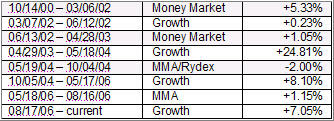


I inserted the S&P; 500 figures and came up with a gain of almost 41%. In my advisor practice, we followed these Buys and Sells with actively managed no load mutual funds and the result was a gain of +53%. In this case, indexing lost out.

There you have it. If you’re using Buy & Hold, over time, including a bear market, you’ll be ahead using index funds as my example shows.

If you’re following trends, actively managed mutual funds (or a combination with indexes) appear to be the better solution based on the above data.

If you decide to play with this and insert your fund holdings, please share your results with me.
