Most Innovative ETF

Ulli Uncategorized Contact

If you’re interested in following risk-adjusted returns of the collective hedge fund universe via one ETF, take a look at “IndexIQ’s IQ Hedge Multi-Strategy Tracker ETF (QAI):”

IndexIQ’s IQ Hedge Multi-Strategy Tracker ETF (NYSE Arca: QAI) has been named the Most Innovative ETF by Capital Link, it was announced today. The IQ Hedge Multi-Strategy Index, the index underlying QAI, also was recognized by Capital Link as the Most Innovative Index, marking the first time a single firm has been awarded this distinction in both the ETF and Index categories.

IndexIQ is a leading developer of index-based alternative investment solutions, offering Exchange-Traded Funds (ETFs), mutual funds and separately managed accounts. The IQ Hedge Multi-Strategy Tracker ETF was introduced on March 25, 2009, and was the first U.S.-listed hedge fund replication ETF. It is designed to capture the risk-adjusted return characteristics of the collective hedge fund universe using multiple hedge fund investment styles, including long/short equity, global macro, market neutral, event-driven, fixed income arbitrage, and emerging markets.

IndexIQ products are designed to be liquid, transparent, low cost, and accessible to a broad range of investors.* QAI, MCRO and IQ ALPHA Hedge Strategy Fund are not hedge funds and do not invest in hedge funds.

The ETFs should be considered a speculative investment entailing a high degree of risk and are not suitable for all investors. An investment in the ETFs does not represent a complete investment program.

Past performance is not a guarantee of future results.

[Emphasis added]

Since QAI has been only on the market for a little over a year, it’s not possible to determine how this ETF would have performed in a bear market, such as 2008. On the bullish side, it’s been disappointing when you look at it on a year chart and compare it to the Total Stock Market ETF (VTI):

Of course, this may not be bad at all, if QAI either avoided the crash of 2008 or actually produced a positive return. When evaluating a fund or a strategy, you always need to combine bullish and bearish periods to arrive at a fair conclusion. In this case, we’ll have to wait and revisit this ETF when the next bear market strikes.

The volume is still pretty low with an average of $1 million per day traded, while the bid/ask spread sports a somewhat high 2 cents.

While the concept sounds intriguing, more data is needed to arrive at a conclusion as to whether QAI has merit. Just because it’s considered one of the most innovative ETFs, does not mean it’s appropriate at this time.

Disclosure: We have holdings in VTI but not QAI.

No Load Fund/ETF Tracker updated through 4/29/2010

Ulli Uncategorized Contact

My latest No Load Fund/ETF Tracker has been posted at:

http://www.successful-investment.com/newsletter-archive.php

Several triple digit days favored the bearish crowd this week, and the major indexes retreated.

Our Trend Tracking Index (TTI) for domestic funds/ETFs has now crossed its trend line (red) to the upside by +4.41% keeping the current buy signal intact. The effective date was June 3, 2009.


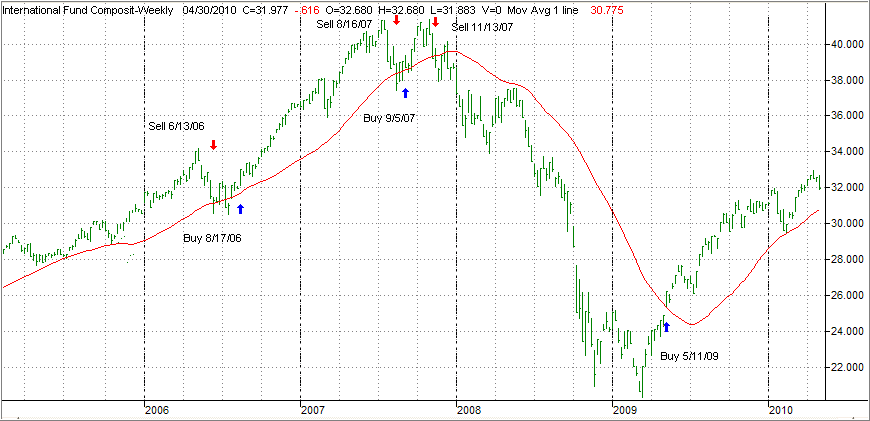
The international index has now broken above its long-term trend line by +3.89%. A Buy signal was triggered effective May 11, 2009. We are holding our positions subject to a trailing stop loss.


[Click on charts to enlarge]

For more details, and the latest market commentary, as well as the updated No load Fund/ETF StatSheet, please see the above link.

Off Course ETFs

Ulli Uncategorized Contact

Leveraged ETFs have been known to stray of course by not exactly tracking the underlying index they’re based on. In “Are ETFs More Risky Than You Think?” this area is explored a little more in detail:

Unlike mutual funds, which are managed to try to get the best return, exchange-traded funds are meant to accurately reflect an entire index of stocks. Investors pick ETFs when they want to invest in a broader group of stocks, not on individual companies, and they generally count on ETFs to do as well — or as poorly — as the broader indexes on which they’re based.

But it turns out that a growing number of ETFs are failing to do just that. In 2009, tracking error — the difference between the performance of an ETF and its index — widened significantly, according to a recent Morgan Stanley report. U.S.-listed ETFs saw an average tracking error of 1.25% in 2009, more than double the 0.52% in 2008. The biggest offenders? Sector and industry funds, global funds, commodity and fixed-income ETFs.

So why does it matter if your ETF doesn’t do what it was created to do? Well, investors choose ETFs, instead of mutual funds or individual stocks, in order to diversify their holdings — and because they believe a broader index might perform better than a managed fund. From that perspective, tracking error can equal higher risk. In other words, tracking error can be cool when an ETF outperforms its index, and less cool when it underperforms the index.

The big question is, how do you know when your ETF has gone astray? Every ETF calculates what’s called the intraday indicative value of its underlying index, which essentially reflects its net asset value. Investors can compare an ETF’s market price to that indicative value to see how well the ETF is tracking its benchmark, and can monitor that matchup over time using an online quote system like Google Finance.

Simply enter the symbol of your ETF with “IV” and Google Finance returns with a chart of the indicative value over the past five days. You can then add the regular ETF symbol to this chart and see at a glance how close the ETF is tracking its index. Most ETF sponsors, particularly the larger ones, provide information about the indicative value going back to the ETF’s inception.

As Alan Segars, investment management officer of The Provident Bank’s Wealth Management Department, puts it: “Is there a certain threshold where investors should immediately sell their ETFs? Hardly. Rather, portfolio managers need to factor tracking error into a holistic investment process.” After all, some tracking error is inevitable, but you want to be sure that your ETF’s deviation matches your investment goals.

In some cases, the tracking error might be worth the benefits, Klein says. “You may just realize that the performance slippage to the market is a modest cost to pay for the benefits of low cost, diversified and liquid access to otherwise difficult to enter markets,” he says.

I must say that in all of my dealings with ETFs, I have not found this to be a major issue. I do recall, however, when back testing the SimpleHedgeStrategy a couple of years ago, that SDS not always performed as advertised by not accomplishing its goal of 200% inverse performance of the S&P; 500 during certain periods.

Using Google Finance, I followed the above suggestion and plotted SDS against its Intraday Value Index:

As you can see, the tracking is fairly accurate and the fluctuations minor for the period shown. I would expect that to be even less with non-leveraged ETFs.

I agree with the article in that modest slippage is acceptable considering the otherwise very worthwhile benefits of using ETFs for structuring a portfolio.

Junking Greece

Ulli Uncategorized Contact


Just as Wall Street had settled in on Tuesday to watch the Goldman Sachs grilling before a Senate committee, S&P; stepped into the limelight by downgrading Greece’s debt to junk and reducing Portugal’s by a notch.

That put the dollar and Treasuries into rally mode, while stock markets around the world headed south. A mid-day rebound attempt fell short as the chart above shows (courtesy of MarketWatch.com), and we closed near the lows of the day.

Ironically, Goldman Sachs’s stock closed up for the day. Go figure…

Despite jawboning to the contrary for the past month, Greek’s problems remain without a firm solution in place as there seems to be some discontent among the EU nations. As a side note, U.S. banks have only minor exposure to Greek debt, with the heavy load being carried by France and Germany.

The big question now is if yesterday was a one-day wonder in terms of sell off and another buying opportunity. I did add a couple of positions thinking this might be the case. Only time will tell if that was the right move. Of course, there is always the possibility that markets are topping out with more downside momentum on the horizon.

None of our sell stops were triggered, but we will watch market direction closely. For months, I have voiced my view that most likely an external event will derail the stock market rally. Whether this point has been reached is still unknown, but what is known is that the troubles in Euro land are far from being over.

Make sure you have your exit strategy in place now so you are prepared to act when it becomes necessary.

On Rising Interest Rates And Commodities

Ulli Uncategorized Contact

The WSJ featured and article titled “Rising Interest Rates Might Be a Buy Signal for Commodities:”

The Federal Reserve raised a key interest rate in February, and market gauges are pointing to more increases in coming months. Does that mean it is a good time to buy commodities?

According to new research, the answer is yes. In fact, periods of rising rates may be the best time to buy.

A study to be published this fall in the Journal of Investing suggests that portfolios that add commodities after the Federal Reserve tightens the discount rate, which is the rate it charges on loans to member banks, perform better than portfolios that don’t—and lower their risk. Conversely, when the Fed cuts the rate, commodity-flavored portfolios suffer more than those without commodities.

The authors, Mitchell Conover of the University of Richmond, Gerald Jensen of Northern Illinois University, Robert Johnson of the CFA Institute and Jeffrey Mercer of Texas Tech University, studied data from December 1970 through August 2007. They added a basket of commodity futures tracking the S&P; GSCI Commodity Index to five types of stock portfolios: value, small-cap, momentum, growth and large-cap.

The commodities added to the returns of all five equity styles during periods when the Fed tightens the discount rate. A 10% dose of commodities would have boosted a small-cap portfolio by the most: 1.67% per year during the restrictive period. That helping of commodities would have added 1% to the momentum portfolio, the least among the five.

Adding commodities also significantly decreased portfolio risk, according to the study. “Commodities, over time, perform much better in a rising interest-rate environment,” Mr. Johnson says.

That is because commodities are generally perceived as an inflation hedge. When the central bank raises rates, it is usually to tamp down inflation, though the Fed said its move in February was designed to reduce the banking sector’s dependence on government credit in the wake of the financial crisis.

While it’s still too early to tell as to when the Fed will raise interest rates further, and when inflation actually will kick in, let’s take a look and see how the Commodity Index (DBC) has fared during the past year:


As you can see, it’s been a sideways pattern with not much upward momentum. My view is that it is way too early to worry about the impact of potential inflation at this point while we are still mired deeply in a deflationary scenario.

Let any inflationary tendencies become more obvious before making alternate investment decisions. At that time, it will be much easier to spot trend reversals in sectors that will benefit from higher interest rates—maybe DBC will be one of them.

Disclosure: No holdings in the above featured funds.

Waiting For A Japan Comeback

Ulli Uncategorized Contact

The Japanese economy has been stuck in a deflationary scenario for the past 2 decades, while the stock market has been in a bear market for the same period.

Sure, there have been rebound rallies, but eventually they have all succumbed to even lower prices. It has been a buy and holders nightmare, but a good trading environment.

The NYT has some thoughts on the Japanese market in “Awaiting a Definitive Comeback in Japan:”

THE Japanese stock market has had more comebacks than Elvis.

In the last two decades, investment professionals have repeatedly proclaimed that Japan’s long bear market might have ended. Yet today, the country’s Nikkei 225 stock index languishes at about a quarter of its 1989 peak.

Given that performance, the record of Japan stock mutual funds shouldn’t surprise: They’ve returned a negative 6.8 percent, annualized, over the last decade, ranking last among foreign fund categories tracked by Morningstar.

Many investors have responded by leaving: money sluiced out of Japan mutual and exchange-traded funds from 2007 through 2009, according to the Financial Research Corporation. The sector had net outflows, on average, of more than 20 percent a year in that time.

“The last two years, it has been really bad — as if Japan doesn’t exist anymore,” said Taizo Ishida, manager of the Matthews Japan fund. “Right now, nobody is interested.”

Even so, Mr. Ishida remains optimistic about the prospects for Japan and thus for his fund. Given current Japan-stock valuations compared with, say, those in China, “Japan is a cheap way to get into Asia,” he said.

And Japanese stocks have had success of late. The MSCI Barra Japan index was up 7.3 percent for the first quarter and almost 35.6 percent for the 12 months ended March 31.


Ms. Benz also questions whether Japan funds, or any single-country offerings, really serve investors. “The vast majority of individual investors don’t need a country-specific fund,” she said. “The key advantage of a diversified fund is that your manager has an escape hatch if a particular market goes terribly wrong” — as, for example, Japan has over the last 20 years.

On top of that, single-country funds can tempt investors into mistakes. “Our research shows that the more narrow the investing universe, the less successful investors are,” said Fran Kinniry, principal in the Investments Strategy Group at Vanguard. More so than in diversified funds, people in single-country offerings may chase performance, buying as markets peak and riding the shares downward to losses, he said.

As I have noted in a previous post, the U.S. market has been on a tear since the February 10 correction with the domestic market outperforming many others. Take a look at a 6-months chart:


Here I plotted the S&P; 500 (SPY) against the emerging markets (VWO), Latin America (ILF) and Japan (EWJ). With the exception of the S&P; 500, the others have shown mediocre performance for the period.

My point is that you currently do not need to have exposure to every one of these markets, or single country funds for that matter. Look at the rankings, as shown in the weekly StatSheet, and select those funds/ETFs that show good upward momentum and are diversified.

Looking at the above graph, I am a bit perplexed by the fact that especially VWO and ILF are lagging the S&P; 500 for this period, since they have been leaders during the economic rebound of the past year. However, those funds with high performances will also be the leaders to the downside when the markets head back south.

Since we don’t know if this sudden non-correlation means that a market turnaround is at hand, we’ll focus on tracking our sell stops to be the guide in showing us when to exit, should market behavior dictate such a move.

Disclosure: We own positions in some of the funds mentioned above.