
In case you missed it, hat tip goes to Mish at Global Economic Trends for posting this video explaining in layman’s terms what Quantitative Easing is all about. No comment necessary:
[youtube=http://www.youtube.com/watch?v=PTUY16CkS-k?fs=1]Sunday Musings: Unconstrained Bond Funds

Yesterday, I talked about how to deal with the potential of rising interest rates. What if you need to continue generating income in the face of higher rates? Losing more in principal than receiving in dividends is hardly the way to come out ahead.
MarketWatch offered some alternatives in “Bond funds that shield you from interest rate risk:”
The smart money is well aware that investing in bonds these days is risky business, especially bonds with long-term maturities, but investors are also well aware they need to allocate some portion of their assets to fixed-income securities. The question is, which ones?
Any increase in interest rates will send the value of long-term bonds straight to the mat, much the same way Mike Tyson punched out Zach Galifianakis, as Alan Garner, in the movie “The Hangover.”
For his part, Harold Evensky, the chairman of Evensky & Brown, one of the nation’s most respected investment firms, has decided not to answer that question — at least not directly.
Since no one really knows when interest rates will rise and bond prices will fall, and since investing in bonds the old-fashioned way is really old-fashioned, Evensky is putting a portion of his client’s portfolios into what are called “unconstrained” bond funds.
Unconstrained bond funds are a relatively new breed of funds where the manager has the ability to invest in most any type of fixed-income security they want. The manager can go long or short on the yield curve, buy U.S. or not, developed markets or emerging, and investment grade or junk. In essence, they can do whatever they want. Even better, they are not tethered to a benchmark or index or category.
“These are blue-sky funds,” said Eric Jacobson, Morningstar’s director of fixed-income research and editorial director of its fund research group. “The managers can do whatever they think is best.”
And therein lies part of the appeal of these funds. The two big funds in this small but increasingly popular category are managed by the best of the best. The PIMCO Unconstrained Bond fund (PUBAX). PUBAX is one of several share classes available) is managed by Chris Dialynas, who has 32 years of investment experience.
The J.P. Morgan Strategic Opportunity fund. JSOAX is one of several share classes available) is managed by Bill Eigen III, who has 18 years of experience, having cut his teeth managing bonds for Highbridge Capital Management and Fidelity Investments. (Another fund in this category is the Harbor Unconstrained Bond Fund (HRUBX) , which happens to be subadvised by Pacific Investment Management Company LLC, otherwise known as PIMCO.)
To trust….or not?
In most cases, giving managers free rein to invest however they see fit in hopes that it will all work out is a recipe for eventual disaster.
“It’s a really tall order to ask someone to deliver positive returns and eliminate interest-rate risk,” Jacobson said. Rare is the time, he said, when he would have sufficient trust to give money to a manager to do anything they want. “It’s easy to make mistakes,” said Jacobson, who plans to initiate coverage of the aforementioned funds in the next few weeks.
Let’s look at performance first. Over the past 2 years JSOAX has been the clear leader; over the past 12 and 6 months periods, BND (as comparison) came out ahead, while during the most recent 3 months period (shown in chart above), JSOAX moved into the lead again.
The unknown is how quickly will fund managers change gears and go from long to short, should rates rise. I have always recommended avoiding making emotional decisions by “staying with a trend until it ends when it bends.”
This bending at the end, if in fact we have reached it, is clearly visible in the above chart, as all fund prices have recently shown downward bias, but have remained above the long-term trend line.
With a potential bond bubble brewing, the jury is still out as to whether these types of bond funds will really protect you in time if and when rates shoot up. Personally, I doubt it. These funds remind me somewhat of the much touted Long/Short funds, which never really lived up to their promise of making money in either market.
Additionally, two of the three funds featured above have front end loads of 3.75%, which I find not acceptable in an era of sliding fund/ETF expenses, especially when considering that this is an unproven product.
My preference, also in regards to bond funds, is to watch the trend and exit when my sell stops get triggered. I will then sit in cash and evaluate the investment landscape before making any new commitments.
We’re in unchartered territory with the Fed’s QE-2 and its possible unintended consequences, which makes me not very eager to seek exposure to products that have not been tried.
Disclosure: Holdings in BND
Reader Q+A: Protection Against Rising Interest Rates
 Reader Ken emailed the following question that has repeatedly come up from time to time:
I am wondering if you could foresee what the wisest investments should be for upcoming increasing in interest rates? It is obvious these low rates cannot go much lower or last much longer so there must be some place for the forward thinking investor to get a bargain.
While I agree with you that interest rates will have to rise at some point in the future, it is still an unknown as to what will trigger such a directional change. To my way of thinking, there could be two events:
1. Economic activity picks up on its own or with assistance from the Fed as QE-2 is being implemented. In its initial stages, QE-2 is designed to keep interest low to give a boost to the economy. I repeatedly have posted that I do not believe that this program will work, and it will likely end up failing and join the previous stimulus packages in a yet to be named graveyard.
If the economy makes no headway, and just muddles along (very likely in my view), that in theory should keep interest rates low for the foreseeable future.
However, there have been some rumblings that the good old U.S.A. may no longer be issuing debt that the rest of world considers worthy of being AAA rated. After all, we have indebted ourselves for generations to come.
Then we might potentially face this scenario:
2. The fact that the quality of our debt may no longer be considered AAA, yet we still have tremendous borrowing needs, means we may have to pay more via higher interest rates to continue our borrowing binge.
You think our debt is still AAA? Just on Wednesday, I posted that a Chinese rating agency reduced our credit rating to A+ from AA citing a “deteriorating intent and ability to repay debt obligations” in view of the Fed’s recent stimulus plan.
That to me that is the biggest threat to low interest rates! Due to our debt burden, our need to borrow will be ever-present, which means we may have to pay whatever the market is willing to offer. Let’s hope it does not turn out like Greece, Portugal, Spain, Ireland and/or others.
Given that, how can an investor prepare himself for the inevitable? Unfortunately, there is no clear cut answer, as we are on the back side of a busted real estate/credit bubble of epic proportions with no precedent. In other words, we are in unchartered territory.
You simply can’t anticipate not only which asset class may benefit, but you also do not know the time frame. And simply guessing is the worst you can do. Case in point is that some newsletter writers advised shorting bonds late last year anticipating higher interest rates. Well, rates plunged, and those following that advice had their heads handed to them on a silver platter.
A far better way is to follow trends in the market place. Take BND, the total bond market for example, which we have positions in. BND has come off its high but remains above its long term trend line, which means we are still in a period of low interest rates. Once the trend line is being broken to the downside, watch out; higher rates may be ahead.
To look at the big picture, make it a point to review the weekly StatSheet, especially the “ETF Master” section. It ranks all ETFs I monitor and, by looking at the %M/A column (% of a fund above or below its long term trend line), you can easily spot changes as one ETF moves below its respective trend line and another one moves above it.
To me, that is the best way I know of to determine when/if trend changes in the markets occur. If an asset class has been in negative territory and is moving above its trend line and becoming bullish, that should get your attention. If you combine these changes along with those occurring in the “Bear Market Funds section,” you will always know when momentum shifts and adjust your holdings accordingly.
I don’t have the crystal ball to guess when changes will occur, but using my free published StatSheet data will give you a heads up by keeping you informed of any important trend changes in the domestic and global market place.
No Load Fund/ETF Tracker updated through 11/11/2010
My latest No Load Fund/ETF Tracker has been posted at:
http://www.successful-investment.com/newsletter-archive.php
What a difference a week makes. The bears took over, and the major indexes closed lower by about 2%.
Our Trend Tracking Index (TTI) for domestic funds/ETFs moved above its trend line (red) by +6.19% (last week +7.99%) and remains in bullish mode.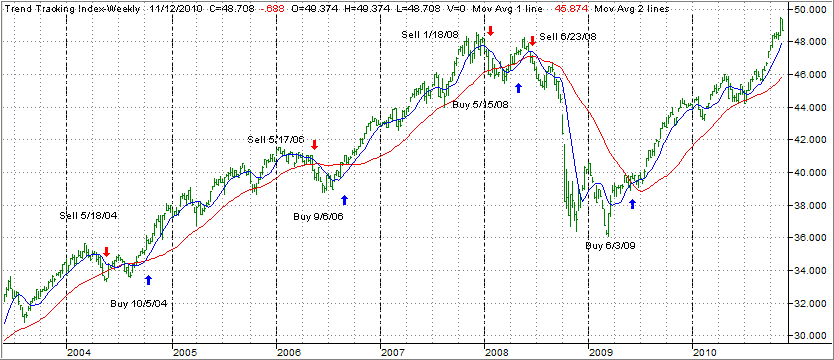
The international index has broken above its long-term trend line by +7.06% (last week +9.11%). A new Buy signal was triggered effective 9/7/10. If you decided to participate, be sure to use my recommended sell stop discipline. 
[Click on charts to enlarge]
For more details, and the latest market commentary, as well as the updated No Load Fund/ETF Tracker StatSheet, please see the above link.
Crosswinds

The market struggled out of the gate yesterday and slumped during the first hour. Buying set in, and the bulls slowly but surely regained the upper hand as the major indexes pulled themselves out of the doldrums in part supported by good news on the jobs front (initial claims fell).
Some crosswinds were blowing from across the Atlantic as global and currency issues continued to weigh along with U.S. economic fundamentals. It did not help matters that Irish and Portuguese debt issues remained on the front burner.
Helping yesterday’s market recover was the dollar, which at first rallied and then fell supporting the rebound late in the day. Crude oil was up and gold was down with the big loser of the day being silver, which received a 7% haircut.
The major indexes continue to hover around their highs of the year, which always raises the question as to whether we’re near at a top and subsequent reversal. It could very well be, but so far any pullback has been met with buying keeping the downside risk limited.
This buying support will face some test today, as the futures point to a lower opening of about 0.5% based on disappointing results from Cisco. Cisco got taken out to the barn and spanked last night at a tune of -13.6%. Ouch!
More Slipping And Sliding

The dollar proved to be almighty yesterday as its rally stopped just about all other asset classes from advancing.
Gold was up initially but reversed course; crude oil fell back and bonds dropped due to a rise in interest rates. And, as usual, the stock market slipped as the dollar headed higher.
Amazingly, the dollar’s rally happened despite a downgrade for U.S. debt by China’s Dagong Credit Rating Company. It reduced its credit rating to A+ from AA and cited a “deteriorating intent and ability to repay debt obligations” in view of the Fed’s recent stimulus plan. Ouch; you can’t get much more direct than that…
On the menu is the G-20 meeting on Thursday, which could affect the markets. Items to be discussed may be not only be the U.S. economy but also the debt issues of Ireland and Portugal.
While those meetings are usually nothing more but useless jawboning with no definite results or accomplishments, we may very well hear a little more name calling and/or mudslinging in view of the Fed’s questionable stimulus plan. Stay tuned.