No Load Fund/ETF Tracker updated through 7/29/2010

Ulli Uncategorized Contact

My latest No Load Fund/ETF Tracker has been posted at:

http://www.successful-investment.com/newsletter-archive.php

Sideways meandering left the major indexes almost unchanged from last week, but up for the month of July.

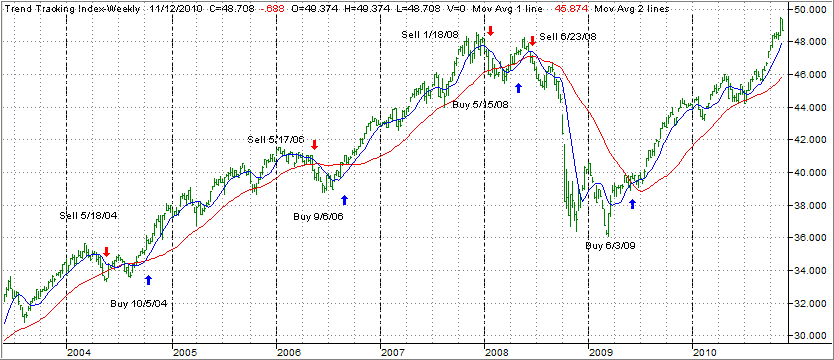
Our Trend Tracking Index (TTI) for domestic funds/ETFs held above its trend line (red) by +2.50% (last week +2.62%) and remains in bullish mode.

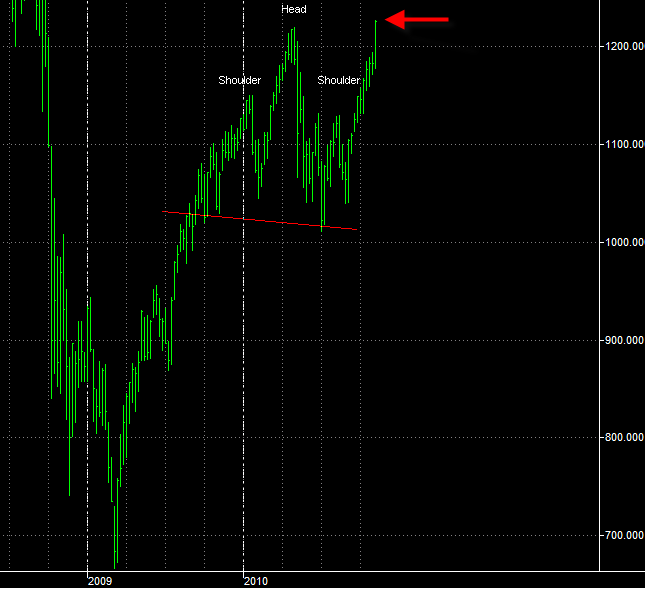
The international index has now broken above its long-term trend line by +1.32% (last week +1.16%). A new Buy Signal was triggered 7/23/10 with the effective date being 7/26/10. Be sure to use my recommended 7% trailing sell stop discipline should you decide to participate in this new uptrend.

[Click on charts to enlarge]

For more details, and the latest market commentary, as well as the updated No Load Fund/ETF Tracker StatSheet, please see the above link.

Dancing Around The Trend Line

Ulli Uncategorized Contact

The battle of earnings vs. economic data continued yesterday as the markets declined slightly but essentially went nowhere.

The Fed’s beige book simply repeated what Fed chairman Bernanke already elaborated on over the past couple of weeks that the economy has lost some steam with not much hiring going on in addition to continued sluggish real estate markets.

As far as upward market momentum is concerned, we have stalled. The S&P; 500 has been dancing around its widely watched 200-day moving average (currently at 1,114) but has not made any meaningful advances above it.

Technically speaking, we have been range bound, and a positive piece of economic news is needed to push us onto higher ground. In the absence of such support the path of least resistance will be to the downside.

The question is wide open at this point as to whether the 1,114 level will continue to serve as resistance, and the top of the rally, or become a new consolidation point to function as a springboard for more gains.

Because if this uncertainty, I have not yet removed the short component of our hedge nor have I added any new positions based on the recent international buy signal. Avoiding a potential whipsaw is important during this sideways period, and I’d rather be a little late to the party than too early.

Maybe the reports on weekly jobless claims and U.S. economic growth due out later this week will give some clue as to which direction the major trend will take.

Taking A Breather

Ulli Uncategorized Contact


After the recent run, the markets took a breather yesterday with the S&P; 500 resting right on its 200-day moving average of 1,114. Attempts of breaking above that level proved to be ephemeral in nature as the 1,121 level was only touched and sideways movements prevailed for the remainder of the session.

Not helping matters was a gloomy report on consumer confidence with the index hitting its lowest level in five months. That should come as no surprise as the jobless rate is anticipated to hover around the 10% level for the foreseeable future.

Last time I checked money for consumer spending and home purchases is usually derived from earned income via a job. In the absence of any improvement in that arena, prospects for a solid recovery remain a mirage.

Be that as it may, the indexes did not sell off yet after the recent run up, which could be considered a bullish sign. However, it remains to be seen if the failing faith in the economic recovery will eventually be noticed by Wall Street and play itself out via a trend reversal.

While I believe the odds of this happening are great, right now I will treat this up move with great respect (with only limited additional exposure) knowing that through my lens the fundamentals simply do not justify these lofty levels.

More On the International Buy Signal

Ulli Uncategorized Contact

As I mentioned in last Friday’s weekly update, the International TTI (Trend Tracking Index) crossed its long-term trend line to the upside, and a new buy signal was generated effective Monday, July 26, 2010.

If you decide to participate, be sure to use ETFs (as opposed to mutual funds), if you can, should this cycle to turn out to be a head fake.

Reader Ken had the following question regarding this latest buy signal:

Can you tell me a little more about the makeup of the International TTI so that I can pick the most representative Funds/ETF’s for the buy signal? For example, does it represent the Global Market ex U.S., or is it more narrowly focused? Does it include an Emerging Markets component that would make an ETF like VWO appropriate?

In the absence of any information about the make-up of the International TTI, I have been considering VEU, GWL or CWI but have been wondering if they are too broad based and if something a little more narrowly focused and matching the TTI would be a better choice.

While the TTI composition is proprietary, I want to point out again that the international signal applies to all “broadly diversified international equity funds/ETFs.” That means from your list VEU, CWI and GWL are suitable for this signal, but VWO is not. I would classify VWO to belong into the Country Fund category, for which a fund’s individual trend line crossing should be used as a signal.

No matter which fund/ETF you decide to use, it’s imperative that you implement my recommended 7% trailing sell stop discipline in case this buy signal turns out to be short-lived.

Disclosure: No holdings at time of writing

Breaking Out Is Hard To Do

Ulli Uncategorized Contact

In last Friday’s market commentary, I talked about the fact that we have reached the upper band of the recent trading range and that a potential break above the S&Ps; 200-day moving average could mean a resumption of the bull market.

This level could also present major resistance and pull the indexes off their lofty levels. Reuters reports more on the subject in “Stocks on brink of breakout:”

Wall Street enters next week on the cusp of a breakout in U.S. stocks, but it will need another spate of convincing earnings reports to feed the rally that sprouted at the end of this week.

The markets endured malaise with poor economic data and downbeat testimony from Federal Reserve Chairman Ben Bernanke on Wednesday but turned decisively after a number of strong results pointed to better times ahead.

“There’s a constant struggle between the bulls and the bears when in fact the answer is in the middle ground. This market is more like a turkey and not a bull or a bear,” said Brian Jacobsen, chief portfolio strategist at Wells Fargo Fund Management in Menomonee Falls, Wisconsin.

Investors have been forced to readjust their expectations for the economy, with data showing the pace of the recovery has gone from a sprint to a crawl.

It has also prompted a divisive argument over the likelihood of an encore recession. But if worries over a double dip are starting to be washed out of the market, an unexpected positive could fuel the market higher.

The broad S&P; 500 also finds itself standing on top of a key resistance level that could turn into a floor for the market. The index closed at 1,102.66, just above the psychologically important 1,100 level for the first time in a month. The level has been a hard one to hold and could buoy the market if the move is ultimately a decisive one.

With the S&P; 500 edging out of official correction territory, trading down about 9 percent from this year’s April high, analysts appear to have reconciled themselves to a slower recovery than they had hoped for. A correction is generally defined as a 10 percent decline from the top.

“All the indicators still indicate growth, we’re just not growing as quickly as we were when we were coming off the bottom, and that makes total logical sense,” said Michael O’Rourke, chief market strategist at BTIG LLC in New York.

O’Rourke added he believes the selloff has run its course, and the early July low will prove to be the low for the year.

Analysts will be hoping to see more earnings season cheer from industrials companies next week after a slew of manufacturers this week topped expectations and raised full-year profit forecasts.

But the economy will remain the wild card, with the potential to pour cold water on investor enthusiasm and a round of top-tier economic data will be looked at to determine the strength of the economic recovery.

The Federal Reserve’s Beige book of economic conditions will also be scrutinized for any illumination of Bernanke’s comment that the outlook is “unusually uncertain.”

Analysts will also digest the results of the European stress tests on banks. But if Friday’s session is an indication, market movement will likely be muted.

What is has come down to is a battle of earnings vs. economic data. The bond market rally indicates that slower economic times are ahead. The recent stock market rebound supports the opposite. Both can’t be right!

We have to wait and see how this battle plays out in order to see which direction the next long-term trend will take. Right now, it’s anyone’s guess.

Sunday Musings: The WSJ On Trend Investing

Ulli Uncategorized Contact

The WSJ featured a niece pieced titled ‘Trend’ Investing Gains Converts:

Proponents of “trend” investing—buying and selling stocks depending on technical analysis of the market’s direction—say the tactic not only enables investors to navigate unstable markets, but also prevents big losses when prices fall.

This stance is winning converts at a time when concern about the strength of the U.S. economic recovery and the future of consumer spending is running high. Yet this technique is controversial, as it counters conventional wisdom that time in the market, not market timing, offers individual investors their best chance for success.

To trend followers, the notion of buy-and-hold investing—picking stocks based on fundamentals and keeping the investments for months or years—has no place in today’s market and, in fact, is a recipe for defeat.

“You have to understand the game you’re playing; you’re playing with sharks,” said Kenny Landgraf, president of Kenjol Capital Management in Austin, Texas . “You may believe in buy and hold, but there are large players out there that don’t.”

Mr. Landgraf uses a proprietary formula to decide when to invest, and approaches the market using exchange-traded funds. As of this past week, the firm was fully invested, having jumped back into the market mid-June. The main advantage of trend investing is protection from heavy losses, Mr. Landgraf said.

“[After starting fully invested] you’re constantly moving to a more-defensive position until you just get out,” he said.

The strategy has shown it can work under the most difficult circumstances. Mr. Landgraf took clients in his Sector Rotation portfolio, his firm’s all-U.S. stock offering, out of the market in August 2008, and after “one or two false starts” didn’t venture back until March 12, 2009.

This approach gave the portfolio an annualized gain of 1.5% for two years from 2008 and 2009. By contrast, the Standard & Poor’s 500-stock index was down 11% over that period. Moreover, data from investment-researcher Morningstar Inc. show that less than 3% of stock mutual funds, just 63 out of 2,301, were in the black.

Trend investing underpins a few specialized stock mutual funds. Stadion Managed Portfolio (trading symbol: ETFFX) lost just 5.8% in 2008, according to Morningstar. The fund, which invests in an array of exchange-traded funds, pulled its money from the market in November 2007 and didn’t fully recommit until mid-April 2009. Nowadays, it is completely out of the market, and has been since the beginning of May.

Stadion’s approach offers investors “a much more comfortable ride” said Brad Thompson, chief investment officer at Stadion Money Management.

Yet while both Stadion’s and Kenjol’s strategies sidestepped the worst of 2008, they also missed much of the recovery the following year.

Kenjol’s Sector Rotation was up 24.3% in 2009 compared with a 26.5% gain for the S&P; 500, while the Stadion fund gained only 2.7%. Kenjol didn’t provide returns for this year, but Stadion’s fund was up 2.5% as of July 15, three percentage points better than the S&P; 500.

Wayne Copelin, founder of Copelin Financial in Sugar Land, Texas, said two bear markets in the past decade have convinced him that a buy-and-hold strategy can’t work in today’s markets.

“We’ve heard for years from money managers the pitch that ‘it’s not about timing but time in the market,’ but then you notice that the ones pitching this are the ones that make money if you stay fully invested,” he said.

[Emphasis added]

The article did a nice job on describing trend following or trend tracking as I refer to it. While there are many different approaches, the ultimate goal is the same: to avoid seeing a portfolio go down in flames when the bear strikes.

To be clear, no matter what strategy you use, you will never be able to avoid losses altogether; they’re simply part of investing. They key is to keep them manageable by not letting a portfolio deteriorate by 40% or more, which will make recouping losses an almost impossible task.

Case in point is a new client who recently came aboard. His portfolio had a value of $1.3 million in the early 90s. It’s now worth some $530k. Two bear markets along with using advisors with no exit strategy can do that to you. Do you think this client is comforted by the fact that “long-term” the market has returned an average of 9%? Of course not, his retirement life has been changed forever.

One key point was totally missed in the above article. If you sidestep one of the worst bear markets (2008) in history, it is not necessary to participate in the subsequent next year rebound to stay ahead of the S&P; 500.

I elaborated on that to some degree in yesterday’s post and in more detail in Buy and Hold Revisited; however, main stream media with its one-sided view never seems to get that point.