
Sputtering Higher

Ulli Uncategorized Contact


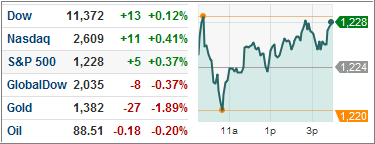
[chart courtesy of marketwatch.com]

It wasn’t pretty yesterday, but the markets managed to sputter higher in the face of rising interest rates and a subsequent higher dollar.

The bond selloff was a clear result of politicians having favored the Bush tax cuts over spending cuts. While in my view the extension of lower taxes in itself is a good thing, with nothing but red ink in sight, the bond market saw things differently and higher rates caused prices to pull back.

The dollar rally pulled gold off its lofty levels, joined by silver, while copper bucked the trend under the assumption that the tax cut extension may produce more economic growth.

The market’s still look like they are going through a consolidation phase, which may form the base for the next leg up. Again, a new driver is needed to push the major averages to the next level.

As I posted Monday, this is the time to watch for yearend distributions in your holdings; be sure to adjust the high prices downward to be in tune with the correct trailing sell stop points.
Losing Steam

Ulli Uncategorized Contact


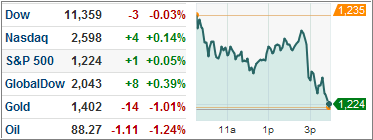
After briefly hitting a 2-year high yesterday, the S&P; 500 lost upward momentum, slipped, recovered but faded into the close ending up nearly unchanged. During the trading day, I was observing some intra-day charts, and the activity was painfully slow; it reminded me of watching grass grow.

Nevertheless, it appeared to be a consolidation day, which is a normal occurrence after the sharp upturn we saw last week.

The initial sprint was a result of President Obama agreeing to extend the Bush era tax cuts while reducing worker payroll taxes and agreeing to continuous jobless benefits for the long-term unemployed.

The dollar ended up higher along with interest rates, while gold and crude oil slumped. No earth shattering news from Europe made this a fairly calm trading day.

None of our sell stops were triggered, and it remains to be seen if the S&P; 500 can generate enough strength to break through yesterday’s high again.

Bernanke Fallout

Ulli Uncategorized Contact

The markets were not able to gain much traction yesterday as the major indexes meandered without much conviction and ended up closing around the unchanged line.

Investors were still trying to digest Fed chairman Bernanke’s relatively gloomy outlook, which he presented on CBS’s “60 Minutes.” Just the fact that he sees unemployment hovering near record levels for some four to five years took the starch out of any upward momentum.

Additionally, he is entertaining the possibility of more quantitative easing depending on the economy’s reaction to the current efforts. All in all, it represented a pretty somber view as the economy struggles to rebound.

Gold again was the beneficiary of this uncertainty, and promptly hit a new high in the most actively tradedFebruary futures contract. Commodity prices rose as did energy and material stocks.

Eurozone worries remained on the front page news menu as the EU ministers were meeting to decide whether the current rescue package will be sufficient in size. As a result, the Euro slipped and the dollar gained, which may have played a part in keeping a lid on equity prices.

Year End Distributions

Ulli Uncategorized Contact

This is the time of the year when mutual funds and ETFs declare their annual distributions.

If you are tracking the sell stops for your positions, it’s imperative that you adjust the “high” numbers.

For example, let’s say that you bought an ETF/mutual fund earlier this year or last, and it reached a high price of $10 since you bought it. This high price becomes the basis from which you calculate your 7% trailing stop loss point.

Let’s say a distribution of $0.25 is declared. Since any distribution reduces the price of the security by the same amount, you will also need to adjust your high price down to $9.75. If you don’t, you will be getting an incorrect signal when your sell stop gets triggered.

In this example, the distribution of $0.25 equaled 2.5% of the current price. If you don’t adjust, you will be suddenly working with a 4.5% trailing sell stop instead of my recommended, or your intended, 7%.

As an aside, many brokerages also don’t account for distributions right away in their YTD performance figures. Simply being aware of that will avoid you having “sticker shock” when suddenly your returns are showing a much smaller number than you’ve seen before the distribution occurred.

No Post

Ulli Uncategorized Contact

The best laid plans sometimes don’t work out. Unexpected events kept me from completing Sunday’s article on the subject of retirement, which will appear a week from today.

Regular posting will resume on Monday.

Missing The Point

Ulli Uncategorized Contact

Recently, a reader emailed and wanted to know if it was a good idea to go short the market after his 7% trailing sell stop had taken him out of a position.

While the short answer is clearly no, I want to elaborate on that issue. The trailing sell stops fulfill the purpose of controlling the downside risk of your holdings. Sure, you may get lucky, short the market, which subsequently declines, breaks through our long term trend line and changes market direction from bullish to bearish with you riding the trend all the way down.

While that is an ideal scenario, the chances of it happening are slim. More often than not the markets will fluctuate, reverse and head back up after you get stopped out, at which point you are looking for a new entry point as you’ve just experienced a whipsaw signal.

Sell stops are simply a safety measure to guard your portfolio not only from sharp setbacks but, as importantly, protect you from sliding down a bear market slope with long positions intact.

The time to consider a short position is when the prices of our Trend Tracking Indexes (TTIs) actually cross their respective trend lines to the downside. That would be the proverbial line in the sand, which divides bullish from bearish territory.

If you are a very aggressive investor, you could work without sell stops and only use the crossing of the trend lines as your last line of defense to cash out and head for the sidelines. However, be aware that, depending on the current positions of the TTIs, it can be a long way down, and you will very likely turn any accumulated profits into losses in the process.

Use the sell stops only for the purpose they were intended and not as a sign that market direction has moved from bullish to bearish. Only the TTIs can make that determination, since their signals represent major directional changes and not minor ones.