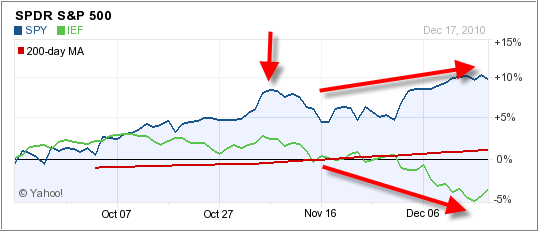
No Load Fund/ETF Tracker updated through 9/16/2010

Ulli Uncategorized Contact

My latest No Load Fund/ETF Tracker has been posted at:

http://www.successful-investment.com/newsletter-archive.php

Slow and steady was the theme of the week, as the S&P; 500 knocked against overhead resistance.

Our Trend Tracking Index (TTI) for domestic funds/ETFs held above its trend line (red) by +3.74% (last week +3.03%) and remains in bullish mode.


The international index broke back above its long-term trend line by +4.21% (last week +2.76%). A new Buy signal was triggered effective 9/7/10. If you decided to participate, be sure to use my recommended sell stop discipline.

[Click on charts to enlarge]
For more details, and the latest market commentary, as well as the updated No Load Fund/ETF Tracker StatSheet, please see the above link.

Bumping Against Resistance

Ulli Uncategorized Contact


So far, overhead resistance, pegged to be the 1,130 level of the S&P; 500, held twice yesterday, as the index backed off, but still closed within striking distance.

It seems to me that the rally from the lows of the trading range appears to be getting a little tired as the market may have gotten way ahead of itself. Evidence of more economic growth is nonexistent, but is the most important factor in sustaining this rally.

Yesterday’s weaker than expected growth in industrial production was largely ignored as was the announcement that the Japanese government sold the yen in an attempt to push it lower against the dollar. History has shown that those types of interventions can have the desired effect, but only on a temporary basis. Long term, all past currency interventions have failed.

Today, the market will face important earnings reports. Among others, FedEx is the most watched as it often signals the direction the economy may be headed. Additionally, initial jobless claims will be reported, which can always be a market moving event.

Try not to get too sidetracked by day to day fluctuations and keep the big picture in mind.

While we’ve bounced nicely of the bottom of the trading range, we have now reached the top level. To my way of thinking, smoke and mirrors will not be enough to push this market decisively higher.

Real supportive economic evidence will be (eventually) required to justify these lofty levels. In the absence of real facts, we could find ourselves moving back down to the lower end of the range in a hurry. Always be aware that markets move down a lot faster than they move up.

Gold Closes At A Record

Ulli Uncategorized Contact


While the S&P; 500 slipped yesterday, after 4 days of gains, gold rallied and closed at a record high. Speculation has it that the Fed will purchase some $1 trillion in bonds to support the economy. At the same time, the dollar fell, which helped silver and commodities and pushed interest rates lower.

The major indexes, with the exception of the Nasdaq, slipped slightly as overhead resistance remained. The pullback was minor, and I would not be surprised to see another attack at the 1,130 level of the S&P; 500.

The Fed’s purchase of $1 trillion in treasuries is widely regarded as a play to improve economic stability in the financial markets while, at the same time, be a boost to GDP by as much as 0.4%. Whether this is just simply ivory tower theory or will actually work as planned has yet to be seen.

Retails sales climbed for the second straight month, which was interpreted as reassuring since economists actually had expected a decline. Some stimulus via bigger back-to-school discounts, tax-free holidays and extended jobless benefits may have lent support to these climbing numbers.

It makes me wonder if anything can possibly be sold these days without prodding or the use of special incentives.

Chart courtesy of marketwatch.com

Last Hour Surge

Ulli Uncategorized Contact


For a while, it looked like the markets were about to surrender their gains at mid-day yesterday, before a last hour surge propelled the major indexes within shouting distance of their highs of the day.

Helping matters was news from China that industrial production grew while retail sales rose sharply. That eased concerns, at least for the day, that Chinese economic growth is deteriorating.

Financials were the other driver of the rally as new global bank capital rules were not as stringent as had been expected. Whether that is a good thing in the long run remains to be seen.

So far, the feared month of September has been very kind to the bullish crowd as the major indexes are all up sharply. Another positive sign is that all three major indexes are now trading above their respective 200-day moving averages for the first time in over four weeks. If prices can stay above these levels, more upside potential may be in the cards.

The number to look for is the high of the S&P; 500 from the past couple of months. I mentioned this 1,130 level last week, which has acted as tough overhead resistance during June and August. A break through that glass ceiling may mean a resumption of the uptrend until the next resistance point (1,200 on the S&P;) comes into play.

This rally also lends an assist to our trailing stop loss points in that our downside risk gets reduced by the percentage your holdings rally on any given day. If the markets turn south, our potential loss will have been reduced by a number less than our original 7% starting sell stop point.

Above chart is courtesy of marketwatch.com.

Cheaper S+P 500 ETF Launched

Ulli Uncategorized Contact

The cheapest S&P; 500 ETF was brought to the market as reported in ”Vanguard Launches New, Cheaper S&P; 500 ETF:”

It’s been a long time coming, but an S&P; 500 ETF from Vanguard is finally here. The Valley Forge, Pennsylvania-based firm rolled out the Vanguard S&P; 500 ETF (VOO) on Thursday, nearly 35 years after the company introduced an S&P; 500 index mutual fund that laid the groundwork for the rise of indexing as an investment strategy. Earlier this decade Vanguard got caught up in a legal dispute with S&P; over the licensing of the index, leading the company to build its line of ETFs around indexes maintained by MSCI–a relative unknown in the industry at the time.

It shouldn’t be surprising to too many investors that Vanguard’s S&P; 500 ETF will come in with a lower expense ratio than its most direct competitors; VOO will charge 0.06%, or three basis points less than the S&P; 500 SPDR (SPY) and S&P; 500 Index Fund (IVV). The existing S&P; 500 ETFs from State Street and iShares have aggregate assets of approximately $80 billion. VOO will join Schwab’s U.S. Broad Stock Market ETF (SCHB) as the cheapest ETF on the market [see 25 Cheapest ETFs]. Vanguard and Schwab have been the two firms primarily responsible for an escalation of price wars in the ETF industry over the last year; both have cut management fees on existing funds and introduced new products that offer lower expense ratios than their most direct competitors.

In addition to VOO, Vanguard rolled out eight additional funds offering exposure to the S&P; MidCap 400 Index and S&P; SmallCap 600 Index, as well as the value and growth subsets of those benchmarks:

* S&P; Mid-Cap 400 ETF (IVOO)
* S&P; Mid-Cap 400 Value ETF (IVOV)
* S&P; Mid-Cap 400 Growth ETF (IVOG)
* S&P; Small-Cap 600 ETF (VIOO )
* S&P; Small-Cap 600 Value ETF (VIOV)
* S&P; Small-Cap 600 Growth ETF (VIOG)
* S&P; 500 Value ETF (VOOV)
* S&P; 500 Growth ETF (VOOG)

Each of these products will also compete very closely with existing ETFs, primarily products offered by iShares. Expense ratios on the new Vanguard funds range from 15 to 20 basis points, making them competitive from a cost perspective. “The new Vanguard index funds and ETFs offer our trademark low costs and tax efficiency, and aim for the utmost tracking precision. They will appeal to financial advisors and institutional investors seeking to build portfolios based on S&P; benchmarks,” said Vanguard Chairman and CEO Bill McNabb in a press release. “In particular, the new ETFs will offer additional choices to investors and help Vanguard continue to build momentum in the ETF marketplace.”

Sure, the competition for lower prices in the ETF universe has heated up and will be a benefit to the investing public. However, to my way of thinking, price is one thing and volume is another.

Just because an ETF has low annual expenses does not make it appropriate. You want to be able to place a trade quickly and see it executed without much slippage and/or a large bid/ask spreads.

To accomplish that, you need to use ETFs with high average volume. For example, if I want to trade the S&P; 500 in my advisor practice, I only use SPY, which, with over $1 billion (with a “b”) average daily volume, is the mother of all S&P; 500 ETFs; no one else comes even close.

Large orders get filled with lightening speed, which can be important if you need to get out in a fast moving market. While low annual expenses are important, be sure to give average daily volume an equal consideration.

Disclosure: No holdings

The $9 Trillion Bailout

Ulli Uncategorized Contact

When referencing articles on the current, past or future state of economic affairs, my preference is to use material from authors who use common sense intertwined with their knowledge of the subject.

Mish at Global Economic Trends is the top blogger in the universe and always writes about as direct and spot on as you can get. Economists Dave Rosenberg and John Mauldin provide deep and insightful analysis. Dr. Housing Bubble, who writes under a pseudonym, has his focus not always on real estate but related economic issues as well.

He recently posted a piece titled “The $9.1 billion bailout price tag,” which takes a look at the big picture. It’s a bit lengthy but well worth the read:

For those following the housing boom and bust carefully, the solution to let prices correct is not a novel concept. That is why it is surprising to see headlines, four years after home values peaked and have been falling, arguing for home values to fall. The equation is simple because people that make less money can only afford a certain amount of home. The only reason to keep home prices inflated artificially was to appease those with tremendous amounts of housing debt. It took four years for some to see the light (many have not) yet trillions of dollars are now out the door under false pretenses for something that was going to happen anyway. In the end we have created the biggest moral hazard with housing as the centerpiece in this modern game of Monopoly. Yet after all the pain and economic suffering that Americans have suffered and with obvious culprits, nothing has occurred to fundamentally change our banking system. To that issue we focus our attention today

Banking Stockholm Syndrome

Some people still believe in the narrative that we had to save the banking system. There is a legitimate case for this. But did we have to save in the way that we did? Absolutely not. Under pressure and fire the biggest looting of American wealth has occurred and no revolution was necessary. Remember when good old Hank Paulson gave us a three page memo requesting $700 billion for “troubled assets” which was a nice euphuism for toxic mortgage crap? Some have forgotten the days of September 2008 when the word bailout seemed to be a daily utterance. By the way, the vast majority of those toxic mortgages still sit on the balance sheet of banks even after the money is now out the door.

Some suffer from a banking Stockholm Syndrome where they now believe in the propaganda pushed out by the bailout winners. Use logic when thinking about this. If that initial bailout was to remove toxic assets from bank balance sheets and banks still have those toxic assets, then the program was an expensive failure by definition. And this bailout was only one of many. The big issue is who has shouldered the cost of the banking and housing calamity.

At the peak of the housing bubble in 2006 Americans had $13 trillion in equity in their residential real estate. At the peak, total residential mortgage debt stood at $9.8 trillion. Today, American households have $6.2 trillion in equity while mortgage debt has grown to $10.3 trillion. In other words American households have faced a real financial loss of $6.8 trillion. At the same time you’ll notice that the amount of mortgage debt has remained steady. The toxic mortgage waste just sits idly by while banks use the taxpayer wallet as an ATM. You can’t have a double-dip without bouncing first. Americans hold most of their net worth in housing. That has not recovered because employment is weak. Stocks, which are heavily tilted as a primary source of income for the top income earners has only made people feel better temporarily. The mainstream media for the most part represents this tiny group and that is why it has taken so long to even realize that there really is no recovery outside of the stock market.

Again, without fixing the core of the banking system we are doomed for another crisis. Those that believe the narrative that “we had to do what banks wanted us to do” forget that it was the banks that spearheaded this housing bubble in the first place. They were the industry that created collateralized debt obligations and options ARMs. The anger in this upcoming election is justified but might miss the real financial problems. The fix has been in for decades. Until we reform how banks and corporations lobby politicians we can simply expect more crony capitalism for years to come.

You don’t become wealthier as a nation by shipping off your jobs or diluting your employment base. Years ago my focus was on jobs and it still remains there. So what if a home costs $750,000 if local area incomes were at $300,000. Home values need to reflect a healthy job market meaning wages can support local home prices without taking on some exotic loan. Instead of focusing on that key part of the equation, banks with the support of the government have been obsessed with lowering lending standards, 3.5% FHA insured loans, HAMP, wacky refinance programs, ignoring non-payments, pushing option-ARMs into 40-year interest only balloon mortgages, but in the end it hasn’t worked because jobs can’t justify bubble home prices even today after a severe correction.

The price tag of the bailout is much higher than headlined

How many times have you heard about the Federal Reserve on your morning news? When we hear about the bailout it is usually confined to the tax breaks and stimulus funds push forward. Not to diminish that but the one simple action of the Fed buying mortgage backed securities is double that amount yet not much is mentioned about this in the media.

The current total price tag is $9.1 trillion. When you break down who got what, you can see the biggest wealth transfer in history. We can debate whether we should have let banks completely fail or to bail them out. Yet there was no debate or even open public discussion about the biggest bailouts in our nation’s history. Wall Street scared the crap out of people in those days when the DOW was dropping constantly so all this was passed in a panic by Congress (with lobbying dollars flowing in). Yet if you remember, it was the public who didn’t want the bailouts in the first place. Their gut intuition was right but our government is unfortunately broken when it comes to protecting us in the financial realm. Right now, this is predatory capitalism where all the productivity of the American public is being skimmed off like froth from a cappuccino and handed out to Wall Street bankers.

Where does the housing market stand today?

It isn’t sufficient to say that giving banks everything they asked for has saved us from a second Great Depression. For the 26 million Americans that are unemployed, underemployed, and have given up looking for work this is a depression. Plus, how many people that have lost jobs and have taken up lower paying jobs are not cited in the above figure? We know that 4 out of 10 of those fully employed workers now are part of the low paying service sector. Do you think buying a new home is the first thing on their mind?

The $9.1 trillion didn’t seem to do much here to help out. In fact, this collapse is on par with that seen in the Great Depression and no $9.1 trillion was handed out to Wall Street back then.

New home sales never did any significant movements because people don’t have the funds to buy expensive homes. Existing home sales had tiny spikes but this was all based on government tax breaks and massive amounts of gimmicks. Once that was removed, home sales collapsed. So $9.1 trillion did what for the housing market? Now we have people saying home prices should correct? They already have and would have done that anyway! We need to go back and get a refund on that $9.1 trillion especially when it comes to the banks.

So what is the solution? At this point, the system is so broken and from reading comments here on this blog and other places the public gets what is going on. This is no mystery. Right now we need some heavy handed leadership to step up and bring justice to the financial ills that have occurred. $9.1 trillion flushed down the toilet should bring up some new Pecora Investigation. As we saw with the AIG deal only after the fact, Goldman Sachs recovered 100 cents on the dollar for all their bad bets. Can you walk up to the Fed and ask for the 30 percent you lost on your home purchase? Or maybe you want a refund for that bad bet on roulette? In the end home prices need to correct. The longer we delay the inevitable the more we look like Japan and their zombie banks. We can debate culture, demographics, and all other things but our banks are doing exactly what their banks did.

Home prices falling is merely a reflection of a bubble popping and people not having incomes high enough to support current prices. How about we focus on fixing the income side of the equation and let housing prices fall where they may?

Be sure to review the entire link for relevant charts to the above article.

There is not much I can add other than to comment again that any real estate stimulus designed to accelerate sales and/or to prop up home prices is destined to fail just as any other stimulus program will.

In the end, there will be nothing left other than a pile of tremendous debt that will be dumped on future generations to deal with.