Sunday Musings: Thoughts On Inflation And Deflation

Ulli Uncategorized Contact

The prospect of inflation, along with the destruction of the dollar, seems to be on many readers’ minds. Frank’s question is very typical:

I have been reading your newsletter for over 2 years, and I enjoy your comments. I have one question and it is a big one do you think we are really heading into deflation or will inflation finally kick in?

While I am not an economist, I have some thoughts on the topic. Keep in mind that after the greatest real estate/credit bust the world has ever seen we have moved into unchartered territory.

To me that simply means that any sudden government or Fed action/intervention can have unintended consequences that can change previous assumptions. Case in point is the recent implementation of QE-2 (Quantitative Easing) in early November designed to stimulate the economy and keep interest rates low. Well, that did not work out too well as interest rates have been on a rising trajectory.

Given the current environment, I see more deflationary forces than inflationary ones. This does not mean it might not change in the future, especially with the Fed being hell-bent on producing inflation.

If I look around, I see nothing but red numbers on every level of government. Many states, cities and municipalities are not able to fulfill their obligations including pension plan promises; more layoffs are virtually a guarantee. I expect a host of cities to default and/or go through bankruptcy proceedings in order to reorganize with the purpose of reducing debt and obligations.

Looking over to Europe, the situation looks equally dire, if not worse, with debt problems being the center point of endless government meetings. All of these issues are deflationary in nature.

To be clear, if you follow sound Austrian economic principles, inflation is defined as the expansion of money supply and credit, with deflation being the opposite. Most readers, however, only look at price levels to define these terms. That’s incorrect, as prices are the effect and not the cause.

Talking about prices, there is an interesting play between the dollar and commodities. Most days, they move in opposite direction, as a weaker dollar is considered inflationary. Take a look at the following 2-year chart:


It shows the bullish dollar (UUP) compared to the commodity index (DBC). Their opposite price movements are clearly demonstrated. So, if you are worried about a declining dollar, DBC should be a part of your portfolio.

As I have posted before, the dollar has been the favorite whipping boy of the world for quite some. However, as soon as a crisis develops somewhere, everybody wants to own the dollar—don’t write it off yet.

Some economies are clearly overheating and are experiencing their own not yet admitted real estate/credit bubble. China, Canada and Australia come to mind. They are facing economic circumstances somewhat similar to what we witnessed around 2007. While inflation is an issue in these countries, it may not be once the bubbles burst.

At this time, I see no inflation on the horizon here in the U.S. I believe that we are following the footsteps of Japan, as we are attempting to solve our debt issue in the same manner that they did (stimulus attempts, creation of zombie banks, etc). Nothing was learned from the fact that stimulus programs don’t work in the long run and Japan, 20 years after their real state bust, has clearly proven that.

Disclosure: Holdings in DBC

More Trend Line Talk

Ulli Uncategorized Contact

In “Reader Question: More On Sell Stops,” reader Jon responded by saying the following:

If you buy only when the index cuts above the trend line and sell when it cuts below it you will, by definition, realize profits equal to the increase in the trend line between these two moments in time!

While that is correct if in fact the trend lines are sloping up, they sometimes continue to head south before heading higher, especially after a large correction. Reader Richard shared these thoughts:

Regarding today’s blog on Sell Stops, there is another reason to not base a Sell Signal on a major trend line. In my experience, when a price curve pierces a major trend line from below, thereby generating a Buy Signal, the trend line almost always still will be sloping downward, and, because the trend line is a relatively long-term moving average, the trend line will continue to slope downward for some time before turning upward.

If an equity’s price would turn downward during the meantime, and if the equity’s price would cross the trend line from above, thereby generating a Sell Signal, the trend line probably will be lower than it was when the Buy signal was generated, thereby resulting in a loss for that trade cycle. Therefore, relying on a major trend line as a Sell Signal would work only when Buy/Sell cycles would be of relatively long durations (which of course cannot be determined in advance).

The market meltdown of 2008, and the subsequent recovery in 2009, is a good example to demonstrate what Richard is talking about. The chart below shows a snapshot in time of the Domestic Trend Tracking Index (TTI) and its buy signal effective 6/3/09:


The trend line (red) was still in correction mode when the price line (green) crossed above it and generated a new Buy. It took about another 4 months before the trend line reversed direction and recovered enough to follow the price line higher.

My experience shows that you need to have at least a 6 months period from a buy to a potential Sell if you are relying on the upward sloping trend line to bail you out.

I have found it much easier and effective to use the upside crossing of the trend line as a Buy point only, while downside protection should be accomplished via your trailing sell stop points.

No Load Fund/ETF Tracker updated through 12/16/2010

Ulli Uncategorized Contact

My latest No Load Fund/ETF Tracker has been posted at:

http://www.successful-investment.com/newsletter-archive.php

Not much volatility, but the S&P; 500 managed to eke out a small gain.

Our Trend Tracking Index (TTI) for domestic funds/ETFs has moved above its trend line (red) by +5.26% (last week +5.12%) and remains in bullish mode.


The international index has broken above its long-term trend line by +6.46% (last week +7.02%). A new Buy signal was triggered effective 9/7/10. If you decided to participate, be sure to use my recommended sell stop discipline.


[Click on charts to enlarge]

For more details, and the latest market commentary, as well as the updated No Load Fund/ETF Tracker StatSheet, please see the above link.

Nothing But Red

Ulli Uncategorized Contact


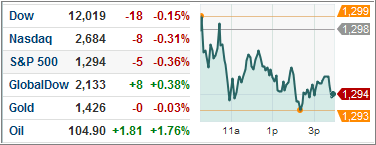
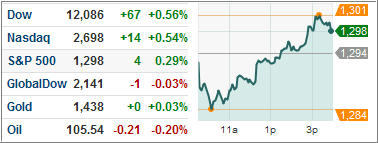
Yesterday, the markets did a repeat of the last few days in that an early rally ran into resistance causing the trend to reverse, and we ended up with slight losses.

Interestingly, there was no place to hide and red numbers dominated the computer screens. Stocks were down along with bonds, gold, oil and most country funds while the dollar headed higher.

Right now we seem to be witnessing a battle between the bulls and the bears, as recent market activity has shown lack of sustainable upward momentum. In other words, we have run into overhead resistance again, which translates to 11,500 on the Dow and 1,250 on the S&P; 500.

The pattern of the recent days, with morning rallies fading into the afternoon, is not exactly confidence inspiring. On the other hand, improved economic data might provide the support needed to break out of this pattern.

Today, we’ll be looking at initial jobless claims, housing starts and building permits. Supporting the early morning sprint were a better-than-expected CPI report and strong manufacturing activity. Providing the headwind and helping the afternoon fade was Moody’s announcement that it was putting Spain on review for a possible debt downgrade.

That caused the dollar to rally, and took the starch out of the upward momentum. The major indexes changed direction and slowly but surely slipped into negative territory.

As always, when the markets run into resistance, you never know which way the next breakout will occur; will it be to the upside or the downside?

Since no one can give me the answer with any degree of certainty, I let my trailing sell stops make the decision as to whether I should remain invested or not. I suggest you do the same.

Repeating The Fade

Ulli Uncategorized Contact

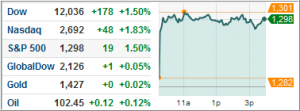
If you look at yesterday’s chart, and compare it to the one shown above, you will see a virtual mirror image of market activity, reflecting almost the same highs and lows in the S&P; 500.

The markets crept higher in the early going, supported by better than expected November retail sales, but sold off after the Fed announcement. There were no earth-shattering news other than that the Fed will continue with its program to boost the economy via Treasury purchases. The official reason is that the pace of the recovery remains so slow that additional stimulus is warranted.

Subsequently, the dollar rose, energy and metals slumped, and the markets headed south, however, the day was saved by a last minute comeback and a close above the unchanged line.

While the Fed conceded that there has been a little improvement in the economy, growth has not been sufficient to bring down unemployment. Nevertheless, business and household spending along with manufacturing and a reviving auto industry are showing small but positive developments.

The Fed reiterated its firm stance that it will employ all tools available to further the recovery and prevent deflation from spreading. Whether that will actually play out this way remains to be seen.

The stock market has already discounted a recovery in the upcoming months, which is reflected in current prices. There is still confusion as to whether the Fed intended for interest rates to rise, or if it’s a sign of failure that the Quantitative Easing program has not been working.

On the other hand, some believe that because of economic improvement, no matter how small, rates have spiked reflecting growing strength.

As usual, there are more questions than answers; so follow the trends, track your stop loss points and try not to figure out all of the fundamentals; it’s impossible to do.

Emerging Market Trends

Ulli Uncategorized Contact


While no trend will last forever, emerging markets have been on a tear for most of this year as the 1-year chart above shows. There was a brief interruption in upward momentum when the S&P; 500 dropped over 13% during the May/June period.

More recently, since the Fed announced its Quantitative Easing (QE-2) program in early November, emerging market ETFs seem to have hit a brick wall and have retreated from their lofty levels. The 3-month chart clearly demonstrates this pullback:


At the same time, the S&P; 500 (represented by SPY in chart), has been moving upward and has made a two-year high in the process.

Bond prices have followed emerging markets down, as interest rates have risen since QE-2, which was probably one of those unintended consequences. With emerging markets and bonds heading south, I have to wonder if they are a leading indicator to a path that stocks eventually will follow.

On the other hand, this could be just a temporary blip in an ongoing bull market. Since no one can be sure about the outcome, simply use your trailing sell stops as a guide to decide when to exit any positions you hold in this arena.

My view is that we will continue to wander through a period of great uncertainty, which makes it absolutely crucial to have a workable plan in place to deal with the unexpected. It is important that you prepare for these eventualities now, so you don’t have to stress out when the market heat is on.

Disclosure: Positions in above ETFs