No Load Fund/ETF Tracker updated through 1/27/2011

Ulli Uncategorized Contact

My latest No Load Fund/ETF Tracker has been posted at:

http://www.successful-investment.com/newsletter-archive.php

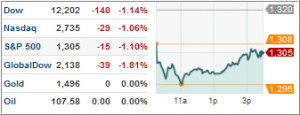
The Egyptian crises pulled major indexes sharply lower today. However, for the week, the losses were modest.

Our Trend Tracking Index (TTI) for domestic funds/ETFs has moved above its trend line (red) by +4.71% (last week +4.58%) and remains in bullish mode.

The international index has broken above its long-term trend line by +7.64% (last week +8.37%). A new Buy signal was triggered effective 9/7/10. If you decided to participate, be sure to use my recommended sell stop discipline.

[Click on charts to enlarge]

For more details, and the latest market commentary, as well as the updated No Load Fund/ETF Tracker StatSheet, please see the above link.

Flirting With Milestones

Ulli Uncategorized Contact


The S&P; 500 bounced against its 1,300 level before selling off yesterday, while the Dow actually broke through its 12,000 milestone, which it briefly held before profit taking pulled it back below.

The cause for this continued bullishness came from the Fed, as it was announced that the current policy with zero interest rates will be continued.

In its statement the Fed said that “the economy continued to be constrained by high unemployment, modest income growth, depressed home prices and tight credit. The central bank conceded that commodity prices are rising.

But core inflation is still trending downward, and that’s why it left its target on its key federal funds rate at 0% to 0.25%. And because it has mandates to control inflation and foster maximum employment, the Fed is continuing its plan to buy in $600 billion in Treasury securities by the end of June.”

It was not as much what the Fed said but, more importantly, that rates will remain low, which is what Wall Street had anticipated despite concerns over globally increasing prices, especially in the food arena.

While the respective 1,300 and 12,000 levels by themselves are meaningless, they do have psychological value in that they confirm that the current upward trend remains intact. Barring any unforeseen news, I would expect these milestones to be conquered in the near future.

On the other hand, the Fed’s announcement is also a clear sign that all is not well, and that the economy continues to sputter along at best, especially when it comes to housing and unemployment.

These are major domestic issues that can have a profound impact on market direction if they are not being resolved or improved upon at some point in the future. Just because the Dow may break the 12,000 barrier does not mean all is smooth sailing from heron forward.

Unexpected headwinds can surface at anytime. You don’t have to anxiously look for them, but simply be prepared and have a plan of action when they appear.

Overcoming Crummy News

Ulli Uncategorized Contact


There was not much good news yesterday, and the markets meandered south shortly after the opening. Some earnings disappointments kept a limit on any rebound attempts while slumping home prices added to negative sentiment.

The metals headed south again as it appeared that hedge funds had lightened their holdings. Oil slipped as well as did commodities in general. Not helping matters was a crummy report on Britain’s economy as it was reported that the GDP dropped 0.5% during the last quarter.

So what caused the turnaround?

After all the bad news was out, and the commodities markets had closed, the focus remained on the only positive of the day, which was a rise in U.S. consumer confidence that was more than forecast indicating that the jobs outlook had improved.

That was all it took; the markets turned and raced out of the basement to close around the unchanged level. Not bad considering that this day could have ended up very poorly for the major indexes.

At this moment, global economic uncertainty has not been a news factor. While the U.S. recovery has been slower than hoped for, no serious adverse reports have surfaced to cause anxiety. I believe that complacency and overall market optimism have been a factor as well to push the metals off their lofty levels.

I believe that precious metals along with commodities should be a part of anyone’s portfolio, as long as these asset classes remain in an uptrend and don’t violate their respective trailing sell stops.

We are living in a volatile world. While all appears calm right now, uncertainty can appear in no time at all, which can push the metals back in other direction. Remember, nothing matters until it does.

Heading Towards Dow 12,000

Ulli Uncategorized Contact

Yesterday, decent earnings reports, along with the technology sector finally showing some leadership after several days of losses, pushed the Dow within striking distance of breaking through its 12,000 level.

Some headwinds, as a result of not very exciting report cards from American Express and Texas instruments, may delay a break through that milestone today, unless other positives outweigh those two negatives. Last time the Dow hovered above the 12,000 level was on June 19, 2008, only four days prior to our domestic sell signal being issued.

Crude oil and interest rates were lower, and the dollar fell as the European Central bank signaled that inflation pressures must be watched carefully, which was interpreted that odds of an interest rate hike have increased. Inflationary pressures are certainly not an issue at this point here in the U.S., and the Fed is expected to hold rates steady.

Reader Q & A: Taking Profits

Ulli Uncategorized Contact

Reader David had the following thoughts on taking profits:

I do not recall you writing about taking profits. We have all heard the old slogan of “cut your losses and let your profits run”. It seems to me that there must be circumstances where you might want to sell part (or all) of a very successful position to lock in some profit before 7% or 10% of it was given back by your stop.

One case would be if you wanted to rebalance your allocations. Another might be because you felt that its price (or the over-all market prices), had reached unsustainably elevated levels…. for example, if it was 30% or 50% or 70% above its 50 day moving average, or if it moved into a flat trading range after a long steady ascent, and the general market had become rather volatile.

I do not expect you to give any precise numerical rules; it’s obviously partly a matter of personal temperament, zeitgeist, and context. Please give us the benefit of your experience.

Let’s recap. The use of the trailing sell stops fulfills two purposes:

1. It limits our losses in case the trade goes against us, and
2. It locks in our profits, if prices continue to rise

This means, short of needing cash from my investments, I let the duration of the trend be my guide as to when to exit a position.

If you don’t, you are just making a wild guess as to when to take profits. In your example above, you might consider taking them when a position has risen 30% above its 50-day M/A, but that is just an arbitrary number that has no resemblance as to any momentum changes.

Since we get whipsawed occasionally, which may result in a loss, we absolutely have to make up for that shortcoming by letting profitable positions run until the end, when the trend bends, reverses and stops us out.

I have not found any other way to identify an exit point with better reliability and consistency. Along the same line, you want to keep it simple by having a clear plan that does not rely on a bunch of indicators no one will use.

The goal here is to have an exit strategy in place designed to take the emotions out of the decision making process. If you can do that, you will be better off more often than not, according to my experience.

Traveling

Ulli Uncategorized Contact

I’ll be out this entire weekend and will not have a chance to write any articles. Regular posting will resume on Monday morning.