
High Volume ETFs On The Cutline – Updated Through 6/22/2011

Ulli ETFs on the Cutline Contact

With the markets having staged a rebound over the past few trading days, it’s no surprise that this strength positively affected some of the High Volume Major Market ETFs, however, on balance, when looking at the big picture, it was a mixed bag.

To clarify, High Volume (HV) ETFs are defined as those with an average daily volume of $10 million or higher.

These ETFs are generated from my selected list of 90 that I use in my advisor practice. It cuts out the “noise,” which simply means it eliminates those ETFs that I would never buy because of their volume limitations. 

Let’s look not only at the winners, but also at those ETFs, whose positions worsened despite the positive market environment.

Improving their positions within the first 20 spots above the Cutline were:

XLY (Consumer Discretionary) from +7 to +19

VTI (Total Market Index) from +5 to +15

IWB (Russell 1000) from +6 to +14

SPY (S&P 500 Index) from +4 to +9

Just because these Major Market ETFs have moved up further into plus territory does not make them a buy, since most of their respective momentum numbers are still negative.

Slipping further below the trend line, or holding fairly steady at lower levels, despite an elevated market, were the following ETFs:

IEV (S&P Europe 350) from +1 to -5

RSX (Russia) from +11 to -6

IOO (S&P Global 100) from -3 to -9

VWO (Emerging Markets) from -14 to -11

BRF (Brazil Small Cap) from -16 to -15

First, take a look at the table and then read my latest commentary:
Read More

6 ETF Model Portfolios You Can Use – Updated through 6/21/2011

Ulli Model ETF Portfolios Contact

This week’s rebound helped 5 of our 6 ETF Model Portfolios to move higher, while the Income Portfolio (#5) retreated. That’s no surprise since its holdings were cut by 50% as two of the trailing sell stops were triggered during the recent slide. If momentum continues upward, I will re-instate these positions.

This caused a changing of the guards in terms of YTD performance. The top of the pecking order is now lead by the Aggressive Portfolio (#3) with the Trend Tracking Portfolio (#1) in close pursuit.

Again, the idea behind these models is not for you to be invested in the top performer but in a portfolio that represents ‘your’ personal risk tolerance – and not someone else’s.

Take a look at this week’s numbers:

Read More

Mutual Funds On The Cutline – Updated as of 6/20/2011

Ulli Mutual Funds On The Cutline Contact

Following our International Sell signal last week, more foreign mutual funds succumbed to selling pressure, despite yesterday’s bounce, and have slipped into bear market territory. Some of the big names from last week are:

Fidelity International Diversified (FDIVX), which fell from +11 to below the -20 position, while the Vanguard International Stock Index (VGTSX) followed suit by moving from +10 to below the -20 spot.

Dropping in from a level above the +20 listing was T. Rowe Price International (TRIGX), which settled at -1.

It confirms my current view that broadly diversified international funds/ETFs are not the place to be at this time. Take a look at the report and note the other contenders that slid below the cutline:

Read More

ETFs On The Cutline – Updated through 6/17/2011

Ulli ETFs on the Cutline Contact

With the International Trend Tracking Index (TTI) having signaled a ‘Sell’ last Wednesday, can the domestic TTI be far behind?

Judging by the action around the current ETF Cutline report, only a substantial rebound with legs may be able to stem the slide and reinstate upward momentum.

Since the last report, several additional major indexes have slid below their long term trend line, even though a week ago they were still solidly entrenched in bullish territory. Holding its ground, but slipping towards the cutline, was the Global S&P 100 (IOO), which dropped from a +16 to a +13 position, while the Russell 2000 retreated to -2 from +7.

Dropping in from a level above the listed +20 ETFs, were the following:

IWZ (Russell 3000 Growth) +11

IWF (Russell 1000 Growth) +9

TMW (Wilshire 5000) -3

SPY (S&P 500) -8

All of the above, except SPY, have triggered their 7% trailing sell stop points and should be sold. As the table shows, these 4 ETFs are tightly hovering around the cutline by less than ¼%. Take a look at the table, and then I’ll tell you the magic number to watch for this coming week:

Read More

Last Week In Review: ETF News And Blog Posts

Ulli ETF News Contact

In case you missed it, here’s a summary of the topics that I posted to my blog during the week ending on 6/19/2011.

Downward market momentum pushed our International Trend Tracking Index (TTI) below its long-term trend line into bear market territory generating a Sell for that area, as I posted last Wednesday.

Will the Domestic TTI follow? While that is still unclear right now, I will report the latest updates as they become relevant. Stay tuned.

My published Cutline tables and Model ETF Portfolios can give you an assist by indentifying weakness and strength in various market segments so that you can make better investment decisions by avoiding exposure in those areas that are trending down.

This week, we covered the following:

Read More

Sunday Musings: 3 Fund Managers Are Missing The Mark

Ulli Mutual Fund Managers Contact

Here’s an interesting article on the subject of fund managers, which I have talked about on various occasions over the years. First, take a look at some highlights from “Berkowitz, Heebner and Miller in tight battle—for last place:”

Three famed stock-pickers having a dismal year so far, with big bets crapping out; still time to be right, however.

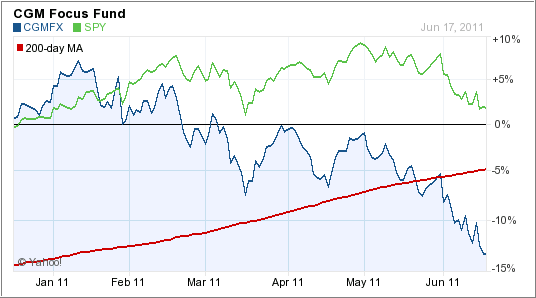
Bruce Berkowitz, Kenneth Heebner and Bill Miller, three of the best-known U.S. stock pickers, are competing for last place this year after their bets on an economic expansion backfired.

Funds run by Berkowitz of Fairholme Capital Management LLC, Heebner of Capital Growth Management LP and Miller of Legg Mason Inc. (LM) are the three worst performers among large diversified U.S. mutual funds in 2011, according to data from Chicago-based Morningstar Inc. The funds lost 11 percent to 12 percent through June 9, compared with a gain of 3.4 percent for the Standard & Poor’s 500 Index.

“People assume because certain managers have had good streaks that they are always going to be a step ahead of the market,” Russel Kinnel, director of mutual fund research at Morningstar, said in a telephone interview. “It never works out that way.”

Read More