7 ETF Model Portfolios You Can Use – Updated through 1/3/2012

Ulli Model ETF Portfolios Contact

As I announced last week, all ETF model portfolios have been rebalanced to their original allocations effective 12/30/11. The only exception is #6, since not all of its portfolio components are positioned above their respective long term trend lines, which is a condition for this particular model.

I want to emphasize that these portfolios are only designed to assist you in your decision making process; they are not a recommendation in this current market environment. They simply allow you to compare a variety of options and observe the effects of various market conditions on my recommended sell stop discipline. If you choose to adapt your personal portfolio to any of these models, you must incorporate my often discussed exit strategy in order to minimize downside risk.

As I have posted, my particular choice at this time, is to be underinvested in equities and have more market exposure via bonds, sectors and cash holdings.

Take a look at the latest update:
Read More

Major Market ETFs Start the New Year With A Bang

Ulli Market Review Contact

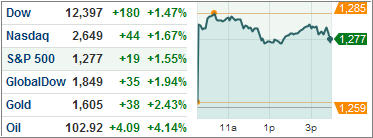
[Chart courtesy of MarketWatch.com]

European worries seemed not to have fazed investors as 2012 has kicked off. The S&P 500 posted a gain of 1.55% while major European and Asian indices also rose. Nevertheless, the Euro didn’t move much, finishing the day at $1.31/Euro.

Also, it looks like investors perceive a slightly less risky environment as the 10-year Treasury yield went up to 1.96%. In commodities, gold and oil skyrocketed 2.42% and 4.19%, respectively. Overall, there were big movements across the market and higher trading volume after last week’s lull.

However, the Eurozone’s future doesn’t look promising. Greece has said that it might leave the euro in 3 months if it can’t agree on additional bailout. There is still no resolution regarding the bond haircut while further austerity is needed. A Greece exit, disorderly or not, would be incredibly destabilizing and have a highly adverse impact on global markets. It is the looming possibility of such an event that keeps me sticking to a low risk portfolio.

Read More

ETFs/Mutual Funds On The Cutline – Updated Through 12/30/2011

Ulli ETFs on the Cutline Contact

Below are the latest ETF Cutline reports, which show how far above or below their respective long-term trend lines (39 week SMA) my currently tracked ETFs/MFs are positioned.

The first report covers the ETF Master List from Thursday’s StatSheet and includes 398 ETFs, of which currently 110 (last week 107) of them are hovering in bullish territory.

The second report includes only High Volume ETFs. To clarify, High Volume (HV) ETFs are defined as those with an average daily volume of $10 million or higher.

These ETFs are generated from my selected list of some 93 that I use in my advisor practice. It cuts out the “noise,” which simply means it eliminates those ETFs that I would never buy because of their volume limitations. Only 16 ETFs (last week 16) have managed to hang on in bullish territory after the recent volatility.

The third report covers Mutual Funds on the Cutline. There are currently 127 (last week 176) above the line and 734 below it out of the 861 that I follow.

Take a look:

1. ETF Master Cutline Report

2. ETF High Volume Cutline Report

3. MF Cutline Report

Last Week In Review: ETF News And Blog Posts To 1/1/2012

Ulli Market Review Contact

In case you missed it, here’s a summary of the ETF topics and market reviews I posted to my blog during the week ending on 1/1/2012.

The major indexes inched slightly lower into the last trading day of the year with the S&P 500 ending 2011 just about unchanged.

Heading into 2012, the world’s excessive debt overhang will remain headline news, as most attempts to solve these thorny problems have focused on providing the liquidity when the real issue has been insolvency.

Traders will return well rested next Tuesday ready to push buy and sell buttons depending on not only the news du jour but also on a host of economic reports ending with the all important employment numbers on Friday.

This week, we covered the following:

Read More

A Rough 2011, But Will 2012 Get Any Better?

Ulli Market Commentary Contact

It’s been a crazy year for markets to put it mildly. Europe descended into a full blown financial crisis, the U.S. failed to make significant headway in economic growth, and Asian economies started heading south. And the sad part is that 2012 might just be much of the same.

Looking back on 2011, Guardian economics editor Larry Elliot reviews the global economy and the dismal year it had (some of it is UK focused). While the PIIGS grabbed headlines for their poor finances, the European core has been hit as well, as evidenced by higher borrowing costs, downgrade threats, and political bickering. The U.S. story hasn’t improved either as housing weakness and high unemployment remain a significant drag.

Not only did developed markets continue to take a hit, but emerging markets felt the pain too. Despite booming growth in recent years, China’s manufacturing has slowed down while India is facing high rates of inflation. And given the dependence of many emerging nations on European banks, a fully fledged Eurozone meltdown could deal a major blow to the emerging world.

I’m afraid that we will be stuck in neutral territory for at least the first part of 2012. With Europe’s situation unresolved and persistent weakness elsewhere, it’s questionable if markets can gain enough momentum to trend up in the near future.

The January Effect: Will It Hold In The Current Investment Climate?

Ulli Market Commentary Contact

As we head into 2012, there are a multitude of scenarios that may unfold. But looking at the short-term, some investors look forward to this time of the year because of the January Effect, an apparent anomaly that questions the efficient market hypothesis.

The January Effect is named for the fact that monthly performance in January has been overwhelming positive. This has primarily been attributed to large stock sell-offs in December for tax purposes, thus resulting in appreciation when investors flock in to buy stock in the New Year. That’s the logic at least.

Furthermore, the effect has been said to have a more pronounced effect on small cap stocks, which arguably are more susceptible to mispricing during periods of significant selling and buying that can benefit investors. For example, since 1926, small caps have outperformed large caps in January over 70% of the time.

Read More