Equity ETFs Remain Flat After Greek Deal, XHB Slips, GLD Glitters

Ulli Market Review Contact

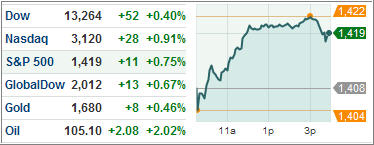
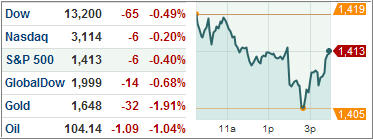
[Chart courtesy of MarketWatch.com]

The Greek torment finally ended (I hope) as Eurogroup Finance Ministers agreed to a long-awaited €130 billion second bailout package early on Tuesday. The final deal arm-twisted the private holders of Greek debt to accept even higher losses than they had agreed to last month.

European officials now say that private lenders, led by banks and hedge funds, have agreed to accept a voluntary 53.5 percent haircut despite approving a 50 percent cut in the face-value of bonds in October in a meeting with German Chancellor Angela Merkel and French President Nicholas Sarkozy.

The new deal doesn’t leave much room for euphoria, though Athens managed to stay on in the economic zone and managed to avoid a disorderly default that could have sent global markets in a tizzy.

Both Christine Lagarde, managing director of the International Monetary Fund, and Jean-Claude Juncker, chairman of the eurogroup finance ministers warned that Greece still needs to take a series of steps by the end of the month before the IMF and/or the eurozone governments sign off the deal.

Read More

European Major Market Indexes Rise On Greek Hopes

Ulli Market Review Contact

The US markets remain closed today as the country celebrates the President’s day. Meanwhile, the negotiations between Athens and the European Finance Ministers over the second bailout package continue in Brussels today. Members of the so-called Eurogroup, made up of 17 members that use the common currency, are discussing whether Greece has done enough to qualify for another round of bailout money.

Latest measures taken by Athens may not be sufficient to bring down the country’s debt-to-GDP ratio to 120 percent by 2020 from the ruinous 160 percent now, a latest IMF/ECB/EC report accessed by Reuters suggest. The baseline scenario predicts the country’s debts to fall to 129 percent of GDP by 2020, well above the targeted and ‘sustainable’ 120 percent mandated by the EU.

Additional debt relief from official and private sectors are required, the 9-page report observed. Internal devaluation of the euro is required to restore Athens’ competitiveness, inevitably driving the county’s debt-to-GDP ratio up, the report says. Thus the Greek program will remain accident-prone with the debt level remaining at 160 percent by 2020 if the country fails to follow through structural reforms and keeps delaying implementation of tighter fiscal policies, raising questions over its sustainability.

Read More

ETFs/Mutual Funds On The Cutline – Updated Through 2/17/2012

Ulli ETFs on the Cutline Contact

Below are the latest ETF Cutline reports, which show how far above or below their respective long-term trend lines (39 week SMA) my currently tracked ETFs/MFs are positioned.

The first report covers the ETF Master List from Thursday’s StatSheet and includes 398 ETFs, of which currently 353 (last week 332) of them are hovering in bullish territory.

The second report includes only High Volume ETFs. To clarify, High Volume (HV) ETFs are defined as those with an average daily volume of $10 million or higher.

These ETFs are generated from my selected list of some 93 that I use in my advisor practice. It cuts out the “noise,” which simply means it eliminates those ETFs that I would never buy because of their volume limitations. 74 ETFs (last week 67) have managed to move into in bullish territory after the recent run up.

The third report covers Mutual Funds on the Cutline. There are currently 808 (last week 762) above the line and 53 below it out of the 861 that I follow.

Take a look:

1. ETF Master Cutline Report

2. ETF High Volume Cutline Report

3. MF Cutline Report

Last Week In Review: ETF News And Blog Posts To 2/19/2012

Ulli Market Review Contact

In case you missed it, here’s a summary of the ETF topics and market reviews I posted to my blog during the week ending on 2/19/2012.

The markets picked up steam again with the S&P 500 gaining some 1.3% for the week, as opinions prevailed that a disorderly default in Greece will not happen. Even though bullish sentiment slowed a little towards the end, that was to be expected ahead of a 3-day weekend with the Euro FinMin meeting scheduled for Monday.

Even though the second financial package is supposed to be approved, you never can be certain with recent history proving the unraveling of many attempts.

This week, we covered the following:

Read More

Asset Diversification During Changing Times

Ulli ETF News Contact

While Greece is unraveling and remains under threat of disorderly default, we can’t deny that equity ETFs have had a favorable run since the start of the year. While I have advocated a less risky portfolio over the last several months due to deteriorating conditions in Europe, acting too conservatively can have its drawbacks.

As seen in this discussion, although equity activity has dropped as of late, equities have done surprisingly well with some of the historical correlations not holding in current times. 1-1/2 weeks ago, I added international equity ETFs in addition to domestic equity ETFs because their respective trend tracking indices are well above their trend lines. Thus, in order to capture some of the upside, it is crucial to take advantage of market bullishness in the short-term while maintaining a sizeable bond ETF allocation.

It’s unrealistic to fully realize positive trends as we want to see steady upward momentum first before adding exposure in a particular area. But with low volatility in recent weeks, this can be a solid entry to add a couple equity ETFs if you can afford to be a little more aggressive. Yet, as always, make sure you have trailing stop losses in place.

A Precedent For Default: Will Greece Fall Again?

Ulli Market Commentary Contact

As Greece heads for treacherous waters in this debt storm, I can only wonder whether Greece will soon default. Amidst the political turmoil among Greek parties and disagreements between Greece and other Eurozone members, this beckons the following question: Can Greece avoid disorderly default?

Despite recently passed austerity measures including a cut in government jobs, a decrease in the minimum wage, as well as reduced pension benefits, it doesn’t address Greece’s long-term problems. A 50% haircut on its current debt would only lower Greece’s debt-to-GDP ratio to 120% by 2020. And the real economy would suffer immensely as already seen by rising unemployment and falling incomes.

Let’s not forget that Greece has defaulted many times before, raising doubts as to whether it can stay in the Eurozone. There has unfortunately been a pattern of Greece accepting loans and failing to pay interest payments on debt in a timely manner. To make matters worse, since Greece’s independence in 1822, it has been in a state of default for over 50% of the time.

Read More