Europe Needs Central Fiscal Structure: Michael Spence

Ulli Europe Contact

Michael Spence, professor of economics at New York University’s Stern School of Business thinks the risks in Europe needs socialization in the short-term. The Eurozone is going to stand or fall depending on the reforms they undertake in Spain or Italy.

Unfortunately, those reforms will take time to show the results. Borrowing costs however remain the dominant problem right now and to bring the sovereign yields of Spain and Italy down, the intervention of core European institutions and the IMF are required as the reforms are initiated. In order to do that, they would need to keep buying peripheral bonds, which involves socializing the risks involved.

The Federal Reserve’s latest move to extend the Operation Twist through the end of the current year had barely any impact on the markets; it was a non event which basically suggests that central banks are running out of monetary tools that can offer solutions.
Read More

New ETFs On The Block: Global X Permanent ETF (PERM)—Will It Replace PRPFX?

Ulli ETF News Contact

The Global X Permanent ETF (PERM), launched by the New York based fund issuer offers investors exposure to a number of core asset classes. The ETF replicates the Solactive Permanent Index, a benchmark comprised of three major core asset classes; stocks, Treasuries & bonds, and precious metals, thus diversifying holdings for all market conditions.

Each of the categories is further diversified to minimize downside risks. Stocks include both domestic and international sectors, Treasuries portfolio is equally split between long-term bonds and short-term bonds and notes while precious metals seek to invest in both gold and silver.

The diversified portfolio is designed to perform regardless of four broadly classified economic conditions including: increasing growth, decreasing growth, increasing inflation and decreasing inflation based on the “permanent” investment strategy made famous by Harry Browne in his 1998 book Fail-safe Investing.  The book assumes that the economy is always in one of four states: prosperity, inflation, recession and depression. The portfolio doesn’t attempt to forecast economic growth or inflation. Rather it seeks to benefit from low volatility while generating moderate returns.

Read More

ETF/No Load Fund Tracker Newsletter For Friday, June 22, 2012

Ulli Market Review Contact

ETF/No Load Fund Tracker StatSheet

————————————————————-

THE LINK TO OUR CURRENT ETF/MUTUAL FUND STATSHEET IS:

https://theetfbully.com/2012/06/weekly-statsheet-for-the-etfno-load-fund-tracker-newsletter-updated-through-06212012/

————————————————————

Market Commentary

Friday, June 22, 2012

US EQUITIES REBOUND ON EUROPE HOPES; EWP FLIES, VIXY CRASHES

US stocks clawed back Friday, recovering part of Thursday’s sharp losses after the European Central Bank said it will lower rating thresholds and amend eligibility criteria for asset-backed securities to ease access to funds for the region’s banks.

The move to loosen up some of the rules on collaterals that banks can offer in exchange for funds from the central bank was taken by the Governing Council of the Frankfurt-based organization in an effort to boost growth.  Lovely; this is as clear of a sign as you can get that quality collateral no longer exists anywhere in Europe, which makes wonder how long this extend and pretend game can go on.

Treasuries slipped over reports that leaders of Germany, Spain, France, and Italy have decided to consult jawbone further on a €125 billion stimulus plan for the single-currency block to boost growth, equal to one percent of the 17-member economic zone’s output.  I can’t wait to hear the results of that latest futile effort.

Read More

Weekly StatSheet For The ETF/No Load Fund Tracker Newsletter – Updated Through 06/21/2012

Ulli ETF StatSheet Contact

ETF/Mutual Fund Data updated through Thursday, June 21, 2012

If you are not familiar with some of the terminology used, please see the Glossary of Terms.


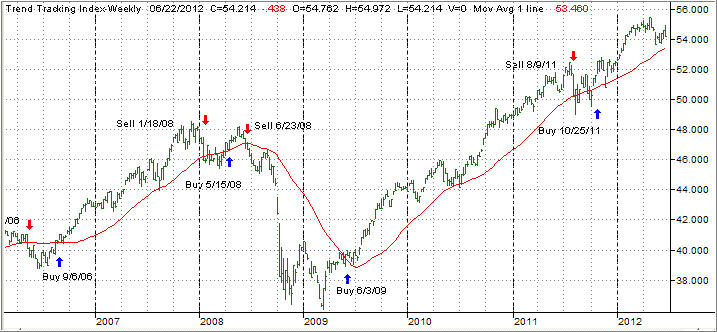
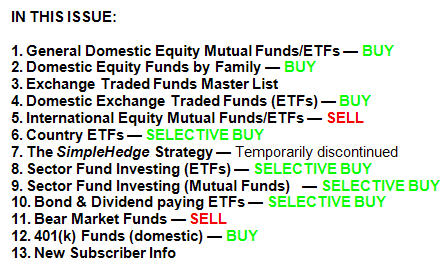
1. DOMESTIC EQUITY MUTUAL FUNDS/ETFs: BUY — since 10/25/2011

The domestic TTI broke through its long-term trend line generating a Sell for this area effective 8/9/2011. Over the recent past, we’ve seen the TTI hovering slightly below and above this dividing line between bullish and bearish territory. The clear break to the upside occurred on 10/24/11 and, effective 10/25/11, a new Buy signal for domestic equities went into effect.

As of today, our Trend Tracking Index (TTI—green line in above chart) has broken above its long term trend line (red) by +1.60%. Be sure to tune into my blog for the latest updates.

Read More

Major Indexes Plunge On Bernake Fallout, Economy And Europe; GAZ Floats, GDXJ Crashes

Ulli Market Review Contact

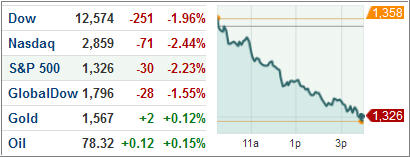
[Chart courtesy of MarketWatch.com]

The major index ETFs took the year’s second hardest knock Thursday losing more than two percent as investors ran for safe haven assets amid indications of a global slowdown, while rumors of an impending downgrade of 17 major US banks by Moody’s Analytics added to market concerns.

Obviously, disappointment in what the markets perceived as a lack of Fed intervention played a big role and added to downward momentum. Again, my view is that the Fed will not pull out the big guns, if it has any left, until the markets dive towards panic territory or the economy slips officially into a recession. My definition of panic in the markets would be another 20% or so correction from current levels putting the S&P 500 towards the 1,000 milestone.

Treasuries progressed for the first time in three down sessions after Europe’s PMI index for June remained near three-year lows while manufacturing output in Germany, the region’s biggest economy, slowed down at the fastest rate in three years and manufacturing  shrank for the eight month in Asia and China. The global slowdown is now underway, and the US market will not be excluded from its effects.

Read More

Equities Whip-saw And Edge Down As Fed Extends Operation Twist; EWP Rises, VIXY Sinks

Ulli Market Review Contact

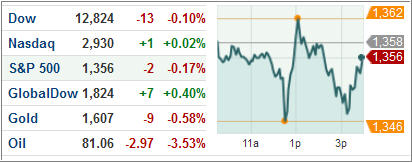
[Chart courtesy of MarketWatch.com]

Equities see-sawed and edged lower Wednesday as the Federal Reserve extended its much anticipated Operation Twist program but stopped short of initiating a more aggressive direct bonds purchase program, which was the exact possibility I discussed in last night’s post.

As the chart above shows, the major indexes went on a wild ride, but held up surprisingly well. Longer term 30-year bonds erased early losses while shorter term Treasuries retreated after the central bank lowered growth forecasts for the largest economy and said it was prepared to do more to support the economy, hinting at more aggressive measures in the future if the labor markets failed to improve.

The Dow Jones Industrial Average (DJIA) closed off 13 points, despite losing more than 94 points in early trade. Within the Dow, 16 of the 30 companies closed higher.

Read More