Looking For ETF Investment Opportunities As The Markets Experience A Pull-Back?

Ulli Market Review Contact

The stock markets have done remarkably well thus far this year with the S&P 500 index posting its best quarter since 1998, soaring more than 12 percent in the past three month, which can certainly be called an aberration supported by excess liquidity and artificially low interest rates.

The markets, however, witnessed a pull back this week, triggered by the FOMC minutes first. Later the ghosts of Europe returned to haunt investors as yields on Spanish debts jumped. The country struggled to sell medium-term notes on Wednesday and managed to raise €2.6 billion from the auction; closer to the bottom of its €2.5-€3.5 billion target.

The Spanish debt-problem has been attracting some attention and there has been an increased chatter over the Greek saga getting repeated again. The country needs to refinance debts worth €370 billion over the next three years, and sharp spending cuts announced by Prime Minister Mariano Rajoy has fuelled speculations of the country witnessing widespread social unrest.

Read More

04-06-2012

Ulli Newsletter Archives Contact

ETF/No Load Fund Tracker Newsletter For Friday, April 6, 2012

ETF/No Load Fund Tracker StatSheet

————————————————————-

THE LINK TO OUR CURRENT ETF/MUTUAL FUND STATSHEET IS:

https://theetfbully.com/2012/04/weekly-statsheet-for-the-etfno-load-fund-tracker-newsletter-updated-through-04052012/

————————————————————

Market Commentary

Friday, April 6, 2012

MARCH PAYROLLS REPORT TRAILS FORECAST; BERNANKE’S JOBS WARNING COMES TRUE

The US economy’s expansion came under threat as hiring by American employers trailed most pessimistic forecasts in March. Employers added 120,000 jobs in March, the fewest in five months, proving the Federal Reserve chairman right who had warned of slower payroll growth last month.

Manufacturing, one of the key drivers of recovery, cooled in March with the ISM reading tumbling to 53.4 from a high of 59.9 in the beginning of 2011. The unemployment rate dropped to 8.2 percent from 8.3 percent in the prior month.

Private payrolls climbed a meager 121,000 in March following the addition of 233,000 jobs in Feb. Manufacturing jobs however, grew by 37,000 after a 31,000 growth, despite the ISM reading tumbling for the month.

Average work week declined to 34.5 hours from 34.6 while average weekly earnings dropped to $806.96 from $807.56.

With today’s report, the Fed is not likely to change the benchmark interest rate, currently hovering around zero percent. However, it’s also unlikely to trigger new asset purchases via quantitative easing when the policy makers meet next on April 24-25.

On the other hand, if the weak trend continues through April and May, a case for added monetary stimulus may/will be made not only during the June FOMC meeting, but would also be loudly supported by Wall Street’s players, who can’t wait to get the punch bowl back.

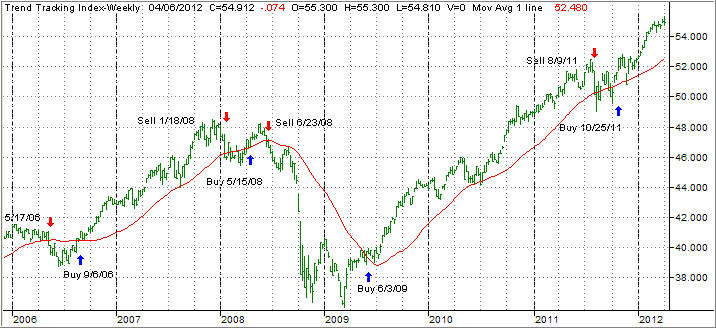
Our Trend Tracking Indexes (TTIs) headed south from last Friday’s position, but both remain deep in bullish territory. Here are this week’s closing numbers:

Domestic TTI: +4.63% (last week +5.10%)

International TTI: +3.76% (last week +5.39%)

Have a great week.

Ulli…

————————————————————-

READER Q & A FOR THE WEEK

All Reader Q & A’s are listed at our web site!
Check it out at:

http://www.successful-investment.com/q&a.php

A note from reader Jack:

Q: Ulli: Could you please explain the difference between a ‘buy’ and a ‘selective buy?’ You use these terms in your weekly StatSheet, but I can’t seem to find an explanation.

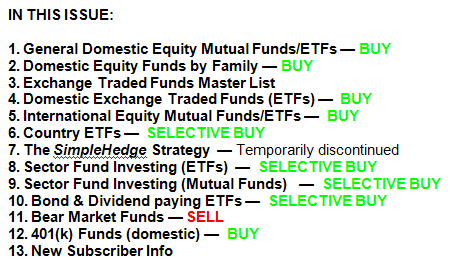
A: Jack: A ‘buy’ refers to all broadly diversified domestic and international funds/ETFs that are tied into the Domestic and International TTI (Trend Tracking Index) as a guide for making buy/sell decisions.

In the case of Country/Sector ETFs, a TTI does not exist, so ‘buy’ decisions will need to be made once each individual ETF crosses its respective trend line to the upside. Some may do that sooner, thereby generating a buy signal quicker, while others may lag; hence the term ‘selective buy.’

———————————————————-

WOULD YOU LIKE TO HAVE YOUR INVESTMENTS PROFESSIONALLY MANAGED?

Do you have the time to follow our investment plans yourself? If you are a busy professional who would like to have his portfolio managed using our methodology, please contact me directly or get more details at:

https://theetfbully.com/personal-investment-management/

———————————————————

Back issues of the ETF/No Load Fund Tracker are available on the web at:

https://theetfbully.com/newsletter-archives/

ETF/No Load Fund Tracker Newsletter For Friday, April 6, 2012

Ulli ETF Tracker Contact

ETF/No Load Fund Tracker StatSheet

————————————————————-

THE LINK TO OUR CURRENT ETF/MUTUAL FUND STATSHEET IS:

https://theetfbully.com/2012/04/weekly-statsheet-for-the-etfno-load-fund-tracker-newsletter-updated-through-04052012/

————————————————————

Market Commentary

Friday, April 6, 2012

MARCH PAYROLLS REPORT TRAILS FORECAST; BERNANKE’S JOBS WARNING COMES TRUE

The US economy’s expansion came under threat as hiring by American employers trailed most pessimistic forecasts in March. Employers added 120,000 jobs in March, the fewest in five months, proving the Federal Reserve chairman right who had warned of slower payroll growth last month.

Manufacturing, one of the key drivers of recovery, cooled in March with the ISM reading tumbling to 53.4 from a high of 59.9 in the beginning of 2011. The unemployment rate dropped to 8.2 percent from 8.3 percent in the prior month.

Private payrolls climbed a meager 121,000 in March following the addition of 233,000 jobs in Feb. Manufacturing jobs however, grew by 37,000 after a 31,000 growth, despite the ISM reading tumbling for the month.

Read More

Weekly StatSheet For The ETF/No Load Fund Tracker Newsletter – Updated Through 04/05/2012

Ulli ETF StatSheet Contact

ETF/Mutual Fund Data updated through Thursday, April 5, 2012

If you are not familiar with some of the terminology used, please see the Glossary of Terms.


1. DOMESTIC EQUITY MUTUAL FUNDS/ETFs: BUY — since 10/25/2011

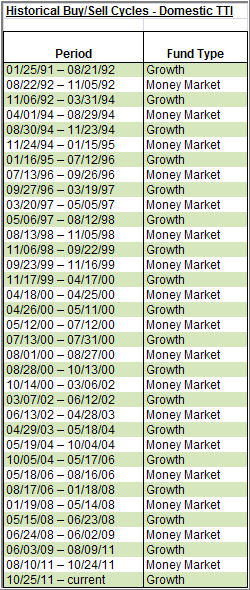
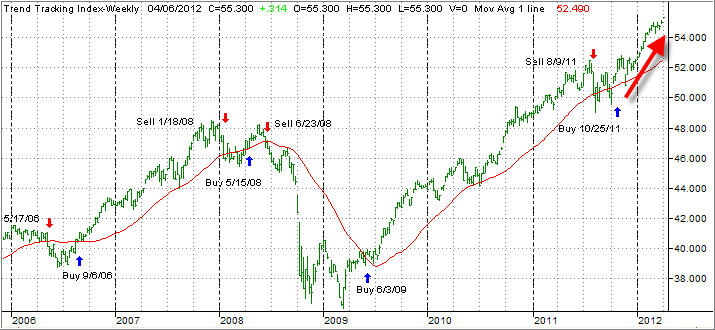
The domestic TTI broke through its long-term trend line generating a Sell for this area effective 8/9/2011. Over the recent past, we’ve seen the TTI hovering slightly below and above this dividing line between bullish and bearish territory. The clear break to the upside occurred on 10/24/11 and, effective 10/25/11, a new Buy signal for domestic equities went into effect.

As of today, our Trend Tracking Index (TTI—green line in above chart) has broken above its long term trend line (red) by +4.77%. Be sure to tune into my blog for the latest updates.

Read More

US Stocks End Mixed; VXX Rallies On Fear, EWO Tanks

Ulli Market Review Contact

US stocks ended mixed Thursday with the broad market ETFs retreating for the third successive day in a shortened week, as worries over Spanish debt crisis returned to haunt Wall Street.

All the indices closed lower for the week despite better weekly claims data ahead of Friday’s nonfarm payrolls reading for March. As equities sank, US Treasuries marched ahead for the second day in a row as rumors over worsening Eurozone debt crisis triggered demand for safe-haven US debts.

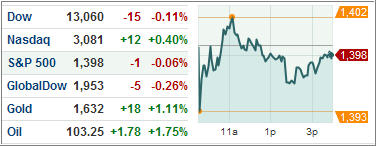
As demand for French debts wilted prices of ten-year US Treasuries jumped to their highest two-day level since January. The Dow Jones Industrial Average (DJIA) slipped 0.1 percent to 13,060.1, down 1.2 percent over last Friday.

Read More

04-05-2012

Ulli Newsletter Archives Contact

The ETF/No Load Fund Tracker—Monthly Review—March 31, 2012

Markets Remain In Rally Mode

US stocks managed decent gains in March that pushed the large-cap indices back to multi-year highs seen earlier in the month.

The majority of the gains were achieved in the last week of the month when Federal Reserve chairman Ben Bernanke said prolonged weakness in the labor market due to a general shortfall of aggregate demand merited an accommodative monetary policy, a term that was interpreted as an indication of further rounds of quantitative easing, if required.

The monthly job data remained robust and weekly jobless claims in the last week of the month dropped to a level not seen since April 2008. Consumer spending increased at a faster pace though personal income gains were modest, validating Bernanke’s observation of structural weaknesses in the labor market. The University of Michigan consumer sentiment index also hit its highest level.

All was not well on the western front, however, and some weaknesses restricted the stock market rally. A report showed pending home sales dropped in Feb, factory activities slowed down in the Midwest, and durable goods orders did not bounce back as forecast. The final reading of fourth quarter GDP however, came as a breather, showing the economy expanded at 3 percent, as had been widely anticipated.

Large caps generally outperformed the markets due to the predominance of tech companies in the large cap growth companies, and the technology sector has been one of the best performing sectors thus far this year. Also, sectors that performed poorly in 2011, technology, consumer discretionary and financials, have performed very well while defensive sectors such as utilities and consumer staples that led last year have lagged in 2012.

There are risks, however, with European credit crisis spreading to other countries and China slowing down in the coming months. The ECB has been trying to live up to the challenges by providing about a trillion Euro band aid via cheap loans for three years to the region’s banks to avoid a credit crunch witnessed following Lehman Brothers collapse.

Also European finance ministers approved a combined rescue fund of about €720 billion when they met in Copenhagen in the last week of March. That should at least temporarily soothe nerves of those who have been fretting over Spain and Italy drowning the EU region and give some time to get their houses in order. Central banks of Brazil, China and India have either begun to lower official interest rates or have lowered bank reserve requirement rates, releasing money into the system.

Domestically, the housing and employment data have been better compared to what we saw in 2010 and 2011, although much of it has been simply a byproduct of rapid Fed stimulation designed to keep the markets aloft.

What we’ve seen in the market during this first quarter has almost been a carbon copy of the up moves from 2010 and 2011. In case you forgot, the major averages tanked big time during mid-year and were “rescued” each time by another round of Fed easing (QE1 and QE2).

That’s a clear sign to me that the economy and the markets are artificially propped up and sooner or later a sense of realty will pull us off these lofty levels, which may very well result in the next round of stimulus being applied.

However, right now, the markets are heading north, as demonstrated by my Domestic Trend Tracking Index (TTI):

It is obvious that this trajectory is simply not sustainable and some form of a pullback is a given; the timing of it is the unknown. This is why, despite the euphoria on Wall Street, I am committed to our exit strategy for all of our portfolios based on our trailing sell stops.

Based on blog reader feedback I have received, there is great complacency among market participants based on the hope that the Fed will be able to put a floor under any correction. I certainly would not count on it, as continued stimulus efforts will eventually lose their effectiveness.