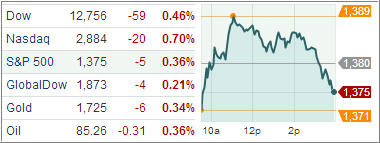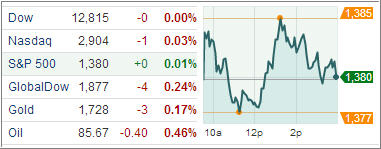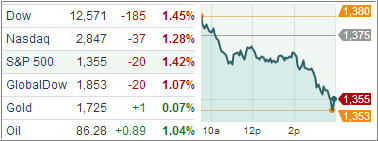
In case you missed it, here’s a summary of the ETF topics and market reviews I posted to my blog during the week ending on 9/30/2012.
With the anticipation of what the Fed might do next being gone, the markets returned to a more normal state and reacted to good and bad news as you might expect them to do. With QEternal now a given fact, the major indexes went through a mild correction with the S&P 500 giving back some 1.3% last week.
Nevertheless, we are still in a total disconnect from the fundamentals when looking at the elevated level of equities. Global economic data points are still confirming that a slowdown is underway, not just in the US but anywhere you look.
Still, the bulls remain in control so far, but weakness in equities has definitely spread since the Fed’s QE announcement. Whether that is just a short-term retrenchment is too early to tell but it behooves you to be aware of where your sell stops are in case downside momentum picks up speed. Should things get ugly, large crowds will attempt to squeeze through small exit doors, so you want to be ahead of the masses.
The US economy is doing pretty well compared to the European ones, says David Blanchflower, a professor of Economics at the Dartmouth College and a Bloomberg Television contributing Editor.
Back from his trip to Europe, David says there is fear everywhere. In France, people are talking about Hollande’s dipping popularity while in Germany people are worried about unemployment rising. The GDP has contracted for the last three quarters in the UK. In comparison, the US is doing pretty well.
In Europe, the Spanish employment rate has been falling steadily since 2008. Barring last week’s sudden dip in unemployment numbers, the US job market has been fairly flat.
Quantitative easing is essentially about creating jobs and David disagrees with Phil Fed President Charles Plosser that quantitative easing will create inflation down the road. Plosser is worried about wage inflation and wage pressure, but there is no evidence that wage inflation has taken place.
In fact, the opposite is true; globalization has diminished workers’ bargaining power. The fear is that companies are not doing so well due to global slowdown, which according to David is misplaced because if they were not, they would have moved somewhere else, he noted.
Austerity is killing growth in Europe. Spending cuts in Europe have resulted in violent street protests across the debt stricken countries, which is a nightmare scenario that everybody was worried about.
iShares, the San Francisco-based ETF issuing arm of BlackRock Inc, has unveiled its first exchange traded fund benchmarked to the MSCI Frontier Markets 100 Index in an effort to expand its lead in the foreign fund space.
iShares, with its lineup of more than 200 funds, has now targeted economies that are one rung below emerging markets. The iShares MSCI Frontier Index Fund (FM) will hold approximately 100 of the biggest frontier market stocks, thus giving exposure to an asset class that is largely neglected by leading fund houses.
The regional ETF space has gained popularity over country-specific funds recently since they offer diversified exposure. FM will give exposure to frontier markets such as Argentina, Vietnam, Pakistan, Croatia and 16 other countries that are forecast to be among the world’s fastest growing economies.
Frontier countries, according to BlackRock, represent 30 percent of the global population. Economically these markets are in the position that BRICS nations found themselves a few decades ago, and hence offer tremendous potential as external trade volume increases and basic infrastructure is put in place.
However, the downside risk is that frontier markets can be extremely volatile and prone to major geo-political upheavals. Also frontier markets tend to be less liquid and hence show lower correlation with developed and emerging markets, meaning they can be a decent source of uncorrelated returns.
EQUITIES END QUARTER ON A HIGH; EUROPE POSTS BIGGEST WEEKLY DECLINE SINCE JUNE; DAVID STOCKMAN BASHES FED’S QE PROGRAMS
Despite a blockbuster quarter, US equities ended the last trading day with a whimper as a gauge of manufacturing in the Midwest contracted unexpectedly while an index for consumer confidence weakened in September, pushing investors a little bit to the edge.
The Dow Jones Industrial Average (DJIA) tumbled 49 points to 13,437, still managing a respectable 4.3 percent gain for the quarter and 10 percent for the year, while the S&P 500 Index (SPX) fell 6 points to 1,441 with telecommunications and technology falling the most but utilities were the sole winner among its 10 business groups.
As Europe struggled to agree over measures to contain the region’s debt crisis and some US economic indicators eased during the week, sustained demand for safe havens helped US Treasuries to finish higher for the second straight week.
Treasuries pared gains for the day, however, after results of a stress test showed Spanish banks would require allegedlyonly EUR 59.3 billion ($76.3 billion) for recapitalization, lower than some analysts had estimated. The news provided relief as EUR 100 billion has already been committed to Madrid for bank recapitalization, easing demand for safe havens.
Meanwhile, the US dollar gained traction Friday after a stress test showed Spanish banks’ capital shortfall was within the tolerance level of the European Financial Stability Mechanism since Madrid has already been committed EUR 100 billion for bank recapitalization.
Across the Atlantic in Europe, the benchmark index posted its biggest weekly drop since early June as Spain continued to weigh on investors’ minds. The Stoxx Europe 600 index slid 1.2 percent for the day, finishing the week 2.7 percent lower. The benchmark however, is up 6.9 percent for the quarter.
Spain’s IBEX 35 index slumped 1.7 percent, led by banks BBVA SA and Banco Santander SA. Down 6.3 percent for the week, the index is, however, up 8.5 percent for the quarter.
The French budget for 2013 was also in focus as socialist President Francois Hollande raised income tax rates to 75 percent for people making more than EUR 1 million annually.
The new measure is expected to garner EUR 30 billion in extra revenues annually for the government. The CAC 40 index tumbled 2.5 percent for the day as banks came under pressure. The benchmark is up five percent for the quarter.
The German DAX 30 index also shed one percent for the day after index component Deutsche Bank slipped 1.1 percent. The index is however, up an impressive 12.5 for the quarter.
In the ETF space, the Teucrium Corn Fund (CORN) jumped 4.74 percent as corn futures rose after the USDA reported lower than estimated inventories. The Teucrium Soybean Fund (SOYB) also rallied, adding 2.39 percent for the day.
European funds lagged the most with the iShares MSCI Italy Index Fund (EWI) tumbling 3.68 percent for the day. The iShares MSCI France Index Fund (EWQ) and the iShares MSCI Spain Index Fund (EWP) also came a cropper, shedding 3.05 percent and 3.01 percent, respectively.
In regards to the Fed’s latest QE effort, you may have heard a variety of opinions. One of the better presentations on the subject was a recent speech given by former budget director (under Reagan) David Stockman, who has a great rant on the Fed’s efforts. It’s 20 minutes long but worth your while.
Hat tip goes to Zero Hedge for pointing to this gem:
Our Trend Tracking Indexes (TTIs) slipped from last week but are maintaining their position on the bullish side of the trend line:
Domestic TTI: +3.14% (last week +3.88%)
International TTI: +2.51% (last week +5.05%)
Have a great week.
Ulli…
Disclosure: No holdings
————————————————————-
READER Q & A FOR THE WEEK
All Reader Q & A’s are listed at our web site!
Check it out at:
Q: Ulli: I am in the same position as last week’s reader Lise – being to cautious and now have a lot of cash ready to put to work. However, from everything I’ve seen, the market is very risky now, and it would be best to purchase on a pullback. One advisor I follow recommends the following:
S&P 1420 – buy 25% of position. If market turns back up add
balance of position
S&P 1405 – buy additional 25% of position. If market turns up
add remaining balance of position.
S&P 1390 – buy additional 25% of position. If market turns up
add remaining balance of position.
S&P 1370 – buy final 25% of position. If market turns up add
remaining balance of position. If market continues to fall –
look for your sell stops to get you out.
Ulli – your thoughts?
A: Freden: While buying when the major trend is down goes against my personal philosophy that does not matter as there are many ways to enter the market.
The one that matters most, and the one you should use, is the one the matches your risk tolerance. After all, if you are not comfortable, stay out! We are at high market levels and, given the global economic slowdown, which has not been discounted by the markets, the downside risk is far greater than the upside potential.
———————————————————-
WOULD YOU LIKE TO HAVE YOUR INVESTMENTS PROFESSIONALLY MANAGED?
Do you have the time to follow our investment plans yourself? If you are a busy professional who would like to have his portfolio managed using our methodology, please contact me directly or get more details at:
EQUITIES END QUARTER ON A HIGH; EUROPE POSTS BIGGEST WEEKLY DECLINE SINCE JUNE; DAVID STOCKMAN BASHES FED’S QE PROGRAMS
Despite a blockbuster quarter, US equities ended the last trading day with a whimper as a gauge of manufacturing in the Midwest contracted unexpectedly while an index for consumer confidence weakened in September, pushing investors a little bit to the edge.
The Dow Jones Industrial Average (DJIA) tumbled 49 points to 13,437, still managing a respectable 4.3 percent gain for the quarter and 10 percent for the year, while the S&P 500 Index (SPX) fell 6 points to 1,441 with telecommunications and technology falling the most but utilities were the sole winner among its 10 business groups.
As Europe struggled to agree over measures to contain the region’s debt crisis and some US economic indicators eased during the week, sustained demand for safe havens helped US Treasuries to finish higher for the second straight week.
Treasuries pared gains for the day, however, after results of a stress test showed Spanish banks would require allegedlyonly EUR 59.3 billion ($76.3 billion) for recapitalization, lower than some analysts had estimated. The news provided relief as EUR 100 billion has already been committed to Madrid for bank recapitalization, easing demand for safe havens.
Meanwhile, the US dollar gained traction Friday after a stress test showed Spanish banks’ capital shortfall was within the tolerance level of the European Financial Stability Mechanism since Madrid has already been committed EUR 100 billion for bank recapitalization.
ETF/Mutual Fund Data updated through Thursday, September 27, 2012
If you are not familiar with some of the terminology used, please see the Glossary of Terms.
1. DOMESTIC EQUITY MUTUAL FUNDS/ETFs: BUY— since 10/25/2011
The domestic TTI broke through its long-term trend line generating a Sell for this area effective 8/9/2011. Over the recent past, we’ve seen the TTI hovering slightly below and above this dividing line between bullish and bearish territory. The clear break to the upside occurred on 10/24/11 and, effective 10/25/11, a new Buy signal for domestic equities went into effect.
As of today, our Trend Tracking Index (TTI—green line in above chart) has broken above its long term trend line (red) by +3.69%. A break back below it will generate a Sell signal to move out of all domestic equity positions. Be sure to tune into my blog for the latest updates.