New ETFs On The Block: Index IQ Hedge Market Neutral Tracker ETF (QMN)

Ulli Market Neutral ETFs Contact

IndexIQ, the leading New York-based issuer of alternative index-based ETFs, has announced the launch of IQ Hedge Market Neutral Tracker ETF (QMN), a fund that provides investors exposure in a range of liquid and transparent market-neutral hedge funds by investing in a range of ETFs.

QMN tracks the IQ Hedge Market neutral Index, a proprietary benchmark that seeks to replicate the risk-adjusted return characteristics of a basket of hedge funds following a market neutral investment strategy.

Market neutral hedge funds go both, long and short, on different asset classes in order to minimize exposure to systematic risk and give the product a low correlation to the broad equity market.

At the time of launch, assets were heavily concentrated in bond ETFs with BSV and SHY accounting for more than 47 percent of total assets. As of August 31, the index was heavily biased towards bonds with 58.7 percent of the benchmark allocated to short-term bonds, 16.2 percent allocated to broad bonds, 5.1 percent allocated to convertible bonds and 4.3 percent allocated high-yield bonds. Only 12.8 percent was allocated to international equities while the remaining 1.98 percent was invested in currencies.

Read More

ETF/No Load Fund Tracker Newsletter For Friday, October 5, 2012

Ulli ETF Tracker Contact

ETF/No Load Fund Tracker StatSheet

————————————————————-

THE LINK TO OUR CURRENT ETF/MUTUAL FUND STATSHEET IS:

https://theetfbully.com/2012/10/weekly-statsheet-for-the-etfno-load-fund-tracker-newsletter-updated-through-10042012/

————————————————————

Market Commentary

Friday, October 5, 2012

US RALLY LOSES STEAM AS JOBS DRIVEN ADVANCE FADES; EUROPE HEADS HIGHER ON US JOBS REPORT

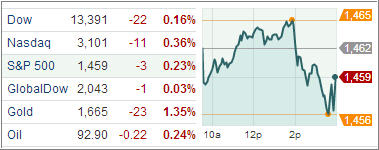
US equities closed mixed Friday, but posted weekly gains after initial euphoria over a significant drop in US unemployment rate faded, as a cloudy outlook on global economy gave way to caution ahead of the quarterly earnings season beginning next week.

The unemployment rate fell to 7.8 percent in September, dropping below the eight percent mark for the first time since President Obama took office in January 2009. Following the revised estimate of 142,000 job additions in August, the economy added 114,000 jobs in September, a Bureau of Labor Statistics report revealed. Also hourly earnings climbed 0.3 percent for the month.

Higher 1.3 percent on the week, the Dow Jones Industrial Average (DJIA) added 35 points to finish at 13,610. Within the 30-stock blue-chip index, winners outpaced laggards 20 to 10 as the Dow industrials hit its highest since December 2007.

Read More

10-05-2012

Ulli Newsletter Archives Contact

The ETF/No Load Fund Tracker—Monthly Review—September 30, 2012

US Markets Eye Jobs Data In The Final Quarter As Fed Stimulus Shows Signs Of Fading

US stocks traded lower in the final days of an otherwise blockbuster quarter, as markets stepped back to analyze some of the QE3 inspired gains.

The disappointing September Chicago PMI was the immediate trigger as the gauge slipped into the contradictory region of 49.7 from 53 in August. Weakness in the automobile sector and everything associated with it were blamed for the decline.

The month’s biggest event however, remained the Federal Reserve’s decision to widen its assets purchase program to boost the economy. On September 13, Chairman Bernanke announced plans to buy additional agency mortgage-backed securities at a pace of $40 billion per month, informally known as QE3, lifting the S&P by 1.6 percent.

The Fed is already running the ‘Operation Twist’ program where it buys $45 billion in longer term debts every month to bring down long-term borrowing costs.

Economic data remained mixed for the month. On the positive side, personal spending grew by 0.5 percent in August, meeting expectations. Weekly jobless claims also continued to slide with the initial reading falling by 26,000 to 359,000 in the final week, the lowest since July, indicating some much-needed improvement in the labor market. The housing sector continued to improve with existing home sales surging to a seasonally-adjusted annual rate of 4.82 million in August.

On the flip side, personal income rose by 0.1 percent in September, falling short of the projected 0.2 percent growth. Also, the University of Michigan’s consumer sentiment survey for September dropped to 78.3 from a preliminary estimate of 79.2. Elsewhere, durable goods order declined 13.2 percent in August while the final iteration of Q2 GDP growth came in lower at 1.3 percent.

The Dow Industrials added 2.7 percent in September and 4.3 percent for the quarter. The S&P 500 rose 2.4 percent for the month and 5.8 percent for the quarter while the tech-heavy NASDAQ Composite Index added 1.6 percent for the month and 6.2 percent for the quarter.

Our main directional guide, the Domestic Trend Tracking Index (TTI) inched higher from last month as the chart below shows:

Europe remained in the news with Spain stealing the spotlight for better part of the month, as it dragged its feet over formally seeking a bailout from its neighbors. Secessionist tendencies flared up with one of the most indebted region Catalonia demanding more control over revenues it generated while violent street protests against austerity measures erupted across the country. Even though the country’s unemployment rate remains above the 20 percent mark, it’s important to note the effects of austerity is yet take shape.

Stress-tests conducted across Spanish banks showed the country would require EUR 59.3 billion (if you can really believe these test results) to recapitalize its struggling lenders, bringing some relief to the markets. Madrid has already received commitments worth EUR 100 billion from the EU for strengthening the balance-sheets of its cajas, aimed at restoring investor confidence.

However, the relief proved fleeting as the government’s report was contested for being too liberal with Nomura Securities and JP Morgan putting the recapitalization estimates between EUR 94 billion and EUR 112 billion.

The pan-European Stoxx Europe 600 index rose an impressive 6.9 percent for the quarter. The French budget for 2013 received much attention after socialist President Francois Hollande raised the income tax rate to 75 percent for individuals earning over EUR 1 million annually. Paris hopes to mop up an additional EUR 30 billion in revenues through the new measures, which are doomed to fail considering that France’s economy is skating on thin ice.

I have mentioned it before in some of my daily blog posts but it bears repeating. The domestic equity market, as measured by the S&P 500, is totally out of sync with underlying economic fundamentals. The only reason that the index is at the current elevated level is because of the Fed’s various stimulation efforts. Even the NY Fed has admitted that the S&P 500 would be hovering at the 600 level (and not at 1,450) if it had not been for all of the QE programs of the past few years.

The latest QE-3 will do nothing for the economy and certainly not much to improve unemployment. It will, however, add to inflationary pressures long-term, which is why I added some exposure to gold (GLD) to our holdings during the month of September.

Given the uncertainty about the upcoming elections, the debt ceiling, Europe’s issues as well as the fiscal cliff, being alert to the fact that things can change in a hurry makes me very cautious when it comes to my investment outlook.

We have entered uncharted territory given the Fed’s policies, which means to me that our trailing sell stops are of vital importance at the very moment the daily “lift-a-thon” of the indexes comes to an end, and reality puts the bears in charge again. Nobody knows when this event will occur, but we are prepared to exit those positions affected by a sudden turnaround.

This is the time to be more concerned with the return of our capital then the return on our capital.

Weekly StatSheet For The ETF/No Load Fund Tracker Newsletter – Updated Through 10/04/2012

Ulli ETF StatSheet Contact

ETF/Mutual Fund Data updated through Thursday, October 4, 2012

If you are not familiar with some of the terminology used, please see the Glossary of Terms.


1. DOMESTIC EQUITY MUTUAL FUNDS/ETFs: BUY — since 10/25/2011

The domestic TTI broke through its long-term trend line generating a Sell for this area effective 8/9/2011. Over the recent past, we’ve seen the TTI hovering slightly below and above this dividing line between bullish and bearish territory. The clear break to the upside occurred on 10/24/11 and, effective 10/25/11, a new Buy signal for domestic equities went into effect.

As of today, our Trend Tracking Index (TTI—green line in above chart) has broken above its long term trend line (red) by +3.71%. A break back below it will generate a Sell signal to move out of all domestic equity positions. Be sure to tune into my blog for the latest updates.

Read More

Economic Report, ECB Spur Bank Rally; Europe Wobbles

Ulli Market Commentary Contact

[Chart courtesy of MarketWatch.com]

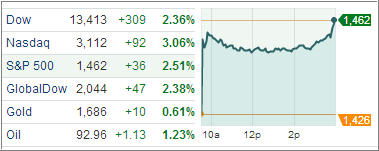
US stocks jumped Thursday with the Dow registering its third gain session in four after the latest jobless report beat estimates, and the US Fed said it allegedly can manage risks arising out of the latest round of balance sheet expansion.

Sentiment got a boost after a Labor Department report revealed initial unemployment benefits claims rose by 4,000 to 367,000 last, still lower than the psychological 400,000 mark and falling short of the projected 370,000. Factory orders also lent support with the August gauge slipping by 5.2 percent versus a projected 5.9 percent decline.

Earlier, the ECB President Mario Draghi stood by his previous pledge to save the euro and said it’s up to the region’s politicians now to seek help as needed.

Risk sentiment was buoyed after the latest FOMC minutes showed most of Chairman Bernanke’s colleagues thought risks could be managed since the central bank could make adjustments to its purchases in response to economic developments or changes in its assessment of the program’s efficacy or cost.

Read More

US Indexes Edge Higher On Data; Europe Ends Lower On Spain Jitters

Ulli Market Commentary Contact

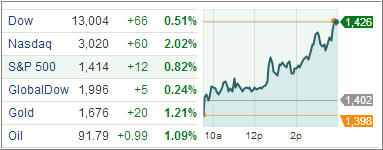
US indexes finished marginally higher Wednesday as improved services sector and payroll data lifted investor sentiments but the gains were pared after China’s official non-manufacturing PMI reading for August dropped to the lowest level since March 2011.

The Institute for Supply Management’s non-manufacturing index that covers nearly 90 percent of the economy rose to 55.1 in September from 53.7 in August, its highest reading since March.

The ADP Employer Services report, the frontrunner to the all-important non-farm payrolls data due later this week, showed US private sector created 162,000 jobs in September, beating forecasts made by most economists but lower than the prior month’s revised estimate of 189,000. However, in the past these ADP numbers have not been a reliable heads up indicator of Friday’s payroll report.

Read More