Uncertainty Reigns As Apple Weighs On NASDAQ; Europe Rises As Nokia Rallies

Ulli Market Commentary Contact

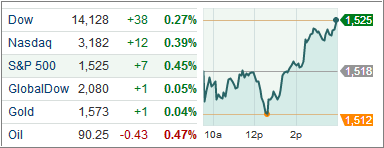
[Chart courtesy of MarketWatch.com]

US equities ended mostly higher Wednesday as Wall Street applauded comments from President Obama on the fiscal cliff, and investors lapped up upbeat corporate news, but Apple Inc dragged down the NASDAQ Composite.

On the economic front, the Institute for Supply Management reported a slightly faster pace of growth for the US services sector in November, and the Commerce Department said factory orders rose unexpectedly by 0.8 percent in October.

Separately, payroll processor ADP reported US private-sector employers added 118,000 jobs in November after a revised 157,000 gain in the prior month. Stocks got a leg up after a Labor Department report showed non-farm productivity rose by 2.9 percent in the third quarter, the fastest clip in two years.

Read More

7 ETF Model Portfolios You Can Use – Updated through 12/4/2012

Ulli Market Commentary Contact

With the looming fiscal cliff as the backdrop, the major indexes meandered and then pulled back with the S&P 500 managing to eke out a 0.6% gain since last week’s ETF Model Portfolio report.

There is no secret that nothing matters much other than the latest battle news from the fiscal cliff participants, as the fronts appear to harden almost daily and the true meaning of the word compromise has been, well, compromised.

As a result, our models did not show much movement, and I expect more of the same until some break in the negotiations occurs, which will either cause a relief rally or a return towards a possible trend line break to the downside.

Here’s the latest update to our ETF Model Portfolios:

Read More

12-05-2012

Ulli Newsletter Archives Contact


The ETF/No Load Fund Tracker—Monthly Review—November 30, 2012

Equity ETFs Finish November Mixed; Europe Heads Higher

US equity ETFs finished November modestly higher, but not before witnessing wild swings triggered by worries over the US fiscal cliff and developments in Europe. The tech-heavy NASDAQ and the smaller cap indices fared better than the large-cap S&P 500 and Dow Jones with the NASDAQ posting its first positive November since 2009.

The US economy continued to dish out mixed numbers. The November Chicago PMI reading, although coming in higher at 50.4 over the prior month’s 49.9, fell short of economists’ projections of 50.7.

Personal income remained unchanged in October and was well below the 0.2 percent increase analysts had predicted. As a result, personal spending data also remained weak, dropping by 0.2 percent versus the 0.1 percent uptick expected by economists.

The Dow Jones Industrial Average lost 0.5 percent for the month while the S&P 500 inched up a modest 0.3 percent.

The housing sector also sent out mixed signals. A report by the National Association of Realtors showed pending home sales jumped 5.2 percent in October, indicating significant improvement. New home sales however, declined 0.3 percent in October after clocking a 0.8 percent rise in the prior month. Analysts, nonetheless, believe the general trend indicates a slow but steady recovery.

With much economic uncertainty, and fallout from the elections, the major indexes tanked big time during the middle of the month but managed to recover before the selling got out of hand. Nevertheless, the downturn was sufficient in momentum to stop us out of our main equity holding, namely DVY, as it breached its long term trend line to the downside.

Additionally, it looked like a market breakdown was about to happen as our Domestic Trend Tracking Index (TTI) briefly dipped into negative territory before recovering. This dip was not a clear piercing of the trend line to the downside, so the all-out sell signal for equities was not generated. Here’s what the updated Domestic TTI looks like:

The red arrow points to the moment in time when the trend line was momentarily broken. The subsequent recovery was mainly attributed to hedge funds trying to engage in some month end window dressing as equities looked more attractive after the selloff.

Even though a report by the Commerce Department showed the US economy expanding at a faster annual clip of 2.7 percent in the third quarter, handily beating the initial 2 percent estimate, it may very likely get revised to the downside, which would more truly reflect the actual state of the alleged economic expansion.

Across the Atlantic, Paris losing its coveted AAA rating was one of the biggest developments for the month. The French downgrade by Moody’s impacted the region’s emergency bailout funds as well after the ratings agency cut both the European Stability Mechanism and the European Financial Stability Facility to Aa1 with negative outlook citing the high correlation in credit risk between the bailout funds and its largest supporters.

With the fiscal cliff looming large here in the US and Europe’s ever worsening debt issues not being addressed but merely sugar coated and actions being postponed, market volatility will be with us for a while. Depending on how the fiscal cliff saga plays out, I will seek exposure to equities again, very likely after the 1st of the year.

I can’t be absolutely sure yet, since we may have very well slipped to the bearish side of the Domestic TTI trend line by then. If markets should succumb to bearish forces, I will increase our bond exposure using BOND, which is PIMCO’s Total Return ETF. During 2012 it has given us enough back data for it to be considered investment material.

Actually, for the 9 months it’s been on the market, it has beaten its mutual fund cousin by a good margin, and I anticipate adding BOND to our holdings. My reasoning is that we are likely facing like a slow growth or muddle through scenario, which will benefit bonds and some dividend paying ETFs more than outright growth equities.

At least that’s what it looks like right now; should the major trends change, I will make adjustments accordingly.

US Indexes Ease As Fiscal Cliff Wrangling Continues; Europe Wobbles On Uncertainties

Ulli Market Commentary Contact

[Chart courtesy of MarketWatch.com]

US stocks turned lower, sending the major equity averages down for a second straight day, as Democrats stuck to their guns on raising taxes for the richest Americans and eurozone differences continued to fester over a new banking regulator in the single currency bloc.

In the latest round of US budget negotiations, the White House rejected a Republican offer for tackling the fiscal cliff that omitted higher tax rates for top earning Americans. President Obama had proposed $1.6 trillion in new taxes last week to bring down the budget deficit by $4 trillion over the next decade. Republicans made a counter offer Monday that included tax reforms and changes to Medicare and other spending cuts worth $2.2 trillion over the next decade.

The Dow Jones Industrial Average (DJIA) fell 14 points, extending losses into the second session. Breadth turned slightly negative with decliners outnumbering winners 16 to 14.  The S&P 500 Index (SPX) shed 2 points with telecommunications faring the worst and industrials fronting the gains among its 10 business groups.

Read More

More Fiscal Cliff Rhetoric With No Tangible Results; Weak Data Pulls Down Indexes

Ulli Market Commentary Contact

[Chart courtesy of MarketWatch.com]

US equities finished lower as politicians in Washington restarted the rhetoric on how to manage the nation’s fiscal policy, and a measure of factory output showed unexpected contraction in November.

The Institute for Supply Management’s index of manufacturing activity dropped to 49.5 in November from 51.7 a month earlier, signaling contraction for the first time since July 2009. Economists polled by Bloomberg had expected a reading of 51.4 and attributed the decline to concerns about the so-called fiscal cliff rather than disruptions due to Superstorm Sandy. The fiscal concerns are affecting business decision making as companies put spending and hiring decisions on hold

US equity indexes have signaled cautious optimism over the past two weeks and with less than 29 days left to the edge of the fiscal cliff before billions of dollars in automatic spending cuts and tax hikes come into effect, house Republican leaders unveiled a counter offer to break the negotiations stalemate. According to House Speaker John Boehner, the new proposal takes a middle ground approach and counts $800 billion in new revenue through tax reforms.

Read More

ETFs/Mutual Funds On The Cutline – Updated Through 11/30/2012

Ulli ETFs on the Cutline Contact

Below are the latest ETF Cutline reports, which show how far above or below their respective long-term trend lines (39 week SMA) my currently tracked ETFs/MFs are positioned.

The first report covers the ETF Master List from Thursday’s StatSheet and includes 398 ETFs, of which currently 332 (last week 308) of them are hovering in bullish territory.

The second report includes only High Volume ETFs. To clarify, High Volume (HV) ETFs are defined as those with an average daily volume of $10 million or higher.

These ETFs are generated from my selected list of some 93 that I use in my advisor practice. It cuts out the “noise,” which simply means it eliminates those ETFs that I would never buy because of their volume limitations. 73 ETFs (last week 72) have managed to remain in bullish territory after the recent market volatility.

The third report covers Mutual Funds on the Cutline. There are currently 701 (last week 217) above the line and 158 below it out of the 861 that I follow.

Take a look:

1. ETF Master Cutline Report

2. ETF High Volume Cutline Report

3. MF Cutline Report

In case you are not familiar with some of the terminology used in the reports, please read the Glossary of Terms.