ETFs/Mutual Funds On The Cutline – Updated Through 4/26/2013

Ulli ETFs on the Cutline Contact

Below are the latest ETF Cutline reports, which show how far above or below their respective long-term trend lines (39 week SMA) my currently tracked ETFs/MFs are positioned.

The first report covers the ETF Master List from Thursday’s StatSheet and includes 398 ETFs, of which currently 343 (last week 322) of them are hovering in bullish territory.

The second report includes only High Volume ETFs. To clarify, High Volume (HV) ETFs are defined as those with an average daily volume of $10 million or higher.

These ETFs are generated from my selected list of some 93 that I use in my advisor practice. It cuts out the “noise,” which simply means it eliminates those ETFs that I would never buy because of their volume limitations. 67 ETFs (last week 62) have managed to remain in bullish territory after the recent market volatility.

The third report covers Mutual Funds on the Cutline. There are currently 809 (last week 772) above the line and 50 below it out of the 859 that I follow.

Take a look:

1. ETF Master Cutline Report

2. ETF High Volume Cutline Report

3. MF Cutline Report

In case you are not familiar with some of the terminology used in the reports, please read the Glossary of Terms.

Last Week In Review: ETF News And Blog Posts To 4/28/2013

Ulli Market Review Contact

In case you missed it, here’s a summary of the ETF topics and market reviews I posted to my blog during the week ending on 4/28/2013.

The prior week’s damage was almost made up during the past five trading days as the indexes found upward momentum again with the S&P 500 adding some 1.7%.

The hunt to break the S&P’s 1,600 milestone marker is still on, and it remains to be seen if that level still can be broken during the month of April even though there are only two trading days left. Once we slip into May, the prevailing attitude for many investors could be “sell in May and go away.”

Personally, I prefer to stay away from such guesswork since you can never be sure if the widely anticipated downward move will materialize. As I have posted ad nauseum, I will stay with the trend and let the trailing sell stops be my guide as to when to exit.

Over past week, we covered the following:

Read More

One Man’s Opinion: Why Has The US Economic Recovery Been So Choppy?

Ulli Market Commentary Contact

92835431The latest inflation number has been quite low at an annual pace of 1.2 percent, but it’s a lagging indicator and will probably keep the Fed on hold for longer, meaning bond proxies and income orientation that has worked well thus far will continue to do so in future, said David Rosenberg, chief economist and strategist at Gluskin Sheff & Associates.

The Fed will probably continue with very low interest rates at least over the course of the next several months, but the reality is that the economy remains very soft considering everything that we have going for us, he noted. Suddenly, all the expectations for a three percent plus growth become 2 ½ percent. It’s fascinating to observe that if China grows three-tenths below consensus at 7.7 percent, headlines scream its economy is falling apart. But if the US misses the target by half-a-point, (people say) “don’t worry, we’re still expanding,” David quipped.

Read More

New ETFs On The Block: ishares Defined Maturity Corporate Bond ETFs

Ulli Bond ETFs Contact

139868600iShares, the world’s largest manager of exchanged traded funds and a business arm of New York-based BlackRock Inc, recently launched four iShareBonds Corporate ex-Financials Term ETFs. The new products are designed to offer you bond-like features such as a range of defined maturities while offering the benefits of ETF diversification and liquidity.

The ETFs provide you access to a diversified pool of non-financial, investment-grade and US dollar denominated corporate credit from both US and non-US issuers with at least in $250 million in outstanding face value and maturing in 2016, 2018, 2020 and 2023, respectively.

You may find the strategy interesting as are institutional clients, particularly commercial banks and private investors who are building a portfolio for retirement. The ETFs track the Barclays US Corporate Index with maturity dates between 2016 and 2023. I have highlighted the features of the funds below.

Read More

04-26-2013

Ulli Newsletter Archives Contact

ETF/No Load Fund Tracker Newsletter For Friday, April 26, 2013

ETF/No Load Fund Tracker StatSheet

————————————————————-

THE LINK TO OUR CURRENT ETF/MUTUAL FUND STATSHEET IS:

https://theetfbully.com/2013/04/weekly-statsheet-for-the-etfno-load-fund-tracker-newsletter-updated-through-04252013/

————————————————————

Market Commentary

Friday, April 26, 2013

UNINSPIRING GDP GROWTH DRAGS DOWN THE BULL

The major averages entered the weekend on a mixed note following a lackluster result on 1Q US GDP growth and a slew of below average earnings releases. The Standard & Poor’s 500 Index ended its winning streak today slipped 3 points (0.2%) to 1,582. The Nasdaq Composite dropped 11 points (0.3%) to 3,279. The Dow Jones Industrial Average in the other hand closed higher by 13 points at 14,713 thanks to Chevron and Boeing. Volume dropped off sharply on both major exchanges in the stock market today compared to Thursday’s pace.

Real GDP rose at a 2.5% annual rate in Q1, below the consensus estimate of 3.2%. The increase was driven by strong personal consumption expenditures (PCE) and inventory rebuilding, but was weighed down by negative net exports, reduced government spending, and a sharp deceleration in nonresidential fixed investment. Housing construction continues to strengthen and is expected to continue to contribute to GDP growth in the coming quarters.

Imports rebounded at a 5.4% annual rate, the most since Q3 2010, while exports rose 2.9%. As a result, net trade subtracted 0.50 percentage points from growth. The government sector fell at a 4.1% annual rate, subtracting 0.80 percentage points from growth. With the sequester taking impact in March, the drag is expected to increase going forward.

Additionally, according to Bloomberg, the gain in consumer spending is viewed as unsustainable, as disposable income adjusted for inflation fell at a 5.3% annualized rate in Q1. With consumer spending accounting for roughly 70% of GDP, this figure really raises concerns. Following the GDP release, treasuries appreciated despite the upward revision to domestic consumer sentiment.

In earnings news, Amazon.com and Dow member Chevron Corp posted mixed 1Q results and Starbucks matched analysts’ expectations, while the housing recovery lifted profits at homebuilder D.R. Horton.

Of the 271 companies in the S&P 500 that have reported earnings to date for the first quarter, 69 percent have beaten sharply reduced analyst expectations – above the 63 percent average since 1994 and slightly over the 67 percent beat rate over the past four quarters.

For the week, the Dow gained 1.1 percent, the S&P 500 added 1.7 percent and the Nasdaq rose 2.3 percent. Another week with mixed economic results – disappointing existing homes sales were met with stronger-than-expected new home sales, jobless claims fell more than expected while durable goods orders missed forecasts.

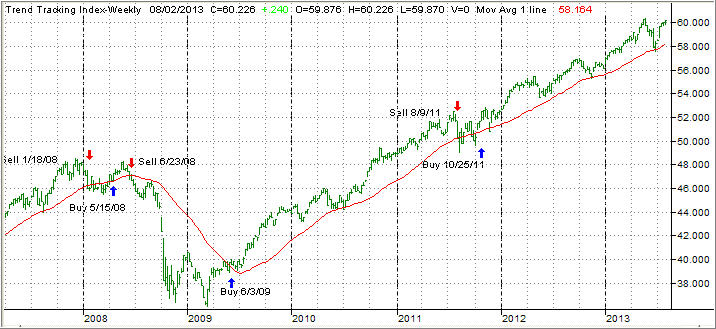
However, stocks managed to end higher thanks to the never ending fact that bad news is good news, as it assures continued money printing by the Fed even as fiscal policy continues to weigh on businesses. Economic growth in Q2 is expected to suffer due to fiscal tightening, before hopefully regaining traction later this year. How will the market be affected? Since we don’t know how things will play out, we will follow the major trends as represented by my Trend Tracking Indexes (TTIs).

Both rallied sharply this week, which means the bull is alive and well.

Here’s how we closed these out the last five trading days:

Domestic TTI: +3.52% (last week +2.80%)

International TTI: +7.35% (last week +5.54%)

Have a great week.

Ulli…

————————————————————-

READER Q & A FOR THE WEEK

All Reader Q & A’s are listed at our web site!
Check it out at:

http://www.successful-investment.com/q&a.php

A note from reader Ed:

Q: Ulli: What are your thoughts on the PRPFX Fund with gold having dropped so fast??

A: Ed: I don’t own it, since it is hovering below its long-term trend line. There are far better opportunities in low volatility ETFs.

———————————————————-

WOULD YOU LIKE TO HAVE YOUR INVESTMENTS PROFESSIONALLY MANAGED?

Do you have the time to follow our investment plans yourself? If you are a busy professional who would like to have his portfolio managed using our methodology, please contact me directly or get more details at:

https://theetfbully.com/personal-investment-management/

———————————————————

Back issues of the ETF/No Load Fund Tracker are available on the web at:

https://theetfbully.com/newsletter-archives/

ETF/No Load Fund Tracker Newsletter For Friday, April 26, 2013

Ulli ETF Tracker Contact

ETF/No Load Fund Tracker StatSheet

————————————————————-

THE LINK TO OUR CURRENT ETF/MUTUAL FUND STATSHEET IS:

https://theetfbully.com/2013/04/weekly-statsheet-for-the-etfno-load-fund-tracker-newsletter-updated-through-04252013/

————————————————————

Market Commentary

Friday, April 26, 2013

UNINSPIRING GDP GROWTH DRAGS DOWN THE BULL

The major averages entered the weekend on a mixed note following a lackluster result on 1Q US GDP growth and a slew of below average earnings releases. The Standard & Poor’s 500 Index ended its winning streak today slipped 3 points (0.2%) to 1,582. The Nasdaq Composite dropped 11 points (0.3%) to 3,279. The Dow Jones Industrial Average in the other hand closed higher by 13 points at 14,713 thanks to Chevron and Boeing. Volume dropped off sharply on both major exchanges in the stock market today compared to Thursday’s pace.

Real GDP rose at a 2.5% annual rate in Q1, below the consensus estimate of 3.2%. The increase was driven by strong personal consumption expenditures (PCE) and inventory rebuilding, but was weighed down by negative net exports, reduced government spending, and a sharp deceleration in nonresidential fixed investment. Housing construction continues to strengthen and is expected to continue to contribute to GDP growth in the coming quarters.

Imports rebounded at a 5.4% annual rate, the most since Q3 2010, while exports rose 2.9%. As a result, net trade subtracted 0.50 percentage points from growth. The government sector fell at a 4.1% annual rate, subtracting 0.80 percentage points from growth. With the sequester taking impact in March, the drag is expected to increase going forward.

Read More