New ETFs On The Block: Egshares Emerging Markets Dividend Growth ETF (EMDG)

Ulli Dividend ETFs Contact

146026450Emerging Global Advisors, the NY-based specialist ETF issuer known for its suite of emerging markets funds, has announced the launch of the EGShares Emerging Markets Dividend Growth ETF (EMDG), the second dividend fund after the EGShares Low Volatility Emerging Markets Dividend ETF (HILO).  The ETF, unveiled on Monday and listed on the NYSE Arca, gives investors exposure to developing market companies that are maturing and focusing more on raising dividends.

EMDG comes at a time when investors are casting their nets wider in search of yields and are willing to diversify their dividend yield sources. The ETF tracks the FTSE Emerging All Cap Ex-Taiwan Diversified Capped Dividend Growth 50 Index, a benchmark co-designed by Emerging Global Advisors and FTSE that represents the performance of 50 emerging market companies that have consistently demonstrated the ability to grow dividends over the past five years. Additionally, the companies are subjected to a series of screens to ensure future dividend sustainability.

To be included in the underlying benchmark – which is a free-float market capitalization weighted index, a company must first be a component of the FTSE Emerging All Cap Ex-Taiwan Universe. It must also have a compound annual dividend growth rate of six percent over the past five years. Constituent companies can be small -, medium -, and large-capitalized with each individual holding quarterly capped at 2.5 percent.

Read More

07-05-2013

Ulli Newsletter Archives Contact

ETF/No Load Fund Tracker Newsletter For Friday, July 5, 2013

ETF/No Load Fund Tracker StatSheet

————————————————————-

THE LINK TO OUR CURRENT ETF/MUTUAL FUND STATSHEET IS:

https://theetfbully.com/2013/07/weekly-statsheet-for-the-etfno-load-fund-tracker-newsletter-updated-through-07032013/?preview=true

————————————————————

Market Commentary

Friday, July 5, 2013

JOB DATA CHEERS BULLS—BOND ETFS TANK AS INTEREST RATES SPIKE

After a holiday break yesterday, the major U.S. averages entered the weekend on a positive note. After choppy trading through much of Friday, which was marked by light volume, stocks rose sharply in late afternoon amid an allegedly strengthening labor market. The Dow Jones Industrial Average closed 147 points higher (1.0%) at 15,136. The S&P 500 Index increased 16 points (1.0%), the biggest rally in three weeks, to close above its 50-day moving average at 1,632. The Nasdaq Composite gained 36 points (1.0%) at 3,479.

The markets responded positive to robust jobs data that pointed to economic growth as investors overcame concerns that the Fed may begin scaling back its stimulus efforts as soon as September.

The much anticipated June’s employment report showed broad-based progress in labor market conditions. Nonfarm payrolls increased by 195,000, above the consensus of 160,000. Private nonfarm payrolls rose 202,000, and have increased 6.7% from the cyclical trough in February 2010. Private sector payrolls increased by 202,000 in June, versus the forecast of a gain of 175,000.

On the extremely negative side, the number of people working part-time for economic reasons jumped by 322,000. There were also increases in the number of marginally attached and discouraged workers. The unemployment rate remained at 7.6%, compared to the decline to 7.5% that economists had expected.

After the job release, treasuries sold off aggressively and spent the remainder of the session on their lows. The benchmark 10-yr yield jumped 22 basis points to end at 2.72%, its highest level since August 2011. Today’s jobs report also gave a notable boost to the dollar, sending the Dollar Index to a three-year high amid all-around greenback strength. What about stocks?

The financial sector settled higher by 1.8% after spending the entire session atop the leader board. Industrials registered a strong gain (1.5%) as transportation-related names drove the sector higher. Health care sector (+1.3%) also finished among the leaders as biotech companies outperformed.

On the flip side, the jump in yields contributed to weakness in the utilities sector, which ended lower by 0.5% after spending the entire day in negative territory. Two other rate-sensitive groups, consumer staples (+0.2%) and telecom services (+0.5%) spent some time in the red, but rallied into the close. Energy sectors rallied throughout the day amid ongoing clashes in Egypt.

For the holiday-shortened week, stocks climbed amid weak volume. The Dow rose 1.5 percent; the S&P 500 was up 1.6 percent and the Nasdaq composite advanced 2.2 percent. The markets have recovered nicely since the correction which started few weeks ago.

The economy is supposed to be back on track for growth as the Fed will likely to slow down its stimulus. Personally, I don’t see that happen yet as fundamentals are far from the point at which the economy could generate sustainable organic growth (growth without any stimulus).

Our Trend Tracking Indexes (TTIs) closed the week as as follows:

Domestic TTI: +1.24% (last week +0.84%)

International TTI: +3.70% (last week +2.88%)

My latest e-book “How to beat the S&P 500…with the S&P 500” has now been uploaded, and you can download your free copy here.

Have a great week.

Ulli…

————————————————————-

READER Q & A FOR THE WEEK

All Reader Q & A’s are listed at our web site!
Check it out at:

http://www.successful-investment.com/q&a.php

A note from reader Maghar:

Q: Ulli:  Your recent comment that normally conservative securities have shown twice the volatility, like SPLV was down about 8% compared to SPY about 4. I wonder how that could happen?

A: Maghar: We are having a totally distorted and manipulated market environment and risk on and risk off tendencies switch at a moment’s notice so that alleged less volatile ETFs all of a sudden can get very volatile.

———————————————————-

WOULD YOU LIKE TO HAVE YOUR INVESTMENTS PROFESSIONALLY MANAGED?

Do you have the time to follow our investment plans yourself? If you are a busy professional who would like to have his portfolio managed using our methodology, please contact me directly or get more details at:

https://theetfbully.com/personal-investment-management/

———————————————————

Back issues of the ETF/No Load Fund Tracker are available on the web at:

https://theetfbully.com/newsletter-archives/

ETF/No Load Fund Tracker Newsletter For Friday, July 5, 2013

Ulli ETF Tracker Contact

ETF/No Load Fund Tracker StatSheet

————————————————————-

THE LINK TO OUR CURRENT ETF/MUTUAL FUND STATSHEET IS:

https://theetfbully.com/2013/07/weekly-statsheet-for-the-etfno-load-fund-tracker-newsletter-updated-through-07032013/?preview=true

————————————————————

Market Commentary

Friday, July 5, 2013

JOB DATA CHEERS BULLS—BOND ETFS TANK AS INTEREST RATES SPIKE

After a holiday break yesterday, the major U.S. averages entered the weekend on a positive note. After choppy trading through much of Friday, which was marked by light volume, stocks rose sharply in late afternoon amid an allegedly strengthening labor market. The Dow Jones Industrial Average closed 147 points higher (1.0%) at 15,136. The S&P 500 Index increased 16 points (1.0%), the biggest rally in three weeks, to close above its 50-day moving average at 1,632. The Nasdaq Composite gained 36 points (1.0%) at 3,479.

The markets responded positive to robust jobs data that pointed to economic growth as investors overcame concerns that the Fed may begin scaling back its stimulus efforts as soon as September.

The much anticipated June’s employment report showed broad-based progress in labor market conditions. Nonfarm payrolls increased by 195,000, above the consensus of 160,000. Private nonfarm payrolls rose 202,000, and have increased 6.7% from the cyclical trough in February 2010. Private sector payrolls increased by 202,000 in June, versus the forecast of a gain of 175,000.

On the extremely negative side, the number of people working part-time for economic reasons jumped by 322,000. There were also increases in the number of marginally attached and discouraged workers. The unemployment rate remained at 7.6%, compared to the decline to 7.5% that economists had expected.

After the job release, treasuries sold off aggressively and spent the remainder of the session on their lows. The benchmark 10-yr yield jumped 22 basis points to end at 2.72%, its highest level since August 2011. Today’s jobs report also gave a notable boost to the dollar, sending the Dollar Index to a three-year high amid all-around greenback strength. What about stocks?

Read More

07-05-2013

Ulli Newsletter Archives Contact

Buy-Sell CyclesThe ETF/No Load Fund Tracker

Monthly Review—June 30, 2013

Fed Taper-Talk Weighs On US Equities In June; Europe Slips On Growth Concerns

US stocks finished June with losses, but managed to post gains for the quarter as investors started to scrutinize stock prices in an environment where a dialing back of asset purchases by the Federal Reserve by the end of the year was being seriously debated.

The latest FOMC statement and subsequent comments from Ben Bernanke sent equities and Treasuries to their lows while boosting the dollar in the latter half of the month. Chairman Bernanke said the Fed could reduce the pace of asset purchases later this year and stop expanding the central bank’s balance sheet entirely by the middle of next year if conditions continued to improve.

The Dow Jones Industrial Average (DJIA) finished June at 14,909.60, down 1.5 percent for the month, but up 2.3 percent for the quarter.

The Dow added 13.8 percent in the first six months of the year, marking its best first half of a year performance since 1999.

The S&P 500 (SPX) ended June 1.5 percent lower at 1,606.28, but picked up 2.4 percent for the quarter.

The tech-heavy NASDAQ Composite index (COMP) closed June at 3403.25, down 1.5 percent for the month, but higher 4.2 percent for the quarter.

Economic news from the US continued to be mixed in June though investor sentiment seems to be very much linked to the perceived longevity of the Fed’s monetary stimulus program, as a downward revision of the first-quarter gross domestic product triggered a rally in the equity markets. This is also known as bad news is good news. The final iteration of first-quarter GDP was revised down to 1.8 percent from 2.4 percent with services-spending contributing the most in the unusual decline.

Consumer opinion held its ground with the June consumer sentiment index final reading coming in at 84.1, beating forecasts for 83, but slightly down from May’s reading of 84.5.

Also, data released by Automatic Data Processing Inc showed US employers added 188,000 private jobs in June, beating street-estimates. First-time jobless claims came in better than expected, dipping by 5,000 to 343,000 in the final week of June, the Labor Department said.

Investor sentiment got a further boost after a report showed pending home sales for May rose 6.7 percent, beating economists projection for a 1.5 percent increase.

On the flip side, the US trade deficit jumped 12.1 percent in May to $45.0 billion as imports rose and exported inched lower, a Commerce Department report revealed.

Also, the services sector growth slowed down in June with the non-manufacturing gauge slipping to 52.2 percent from 53.7 percent in May. Readings above 50 percent signal expansion with higher rates indicating faster growth. Economists had forecast a reading of 54.2 percent.

The International Monetary Fund lowered US growth forecast to 2.7 percent from 3 percent in 2014. The Fed must carry on large-scale assets purchase at least until the year-end to sustain growth, it added.

Across the Atlantic, European stocks finished the month and the quarter down, dragged lower by concerns over US interest-rate policy and growth in emerging markets even as European economies showed some signs of improvement.

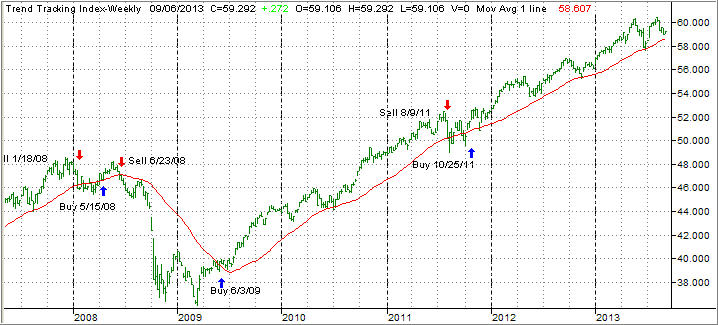
In regards to long-term trends, things started to look a little shaky after the Fed’s tapering announcement. Our main directional gauge, the Domestic Trend Tracking Index (TTI), headed south and briefly dipped into bear market territory on June 24th. The ensuing rally prevented us from executing the sell signal. Here’s what the Domestic TTI looks like with the red arrow pointing to the dip below the trend line:

TTI-NL

While that sell signal was temporarily avoided, weakness in other areas persisted and several sell stops were triggered.  The Vanguard REIT Index (VNQ) headed sharply south early on in June and was sold.

Our holdings in the low volatility index (SPLV) followed suit and was liquidated as well. Two things were unusual during the June sell off:

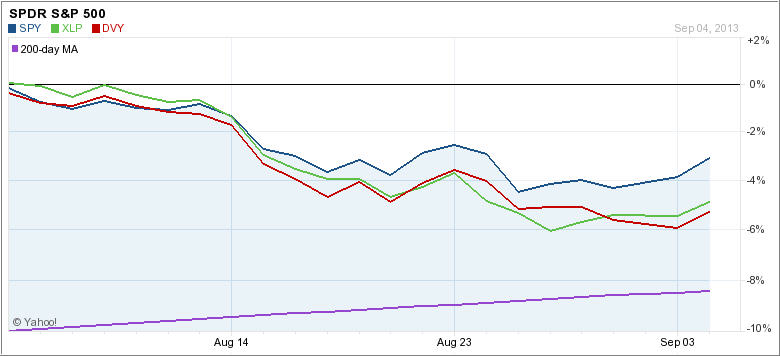
1. Low volatility ETFs, such as XLP and SPLV, behaved like high volatility funds, and fluctuated with greater magnitude than the benchmark S&P 500 index.

2. The benefit of a diversified portfolio into equities and bonds did not hold up as bonds declined right along with equities, a result of rising interest rates, which pushed mortgage rates up by an incredible 1.5% within a couple of weeks.

In the end, the place to be was 100% in equities as they held up better due to support by Fed policy. We also ended up liquidating the PIMCO Income Fund (PONDX) as it not only triggered its trailing sell stop but also pierced its respective trend line to the downside.

This leaves us with an invested position of about 50% which, given the accelerating uncertainties, is not a bad place. Some of our holdings are within 2.5% of triggering their respective sell stops, so it won’t take much of a downturn to get us out of the market.

Earnings season is upon us, and the ever lengthening menu of various hot spots around the world could very easily put the bears in charge. I will execute our stops when necessary to protect our portfolios from undue downside risk.

Weekly StatSheet For The ETF/No Load Fund Tracker Newsletter – Updated Through 07/03/2013

Ulli ETF StatSheet Contact

ETF/Mutual Fund Data updated through Wednesday, July 3, 2013

Table of Content082312

If you are not familiar with some of the terminology used, please see the Glossary of Terms.


1. DOMESTIC EQUITY MUTUAL FUNDS/ETFs: BUY — since 10/25/2011

TTI

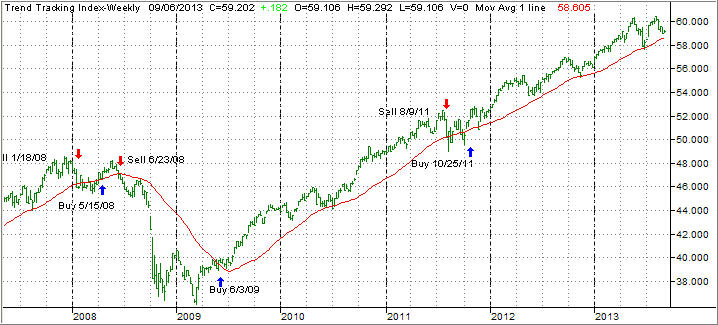
The Domestic TTI broke through its long-term trend line generating a Sell for this area effective 8/9/2011. Over the recent past, we’ve seen the TTI hovering slightly below and above this dividing line between bullish and bearish territory. The clear break to the upside occurred on 10/24/11 and, effective 10/25/11, a new Buy signal for domestic equities went into effect.

As of today, our Trend Tracking Index (TTI—green line in above chart) has bounced off its long term trend line (red) by +1.38% after briefly dipping below it late in June.

To avoid a potential whip-saw, a Sell signal to move out of all domestic equity positions will be generated once we have clearly pierced the line to the downside. Be sure to tune in for the latest updates.

Read More

Bulls Remain In Charge Despite International Turmoil

Ulli Market Commentary Contact

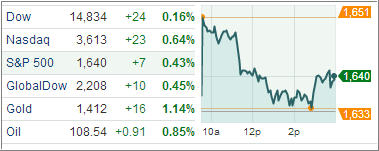
WEd pic

[Chart courtesy of MarketWatch.com]

The major U.S. equity averages finished the shortened trading session due to tomorrow’s Independence Day to the upside. The U.S. stock market closed at 1 p.m. today. It will reopen on Friday for a full session.

Wednesday was a volatile day as traders squared positions before the holiday and Friday’s job market data. Stocks began on a lower note as global events such as political unrest in Egypt and Portugal and disappointing economic data out of China and the Eurozone injected a degree of uncertainty into the market.

Equities fought back from opening losses with technology pacing the advance. The sector ended with a gain of 0.6% as large components like Apple and Oracle provided notable support. The discretionary sector also outperformed the broader market, and homebuilders displayed broad strength. On the downside, the renewed sovereign debt concerns pressured the financial sector, which ended lower by 0.4% after spending the entire session in the red.

Political events around the world are having impacts on global economies and the equity markets. In Egypt, military ousted President Mohamed Mursi from power after he failed to answer the demands of protesting crowds within the timeframe specified by the country’s armed forces.  The constitution was also suspended. The military announced an early presidential election in a bid to resolve the political crisis that has polarized the nation. And that is not all.

Read More