7 ETF Model Portfolios You Can Use – Updated through 9/24/2013

Ulli Model ETF Portfolios Contact

After making new highs last week, following the Fed’s surprising “non-taper” announcement, the major indexes slipped with the S&P 500 dropping slightly below its 1,700 level and giving back some 0.5% since last week’s Model portfolio report.

It’s amazing to me that the Fed blinked after the markets had for weeks priced in a modest amount of taper, probably in the area of $10 billion per month, which may not have pulled the indexes off their lofty levels as expectations simply would have been met.

Not tapering at all has caused confusion in the markets and simply constitutes an admission by the Fed that the economy is in far worse shape as had been assumed. With several years of Quantitative Easing (QE) now in the rear view mirror, and trillions of dollars spent, it has become clear that nothing has been accomplished in regards to organic economic growth. Makes me wonder whether the Fed will ever be able to stop their endless QE efforts…

Most likely, at some point in the future the market will force the hand.

In the meantime, here’s the latest ETF Model Portfolio update:
Read More

Congress Battles Heat Up; Turning Stocks Red

Ulli Market Commentary Contact

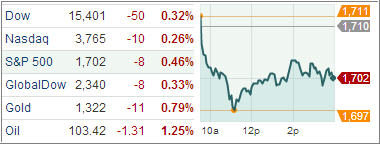
Tue chart

[Chart courtesy of MarketWatch.com]

U.S. equities concluded a lackluster day of trading hovering near the flatline during the final hour of the session, before ultimately ended lower, extending their recent slide to a fourth session as worries over a possible U.S. government shutdown added to investor caution.

The market’s recent losses mark the longest losing streak since last month for the S&P 500, which has been down every session since rallying 1.2 percent last Wednesday on the Fed announcement. Meanwhile, Treasuries were mostly higher, despite a report that showed housing prices gained ground again in July, while separate releases for September showed consumer sentiment declined more than expected.

Though uncertainty remains over the Federal Reserve’s intentions to scale back its stimulus since the central bank’s decision last week to leave its current program unchanged, some of the focus for now has turned to Capitol Hill. Stocks slipped during the opening hour in reaction to a below-consensus consumer confidence report for September. Gains in the stock market were unable to thwart pessimism in the labor market as the September Consumer Confidence Index fell to 79.7 from an upwardly revised 81.8 (from 81.4) in August. Economists expected the Index to drop to 80.0. Despite the opening slip, the S&P recovered swiftly, but was unable to hold the 1,700 level into the close as financials and technology weighed.

Read More

Confusion Continues Thanks To Fed And Congress

Ulli Market Commentary Contact

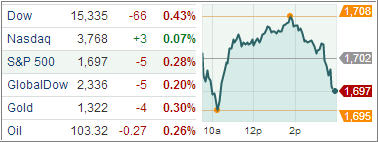
Mon pic

[Chart courtesy of MarketWatch.com]

U.S. equity indexes declined for a third straight session today amid the continued uncertainty surrounding the Federal Reserve’s timing over tapering and the U.S. fiscal fight brewing in Washington.

Meanwhile, treasuries ended higher following a preliminary report that showed growth in U.S. manufacturing activity unexpectedly decelerated. Technology stocks, however, found some support from Apple’s announcement of its weekend-record-sales of the new iPhones, while Blackberry Limited entered into a letter of intent agreement with a consortium lead by Fairfax Financial Holdings Limited to acquire the smartphone maker in a transaction worth roughly $4.7 billion.

The preliminary Markit US Manufacturing PMI Index declined to 52.8 in September, from 53.1 in August, compared to the improvement to 54.0 that economists had expected. The report showed although output grew at a faster rate, expansion in new orders slowed, while new export orders fell back below 50 and inventories remained in contraction territory. This was the second-straight monthly decline, but a reading above 50 denotes expansion in manufacturing activity, the economy is showing signs of alleged stealthy acceleration.

Read More

ETFs/Mutual Funds On The Cutline – Updated Through 9/20/2013

Ulli ETFs on the Cutline Contact

Below are the latest ETF Cutline reports, which show how far above or below their respective long-term trend lines (39 week SMA) my currently tracked ETFs/MFs are positioned.

The first report covers the ETF Master List from Thursday’s StatSheet and includes 398 ETFs, of which currently 322 (last week 310) are hovering in bullish territory.

The second report includes only High Volume ETFs. To clarify, High Volume (HV) ETFs are defined as those with an average daily volume of $10 million or higher.

These ETFs are generated from my selected list of some 93 that I use in my advisor practice. It cuts out the “noise,” which simply means it eliminates those ETFs that I would never buy because of their volume limitations. 67 ETFs (last week 63) have managed to remain in bullish territory after the recent market volatility.

The third report covers Mutual Funds on the Cutline. There are currently 800 (last week 784) above the line and 59 below it out of the 859 that I follow.

Take a look:

1. ETF Master Cutline Report   

2. ETF High Volume Cutline Report

3. MF Cutline Report

In case you are not familiar with some of the terminology used in the reports, please read the Glossary of Terms.

If you missed the original post about the Cutline approach, you can read it here.

One Man’s Opinion: Has The US Fed Lost Control Over The Bond Market?

Ulli Market Review Contact

92835431Marc Faber, author of the Gloom, Boom & Doom report expected the Federal Reserve to reduce its monthly bond purchase program by $10-$15 billion, but says he’s not surprised Ben Bernanke didn’t bite the bullet.

The people at the Fed are academics with little understanding what’s happening on the ground. What they fail to understand is that printing money benefits only a miniscule proportion of the population. Equities and commodities reacted positively to the Fed’s announcement with prices of crude, silver and gold surging. However, the downside far outweighs the benefits as only 11 percent of Americans directly own equities and don’t benefit from an increase in asset prices, Mark argued.

When told low interest rates benefit mortgage and car buyers, Marc said the bond markets had peaked out and interest rates hit the bottom on July 25, 2012, well ahead of the QE3 announcement made by the Fed on Sep 14, 2012. Ten-year Treasury note yields had tumbled to 1.43 percent and Bernanke had said in a press conference the objective of the Fed is to keep interest rates low; yields have doubled since then, meaning markets were ready for taper, but Bernanke failed to pull the trigger, he quipped.

Read More

New ETFs On The Block: ETRACS Diversified High Income ETN (DVHI)

Ulli Income ETFs Contact

146026450ETRACS, the ETF issuing arm of Swiss banking giant UBS, has unveiled an exchange-traded note that seeks to provide high income through a diversified basket of equities and fixed income. Since the Federal Reserve has decided to continue the current pace of assets purchases, yields are likely to remain weak till the labor market improves and inflation remains benign.

If you are seeking higher yield, you may consider the latest UBS product since it offers a new way to target high-yield securities from across the globe, potentially providing a new perspective on income-focused products.

Multi-asset income funds have gained wide acceptance in the past year-and-a-half with the Guggenheim Multi-Asset Income ETF (CVY) leading the pack with assets of about $750 million under management. Nevertheless, UBS is the first sponsor to unveil a product in an ETN package and may appeal to investors who wish to avoid capital losses with the slow normalization of interest rates in the US.

Read More