Chinese Stocks Enter Bear Market Territory; Domestic TTI Follows Suit; Is The S&P 500 Next?

Ulli Market Commentary Contact

Mon pic

[Chart courtesy of MarketWatch.com]

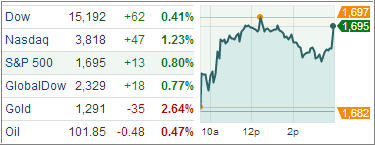
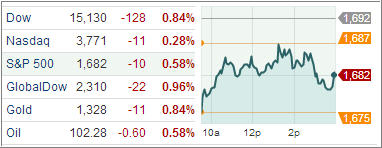
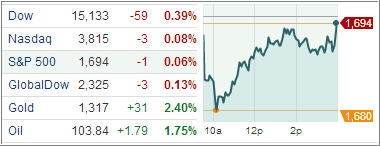
Equity and bond index ETFs were battered and beaten on Monday, sending the Standard & Poor’s 500 Index to a nine-week low and adding to last week’s move downward. The focal points on those fronts were the 10-yr note yield, which spiked to 2.66% in early action, and the uncertainty surrounding what impact the Federal Reserve’s potential tapering will have on the economy was exacerbated by festering liquidity fears in China.

The Dow Jones Industrial Average dropped more than 240 points (or 2%) in early trading, fought back to a loss of nearly 60 points by midday, before tripping up and finishing down 139 points (0.9%). The Standard & Poor’s Index 500 lost 19 points (1.2%) to 1,573, while the Nasdaq Composite declined 36 points (1.1%) to 3,321.

The initial plunge in U.S. markets appeared to be precipitated by China. Chinese equities entered a bear market as the CSI 300 Index of China’s biggest companies tumbled 6.3 percent, the most since August 2009 as depicted by a 20% pullback from recent highs, as banking stocks in China came under heavy pressure. The People’s Bank of China was behind this sell-off but refused to inject liquidity into its banking system. It issued a statement today saying lenders should not expect it to help stem a perceived credit crunch.

Read More

ETFs/Mutual Funds On The Cutline – Updated Through 6/21/2013

Ulli ETFs on the Cutline Contact

Below are the latest ETF Cutline reports, which show how far above or below their respective long-term trend lines (39 week SMA) my currently tracked ETFs/MFs are positioned.

The first report covers the ETF Master List from Thursday’s StatSheet and includes 398 ETFs, of which currently 263 (last week 313) are hovering in bullish territory.

The second report includes only High Volume ETFs. To clarify, High Volume (HV) ETFs are defined as those with an average daily volume of $10 million or higher.

These ETFs are generated from my selected list of some 93 that I use in my advisor practice. It cuts out the “noise,” which simply means it eliminates those ETFs that I would never buy because of their volume limitations. 45 ETFs (last week 56) have managed to remain in bullish territory after the recent market volatility.

The third report covers Mutual Funds on the Cutline. There are currently 722 (last week 795) above the line and 137 below it out of the 859 that I follow.

Take a look:

1. ETF Master Cutline Report

2. ETF High Volume Cutline Report

3. MF Cutline Report

In case you are not familiar with some of the terminology used in the reports, please read the Glossary of Terms.

Last Week In Review: ETF News And Blog Posts To 6/23/2013

Ulli Market Review Contact

In case you missed it, here’s a summary of the ETF topics and market commentaries I posted to my blog during the week ending on 6/23/2013.

The bulls started the past week with a bang only to see the bears move in, take over and dish out a severe spanking.

The S&P 500 gave back more than 2%, while world markets in general hit the skids with our Domestic Trend Tracking Index (TTI) moving dangerously close to slipping into bear market territory. Again, as I have repeatedly pounded on, be sure to have your exit strategy in place and execute it as your sell stops tell you to do so.

With today being the 5-year anniversary of our last major sell signal (6/23/08), and our TTIs heading south, it is advisable for you to prepare your portfolio for evasive action. With the Fed’s policies having been the only driver for equity markets, you never know when this bull market will end; maybe it already has.

Over past week, we covered the following:

Read More

One Man’s Opinion: Is The Fixed-Income Market Still Overvalued?

Ulli Market Commentary Contact

92835431Stocks are still the right long-term buy because of valuation, says Russ Koestrich, chief investment strategist at Blackrock Inc.  Blackrock preferred stocks over bonds at the beginning of the year and continues to do so. It had predicted more volatility this summer, partly because of a slowing economy, and partly because investors adjusting to the notion that monetary policy won’t be as accommodative going forward, Russ added.

If investors look at the long-term, they have to go back to relative valuation, he said. Bonds, even after the latest sell-off, are still extremely expensive because they have been bought by the central banks for most of the last four years. As a result their valuation doesn’t reflect all of the economic realities. Equities are not as cheap as they were at the beginning of the year, but they still look reasonably valued by most measures, particularly outside of the United States where most stock markets are fairly cheap, Russ noted.

Asked if investors should be scared of the impending tapering of QE by the Federal Reserve, Russ said the Fed will probably start tapering later this year or early 2014 and it’s going to take a very long time to unwind. So, investors should remember tapering doesn’t mean selling, it just means slowing down or stopping the rate of purchase. The Fed, like many other central banks of the world, is likely to have a very bloated and expanded balance sheet in the years to come; and hence it will be a very long unwind. This, in turn, changes where one wants to be in the market. The big beneficiaries over the last year, particularly the early part of this year, were bond market proxies like utility companies and REITs. Those parts of the market don’t look that attractive now in an environment of rising interest rates, he pointed out.

Read More

New ETFs On The Block: Powershares Global Short Term High Yield Bond Portfolio (PGHY)

Ulli Income ETFs Contact

139868600Invesco PowerShares Capital Management LLC, the Wheaton, Illinois-based sponsor of quantitative rules-based exchange traded-funds, has launched a short-term, high-yield/junk global bond ETF in an effort to bring more variety in the short-term yield-focused fixed-income world that’s currently dominated by a handful of successful ETFs.

Since longer maturity bonds are generally more sensitive to interest rate movements, these securities came under severe selling pressure recently as investors got ready for higher interest rates and tapering of QE by the US Federal Reserve. This is the reason securities from short-end of the yield curve held up a lot better despite recent volatility in the fixed-income market. Hence, if you wish to stay invested in the fixed-income market, you should concentrate on this segment for better yields.

The PowerShares Global Short Term high Yield Bond Portfolio (PGHY) tracks the Deutsche Bank Global Short Maturity High Yield Bond Index, using a ‘sampling methodology’ and holding about 30 bonds in its portfolio, all denominated in US dollars. The index targets below-investment grade (junk/high-yield) short-term bonds across the world, including the US.

Read More

06-21-2013

Ulli Newsletter Archives Contact

ETF/No Load Fund Tracker Newsletter For Friday, June 21, 2013

ETF/No Load Fund Tracker StatSheet

————————————————————-

THE LINK TO OUR CURRENT ETF/MUTUAL FUND STATSHEET IS:

https://theetfbully.com/2013/06/weekly-statsheet-for-the-etfno-load-fund-tracker-newsletter-updated-through-06202013/

————————————————————

Market Commentary

Friday, June 21, 2013

BIG WEEKLY LOSSES DESPITE LATE GAINS

U.S. equities escaped from ending in the red on the heels of the worst two-day decline in over a year and closed mostly higher on Friday. Blue chip stocks were able to regain some of their strength to finish with nice gains amid the continued hangover from statements from Fed Chief Ben Bernanke.

The Dow Jones Industrial Average rose 41 points (0.3%) to 14,799, the Standard & Poor’s 500 Index gained 4 points (0.3%) to 1,592, while the Nasdaq Composite shed 7 points (0.2%) to 3,357 with pressures coming from the weakness in large technology shares. In heavy volume on a quadruple-witching day, 1.9 billion shares were traded on the NYSE, and 2.8 billion shares changed hands on the Nasdaq.

Technology stocks lagged from the opening bell when Oracle’s shares fell 9.3% in reaction to a disappointing earnings report. Other major tech components like Apple and Google also settled in the red. Rising Treasury yields have been in focus all week with the climb continuing today.

The benchmark 10-yr yield jumped almost ten basis points to 2.514%, its highest level since August 2011. Despite the ongoing rise in yields, income-oriented sectors held up well today as telecom services and utilities ended with respective gains of 0.6% and 1.3%. However, the two defensive sectors ended the week with respective losses of 3.7% and 2.8%. Also of note, the financial sector ended in line with the broader market, but major banks came under pressure after a Bloomberg story suggested U.S. regulators are thinking the idea of doubling minimum capital requirements for the country’s largest banks.

On economic news, existing home sales rose 4.2% in May, the most in nine months, to a 5.18 million unit annual rate, above the consensus for a 0.6% gain to 5.0 million units. Real median prices advanced at a record 11.2% from a year ago, and could continue to provide impetus to economic growth over the next six months.

The week started with two consecutive days of gains. However, those quickly evaporated after Federal Reserve Chairman Ben Bernanke confirmed what many had feared in his press conference, saying that Fed could reduce the pace of purchases later this year with a potential end to purchases coming in the middle of 2014.

Following the news, equities across the globe tumbled before gaining some back today heading into the weekend. For the week, the Dow fell 1.8%, the S&P was down 2.1%, and the Nasdaq lost 1.9%. It was the biggest weekly decline for all three since April and also the fourth week of losses out of the past five.

It’s interesting to note that all of this weakness comes on 5th anniversary of our last major sell signal of 6/23/08. Here we are within striking distance of leaving the equity markets again, a trend, which started today, as we liquidated those holdings that had triggered their respective sell stops.

It will not take much more of a sell off before we will head for the sidelines and a 100% cash position as our Trend Tracking Indexes (TTIs) suggest:

Domestic TTI: +0.42% (last week +2.65%)

International TTI: +2.23% (last week +5.14%)

Another unusual occurrence was the fact the some of our low volatility holdings displayed far more volatility during the various sell offs over the past month than they should have—according to the theory. I am not sure why that is, but I attribute it to the distorted and manipulated financial market environment in general.

Have a great week.

Ulli…

————————————————————-

READER Q & A FOR THE WEEK

All Reader Q & A’s are listed at our web site!
Check it out at:

http://www.successful-investment.com/q&a.php

A note from reader Thomas:

Q: Ulli: Good morning. I need your opinion; I have a large share of my fixed income invested in HYG & JNK. Should I sell both positions at this time? Thank you.

A: Thomas: As you know, I let my trailing sell stops make those decisions for me, so that I don’t have to be emotionally involved. Depending on your risk tolerance, you can use a 5% or 7% trailing stop.

Figure out your high point from the time you purchased these ETFs, reduce that number by the dividends received, and then apply your sell stop. If it gets triggered, you sell; if not, you continue to hold. That’s what I would do.

———————————————————-

WOULD YOU LIKE TO HAVE YOUR INVESTMENTS PROFESSIONALLY MANAGED?

Do you have the time to follow our investment plans yourself? If you are a busy professional who would like to have his portfolio managed using our methodology, please contact me directly or get more details at:

https://theetfbully.com/personal-investment-management/

———————————————————

Back issues of the ETF/No Load Fund Tracker are available on the web at:

https://theetfbully.com/newsletter-archives/