08-05-2013

Ulli Newsletter Archives Contact

Buy-Sell Cycles The ETF/No Load Fund Tracker

Monthly Review—July 31, 2013

US Equities Finish July Higher On Fed Talk, Europe Rallies On Better Economic Readings

US stocks finished higher in July with all equity indexes hitting new highs as the Federal Reserve refrained from giving any hint on a potential September-taper or changes to its monetary policy after its latest FOMC meeting last week.

The Federal Open Market Committee kept its monthly bond purchase program unchanged at $85 billion after a two-day meeting in Washington on Wednesday and noted the economy was expanding at a ‘modest’ pace, a change from the ‘moderate’ pace seen in June. The committee however, said it expects growth to pick up from the recent pace and warned inflation below the Fed’s targeted 2 percent could risk the economy’s performance.

Analysts believe the central bank has taken greater recognition of a deflation risk, which stopped it from giving out any hint on tapering. The blue-chip Dow Jones Industrial Average ended the month up 4 percent, marking its eighth monthly rise in nine. The S&P 500 index posted a 5 percent monthly gain while the tech-laden NASDAQ Composite advanced 6.6 percent for July, registering its best monthly performance since January 2012.

On the flip-side, the all-important nonfarm payrolls data for July came in at 162,000 – the smallest gain in four months, and was well below the downwardly revised 188,000 recorded in June. The disappointing number fell short of the 175,000-185,000 gain forecasted by most economists.

Though unemployment rate declined to 7.4 percent in July from 7.6 percent in June, a fall in labor participation rate to 63.4 percent from June’s rate of 63.5 percent contributed to about half of the decline.

Separately, a Commerce Department report showed the US economy grew at a 1.7 percent annual pace in the second quarter, surpassing market expectations and coming in well ahead of a downwardly revised 1.1 percent growth rate for the first quarter. Business investment surged 9 percent in the second quarter while consumer spending rose 1.8 percent, helping offset a 9.5 jump in imports – a negative for the economy.

Economists agree mixed data continued to pose challenges for the Fed since it needs to start trimming its balance sheet, but remains unsure if the apparent pickup in growth is sustainable.

Meanwhile, European equities rallied as the region’s economy showed signs of revival. The pan-European Stoxx Europe 600 index finished July 5.1 percent higher, posting its biggest monthly gain since October 2011.

Economic data from Europe’s largest economy Germany continued to be mixed. While jobless claims fell surprisingly in July and unemployment rate remained stable near a record 6.8 percent, retail sales for June slipped 1.5 percent.

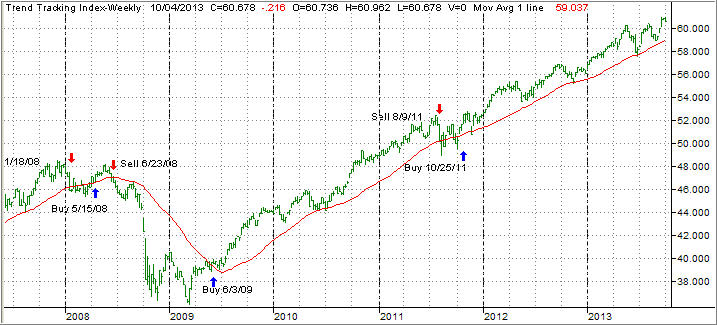
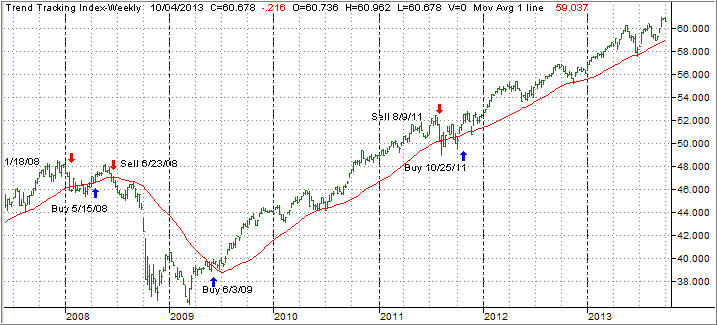
The major trend remains bullish, and our main indicator, the Domestic Trend Tracking Index (TTI), currently resides +3.90% above its long term trend line (red) as the chart shows:

TTI

With the Fed being the major driver to promote the relentless upward trend while, at the same time, defending any downward bias, at least for the time being, equity ETFs remain the place to be invested in. While bond ETFs bounced off their June bottom, they are still stuck below their long term trend lines and therefore in bear market territory.

We added SPY (S&P 500 index) to our holdings the middle of July after it had become clear that June’s sharp selloff appeared not to be the major correction I had been looking for but merely a temporary pullback.

We continue our cautious exposure knowing that at anytime some unintended consequences of the Fed’s monetary policy can backfire and bring this bull to its knees in a hurry.  All of our sell stops are identified and will be executed should the need arise.

ETFs/Mutual Funds On The Cutline – Updated Through 8/2/2013

Ulli ETFs on the Cutline Contact

Below are the latest ETF Cutline reports, which show how far above or below their respective long-term trend lines (39 week SMA) my currently tracked ETFs/MFs are positioned.

The first report covers the ETF Master List from Thursday’s StatSheet and includes 398 ETFs, of which currently 301 (last week 307) are hovering in bullish territory.

The second report includes only High Volume ETFs. To clarify, High Volume (HV) ETFs are defined as those with an average daily volume of $10 million or higher.

These ETFs are generated from my selected list of some 93 that I use in my advisor practice. It cuts out the “noise,” which simply means it eliminates those ETFs that I would never buy because of their volume limitations. 58 ETFs (last week 57) have managed to remain in bullish territory after the recent market volatility.

The third report covers Mutual Funds on the Cutline. There are currently 664 (last week 803) above the line and 195 below it out of the 859 that I follow.

Take a look:

1. ETF Master Cutline Report

2. ETF High Volume Cutline Report

3. MF Cutline Report

In case you are not familiar with some of the terminology used in the reports, please read the Glossary of Terms.

One Man’s Opinion: Is The Federal Reserve Likely To Initiate Tapering In September?

Ulli Market Review Contact

92835431US July nonfarm payrolls data came in at 162,000, well below the 200,000 forecasted by most economists, and showed the labor market continues to improve, but at a frustratingly slow pace, said Mohamed El-Erian, chief executive officer and co-investment officer at PIMCO.

Internal factors like earnings, long-term unemployment rate, labor participation rate and youth unemployment rate indicate the situation is very fragile. So, the signals that go out to the public are very different from the signals that go out to the US policymakers. The signals to the policymakers are two-fold: First, (the Congress) should refrain from creating extra headwinds because of the imminent debt-ceiling discussions when congress meets; and second, the FOMC members and the Federal Reserve should realize the job on hand is very complicated, Mohamed added.

Asked how damaging a political-gridlock could be for the economy, Mohamed said the polarization in Washington is a matter for concern since it creates headwinds for the economy and slows down the pace of growth. It is hoped that Congress has learnt its lesson from the 2011 debacle and will not put itself in a similar situation. If it hurls itself into a mine-field situation similar to 2011, it will create additional uncertainties for the economy. The matter can get compounded further because of the forthcoming German elections in September. Hence the latest employment report should convince policymakers not to create further headwinds, he noted.

Read More

New ETFs On The Block: Wisdomtree US Smallcap Dividend Growth Fund (DGRS)

Ulli Dividend ETFs, Small Cap ETFs Contact

139868600WisdomTree, the New York-based fifth largest sponsor of exchange traded funds, continues with its launching spree this year amid a strong bull market. The number of new launches this year has already surpassed the total number of launches in the previous two combined and given the phenomenal success of their start performer this year – the Japan Hedged Equity Fund (DXJ); it’s quite likely the company will continue to explore niches in an effort to beat the markets.

The new product – the WisdomTree US SmallCap Dividend Growth Fund (DGRS), focuses on the small cap sector of the market but with a unique feature in that it targets growing dividend paying securities. Investors often tend to overlook the small cap companies due to higher returns volatility.

However, small cap stocks have historically outperformed their large cap peers during bull markets. Also, small cap stocks tend to be tied more closely to the domestic market, and with the US economy showing signs of durable growth; they are likely to become more attractive than blue-chip large caps which are more sensitive to global developments.

Read More

08-02-2013

Ulli Newsletter Archives Contact

ETF/No Load Fund Tracker Newsletter For Friday, August 2, 2013

ETF/No Load Fund Tracker StatSheet

————————————————————-

THE LINK TO OUR CURRENT ETF/MUTUAL FUND STATSHEET IS:

https://theetfbully.com/2013/08/weekly-statsheet-for-the-etfno-load-fund-tracker-newsletter-updated-through-08012013/

————————————————————

Market Commentary

Friday, August 2, 2013

BULLS SHOW UP LATE TO KEEP RALLY ALIVE

U.S. equity markets rebounded off the morning lows to close narrowly in positive territory at record highs, extending yesterday’s rally, while the dollar weakened as traders digested a disappointing July nonfarm payroll report and what that means for future Federal Reserve policy.

Elsewhere, Treasuries rallied in the wake of the tepid data, which included a roughly in line read on personal income and spending, as well as smaller-than-expected rise in factory orders. The Dow Jones Industrial Average closed 30 points higher (0.2%) at 15,658, the S&P 500 Index gained 3 points (0.1%) to 1,709, and the Nasdaq Composite added 13 points (0.4%) to 3,689. The opening slip took place as investors reacted to a weaker-than-expected July jobs report.

Nonfarm payrolls increased 162,000 in July, below the consensus of 183,000. Additionally, the prior two months were revised down by a total of 26,000 jobs. Moreover, private sector payrolls increased by 161,000 in July, versus the forecasted gain of 195,000, after expanding by an downwardly revised 196,000 in June. However, the unemployment rate fell from June’s 7.6% rate to 7.4%, compared to the expected decline to 7.5%, as the civilian labor force participation rate dipped to 63.4% from 63.5%, and the number of persons employed part time rose for economic reasons.

Although the July job growth figure and previous revisions were disappointing, steady employment growth continues, with the economy adding an average of nearly 190,000 jobs over the past twelve months, enough to keep chipping away at the unemployment rate. Also, the outlook for further job growth appears to be intact.

Meanwhile, personal income rose 0.3%, below the consensus of 0.5%. Moreover, personal consumption expenditures (PCE) rose 0.5% in June, in line with the consensus. Inflation pressures picked up somewhat. The PCE price index rose 0.4%, while its core picked up 0.2%. Both measures, however, remain well below the Fed’s longer-term inflation target of 2.0%. Finally, factory orders rose 1.5% m/m in June, compared to the 2.3% increase that was expected by economists. Treasuries traded higher following the data.

Yield on the 2-year note declined to 0.30%, the yield on the 10-year note fell to 2.60%, and the 30-year bond rate dropped to 3.70%. Although stocks moved lower initially, the S&P erased almost all of its early losses as participants fell back on the Federal Reserve’s pledge to provide support to the markets for as long as economic data continues to paint a lukewarm picture.

The recovery effort in equities was assisted by the relative strength of consumer discretionary, materials, and technology sectors. Markets were higher on the week, as the DJIA gained 0.63%, the S&P 500 Index appreciated 1.1% and the Nasdaq Composite Index was higher by 0.38%.

Our Trend Tracking Indexes (TTIs) edged higher as well and closed the week as follows:

Domestic TTI: +3.90% (last week +3.32%)

International TTI: +7.45% (last week +6.66%)

Have a great week.

Ulli…

————————————————————-

READER Q & A FOR THE WEEK

All Reader Q & A’s are listed at our web site!
Check it out at:

http://www.successful-investment.com/q&a.php

A note from reader Bob:

Q: Ulli: I have a question that has come to my mind a few times and was wondering if you could answer a question I have about M-Index on your Master Lists for both Funds and ETF’s.

What I was wondering is how the M-Index is calculated.  I see you place the most emphasis on using this number to sort the Funds or ETF’s on a particular list.  Better said that instead of sorting, I probably should save their ranking on each list.  For me, knowing how the M-Index was calculated would help in my understanding of what you select as being most important in your ranking system.

Thank you for your help.  Wonderful information you provide us.

A: Bob: The M-Index calculation is no secret. In #6 of the glossary it states this:

The M-Index (Momentum Index) shows the average non-weighted momentum ranking of a fund or ETF. The average is calculated from the existing 4wk, 8wk, 12wk and YTD momentum numbers. The higher the number, the more upside momentum a fund has.

However, volatility is increased at the same time. If you’re conservative, drop down a few

numbers from the top of the ranking food chain.

———————————————————-

WOULD YOU LIKE TO HAVE YOUR INVESTMENTS PROFESSIONALLY MANAGED?

Do you have the time to follow our investment plans yourself? If you are a busy professional who would like to have his portfolio managed using our methodology, please contact me directly or get more details at:

https://theetfbully.com/personal-investment-management/

———————————————————

Back issues of the ETF/No Load Fund Tracker are available on the web at:

https://theetfbully.com/newsletter-archives/

ETF/No Load Fund Tracker Newsletter For Friday, August 2, 2013

Ulli ETF Tracker Contact

ETF/No Load Fund Tracker StatSheet

————————————————————-

THE LINK TO OUR CURRENT ETF/MUTUAL FUND STATSHEET IS:

https://theetfbully.com/2013/08/weekly-statsheet-for-the-etfno-load-fund-tracker-newsletter-updated-through-08012013/

————————————————————

Market Commentary

Friday, August 2, 2013

BULLS SHOW UP LATE TO KEEP RALLY ALIVE

U.S. equity markets rebounded off the morning lows to close narrowly in positive territory at record highs, extending yesterday’s rally, while the dollar weakened as traders digested a disappointing July nonfarm payroll report and what that means for future Federal Reserve policy.

Elsewhere, Treasuries rallied in the wake of the tepid data, which included a roughly in line read on personal income and spending, as well as smaller-than-expected rise in factory orders. The Dow Jones Industrial Average closed 30 points higher (0.2%) at 15,658, the S&P 500 Index gained 3 points (0.1%) to 1,709, and the Nasdaq Composite added 13 points (0.4%) to 3,689. The opening slip took place as investors reacted to a weaker-than-expected July jobs report.

Nonfarm payrolls increased 162,000 in July, below the consensus of 183,000. Additionally, the prior two months were revised down by a total of 26,000 jobs. Moreover, private sector payrolls increased by 161,000 in July, versus the forecasted gain of 195,000, after expanding by an downwardly revised 196,000 in June. However, the unemployment rate fell from June’s 7.6% rate to 7.4%, compared to the expected decline to 7.5%, as the civilian labor force participation rate dipped to 63.4% from 63.5%, and the number of persons employed part time rose for economic reasons.

Read More