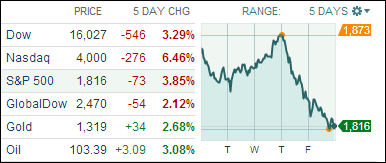
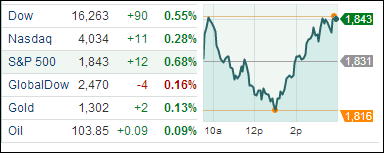
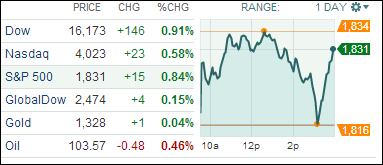
Heading Towards Bear Market Territory; Let’s Hope February Is A Very Short Month

Ulli Market Commentary Contact

Mon pic

1. Moving The Markets

A new report on U.S. manufacturing growth was released today that showed the sector barely expanded in January. This was not a good start for trading in February and the Dow Jones Industrial Average (DJI) felt the wrath falling by more than 2% on the day. If you read the last piece I wrote at the end of January, then you may remember us discussing the common saying “as January goes, so goes the year.” Well, the saying rang true as ever today as the Nasdaq and S&P 500 also dropped more than 2%.

Throughout the month of January traders were jittery about the health of both the U.S. and developing country economies. This did not bode well for retailers because of their sensitivity to consumer confidence, so we saw big names like Amazon (AMZN), Home Depot (HD) and Best Buy (BBY) get hammered. As nervous as investors are these days, it would not come as a surprise to see continued volatility in this sector for the near future.

To follow suit, auto manufacturers released some consistently underperforming data for January sales. Ford (F), GM (GM and Toyota (TM) all posed sales declines to start the new year. Chrysler, however, reported sales that topped analysts’ forecasts. So, it wasn’t all red for all companies today. We did see some big gainers, such as Herbalife (HLF) whose shares rose more than 7% when the company said 2013 Q4 earnings would beat forecasts and that it would raise its planned stock buyback by another $500 million.

Our 10 ETFs in the Spotlight headed south, one trailing sell stop was triggered while 3 of them have now crossed their respective long-term trend lines to the downside. Take a look:

Read More

ETFs/Mutual Funds On The Cutline – Updated Through 01/31/2014

Ulli ETFs on the Cutline Contact

Below are the latest ETF Cutline reports, which show how far above or below their respective long-term trend lines (39 week SMA) my currently tracked ETFs/MFs are positioned.

The first report covers the ETF Master List from Thursday’s StatSheet and includes 398 ETFs, of which currently 301 (last week 311) are hovering in bullish territory.

The second report includes only High Volume ETFs. To clarify, High Volume (HV) ETFs are defined as those with an average daily volume of $10 million or higher.

These ETFs are generated from my selected list of some 93 that I use in my advisor practice. It cuts out the “noise,” which simply means it eliminates those ETFs that I would never buy because of their volume limitations. 48 ETFs (last week 52) have managed to remain in bullish territory after the recent market volatility.

The third report covers Mutual Funds on the Cutline. There are currently 557 (last week 590) above the line and 292 below it out of the 859 that I follow.

Take a look:

1. ETF Master Cutline Report     

2. ETF High Volume Cutline Report

3. MF Cutline Report

In case you are not familiar with some of the terminology used in the reports, please read the Glossary of Terms.

If you missed the original post about the Cutline approach, you can read it here.

Please note that Mutual fund prices have not been adjusted for yearend distributions.

One Man’s Opinion: Can The Emerging Market Volatility Be Contained Or Will It Spread?

Ulli Market Review Contact

92835431It has been an exciting and sometimes scary week thus far as investors didn’t know if the current market volatility was going to be something bigger or this was just going to be some sort of a correction that needs to be endured, said Brian Jacobsen, chief portfolio strategist at the Wells Fargo Advantage Funds.

Thankfully the fourth-quarter US GDP data turned out to be pretty decent, which in turned helped the markets to propel a little bit higher. Also, the markets witnessed a lot of aftershocks related with some of the problems in the emerging market countries. The markets really didn’t see a lot of fallout from some of the moves of by say the central banks in Turkey or South Africa. The positive economic data from the US showed the recovery is going to trudge along, he noted.

Asked if the sell-off was more of a knee-jerk reaction because of the developments taking place in Asia or if it was the beginning of the correction that the market has been long expecting, Brian said when everybody waits for a correction, those pullbacks rarely happen.

Read More

New ETFs On The Block: PowerShares NYSE Century Portfolio ETF (NYCC)

Ulli Equity ETFs Contact

141319272US equities remain favorites with many investors in 2014, particularly after last year’s remarkable performance that saw the S&P 500 surge by more than 30 percent year-on-year. Small cap stocks even performed better, triggering a spurt in cash flows in ETFs focused on the US economy.  In fact, data compiled by research agencies showed more than $117 billion flowed into US equity funds in 2013, underling the renewed investor confidence in the world’s largest economy.

With such heavy investor interest, many ETF issuers have launched new products targeting the US market in recent months. Some of these have a few novel features that set them apart in the crowded US equity space.

In particular, the latest addition from Illinois-based Invesco PowerShares offers an interesting alternative to investors wishing to play the broader US market since it focuses on both large- and small cap US companies. The PowerShare Century Portfolio ETF (NYCC), launched in collaboration with NYSE Euronext – an exchange operator and index provider, is the first fund to be based on the NYSE Century Index.

Read More

01-31-2014

Ulli Newsletter Archives Contact

ETF/No Load Fund Tracker Newsletter For Friday, January 31, 2014

ETF/No Load Fund Tracker StatSheet

————————————————————-

THE LINK TO OUR CURRENT ETF/MUTUAL FUND STATSHEET IS:

https://theetfbully.com/2014/01/weekly-statsheet-for-the-etfno-load-fund-tracker-newsletter-updated-through-01302014/

————————————————————

Market Commentary

Friday, January 31, 2014

A BEARISH END TO A NOT SO FRUITFUL MONTH

Fri pic

[Chart courtesy of MarketWatch.com]

1. Moving The Markets

This week was filled with ups and downs in the market, as you can see from the above weekly chart. Various corporate earnings reports, as well as strong Q4 2013 growth data, were released this week that entailed an overall bullish sentiment for the U.S. economy. However, worries pertaining to emerging markets trumped the positive sentiment for U.S. Growth, which resulted in losses across the board for the major U.S. indexes this week and for the month of January respectively.

In January, the Dow fell 5.3%, the S&P fell 3.6% and the Nasdaq ended the month down 1.7%. This was the first time that the S&P ended January in the red since 2010.

Global equity markets have been rattled by the outlook for emerging markets, including slower growth in China, while the Federal Reserve’s decision this week to keep withdrawing its monetary stimulus added to worries. Now that the Fed has decided to cut back on its bond purchases, many Investors are selling off their share emerging market investments mainly because they are no longer as attractive.

For those of you living in a winter wonderland of snow over the past month, it has been hard not to notice the bullish performance that natural gas has experienced. Recently, the price of natural gas passed $5.00/mmbtu, up from $3.50/mmbtu three months ago. In Friday’s trading, UNG (which we have no holdings in) surged more than 8%, which is a 52-week high. However, some speculate that there a continued increase is not sustainable and are thus looking to secure gains and sell. It will be interesting to see how Mother Nature treats the U.S. over the next month and subsequently how the natural gas market responds.

Our 10 ETFs in the Spotlight slipped but 9 of them are remaining on the bullish side of their respective trend lines as the table below shows.

2. ETFs in the Spotlight

In case you missed the announcement and description of this section, you can read it here again.

It features 10 broadly diversified ETFs from my HighVolume list as posted every Monday. Furthermore, they are screened for the lowest MaxDD% number meaning they have been showing better resistance to temporary sell offs than all others over the past year.

In other words, none of them ever triggered their 7.5% sell stop level during this time period, which included a variety of severe market pullbacks but no move into outright bear market territory.

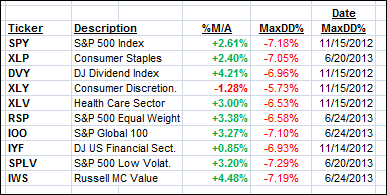
Here are the 10 candidates:
MaxDD

All of them, except XLP, are in “buy” mode meaning their prices are above their respective long term trend lines by the percentage indicated (%M/A).

Now let’s look at the MaxDD% column and review the ETF with the lowest drawdown as an example. As you can see, that would be XLY with the lowest MaxDD% number of -5.73%, which occurred on 11/15/2012.

The recent sell off in the month of June did not affect XLY at all as its “worst” MaxDD% of -5.73% still stands since the November 2012 sell off.

A quick glance at the last column showing the date of occurrences confirms that five of these ETFs had their worst drawdown in November 2012, while the other five were affected by the June 2013 swoon, however, none of them dipped below their -7.5% sell stop.

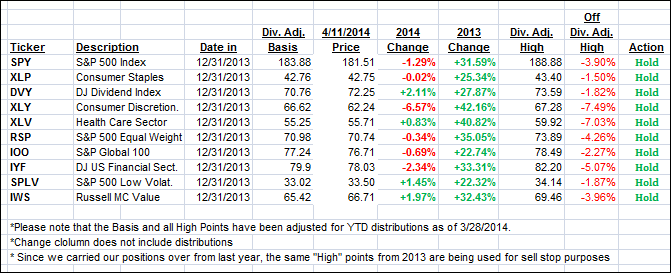
Year to date, here’s how the above candidates have fared so far:
YTD

3. Domestic Trend Tracking Indexes (TTIs)

Our Trend Tracking Indexes (TTIs) joined the ups and downs of the past week, but they remain on the bullish side of their respective trend lines:

Domestic TTI: +2.24% (last Friday +2.67%)

International TTI: +3.16% (last Friday +4.34%)

Have a great week.

Ulli…

Disclosure: I am obliged to inform you that I, as well as advisory clients of mine, own some of these listed ETFs. Furthermore, they do not represent a specific investment recommendation for you, they merely show which ETFs from the universe I track are falling within the guidelines specified.

————————————————————-

READER Q & A FOR THE WEEK

All Reader Q & A’s are listed at our web site!
Check it out at:

http://www.successful-investment.com/q&a.php

A note from reader Don:

Q: Ulli:

Is your 39 week moving average really a 195 day moving average?  (39 weeks x 5 trading days per week = 195)

A: Don: There is a small difference. With a 39-week M/A, you recalculate the average only every Friday while when using a 195 day M/A, you would recalculate every day. I prefer the former, though in the end it may not make that much difference. Whatever you prefer, you should use.

———————————————————-

WOULD YOU LIKE TO HAVE YOUR INVESTMENTS PROFESSIONALLY MANAGED?

Do you have the time to follow our investment plans yourself? If you are a busy professional who would like to have his portfolio managed using our methodology, please contact me directly or get more details at:

https://theetfbully.com/personal-investment-management/

———————————————————

Back issues of the ETF/No Load Fund Tracker are available on the web at:

https://theetfbully.com/newsletter-archives/

ETF/No Load Fund Tracker Newsletter For Friday, January 31, 2014

Ulli ETF Tracker Contact

ETF/No Load Fund Tracker StatSheet

————————————————————-

THE LINK TO OUR CURRENT ETF/MUTUAL FUND STATSHEET IS:

https://theetfbully.com/2014/01/weekly-statsheet-for-the-etfno-load-fund-tracker-newsletter-updated-through-01302014/

————————————————————

Market Commentary

Friday, January 31, 2014

A BEARISH END TO A NOT SO FRUITFUL MONTH

Fri pic

[Chart courtesy of MarketWatch.com]

1. Moving The Markets

This week was filled with ups and downs in the market, as you can see from the above weekly chart. Various corporate earnings reports, as well as strong Q4 2013 growth data, were released this week that entailed an overall bullish sentiment for the U.S. economy. However, worries pertaining to emerging markets trumped the positive sentiment for U.S. Growth, which resulted in losses across the board for the major U.S. indexes this week and for the month of January respectively.

In January, the Dow fell 5.3%, the S&P fell 3.6% and the Nasdaq ended the month down 1.7%. This was the first time that the S&P ended January in the red since 2010.

Global equity markets have been rattled by the outlook for emerging markets, including slower growth in China, while the Federal Reserve’s decision this week to keep withdrawing its monetary stimulus added to worries. Now that the Fed has decided to cut back on its bond purchases, many Investors are selling off their share emerging market investments mainly because they are no longer as attractive.

For those of you living in a winter wonderland of snow over the past month, it has been hard not to notice the bullish performance that natural gas has experienced. Recently, the price of natural gas passed $5.00/mmbtu, up from $3.50/mmbtu three months ago. In Friday’s trading, UNG (which we have no holdings in) surged more than 8%, which is a 52-week high. However, some speculate that there a continued increase is not sustainable and are thus looking to secure gains and sell. It will be interesting to see how Mother Nature treats the U.S. over the next month and subsequently how the natural gas market responds.

Our 10 ETFs in the Spotlight slipped but 9 of them are remaining on the bullish side of their respective trend lines as the table below shows.

Read More