Stocks Back On Top; ECB Not To Drop Interest Rates

Ulli Market Commentary Contact

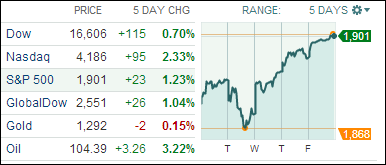
Thur pic

[Chart courtesy of MarketWatch.com]

1. Moving The Markets

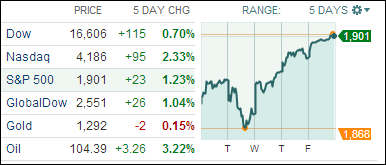
Stocks here in the U.S. had their best gain in 7 weeks today. The S&P 500 (SPX) closed up 1.24%, the Dow (DJIA) closed up 1.22% and the Nasdaq Composite (COMP) finished the day 1.1% higher. What seemed to have the biggest impact on markets today was the data on weekly jobless claims. Data was released that showed the number of people who applied for unemployment benefits for the first time fell by 20,000 to 331,000 last week, which was 6,000 better than the forecasted 337,000

Green Mountain Coffee Roasters (GMCR) exploded upwards 26% today after releasing the news that Coca-cola (KO) will take a 10% stake in the company for $1.25 billion alongside a 10-year drink deal.  Disney (DIS) was one of the Dow’s big gainers today. Shares increased 5.3% after its earnings topped estimates, drawing on big gains from the recent blockbuster “Frozen”.

Across the globe, European stock markets reacted positively to the news that the European Central Bank has decided not to change interest rates from their current 0.25% level. Some analysts had thought it might cut rates down to 0.1%. Weak growth and an unexpected drop in inflation have raised concerns that the eurozone might slide into deflation, which could cripple the economy. Asian stocks performed relatively well today apart from the Nikkei.

Our 10 ETFs in the Spotlight recovered as well with only 2 of them hovering below their respective long-term trend lines.

Read More

Volatility Is All The Buzz

Ulli Market Commentary Contact

WEd pic

[Chart courtesy of MarketWatch.com]

1. Moving The Markets

Volatility seems to be the name of the game so far in 2014. One day the markets are down, the next they bounce back only to fall again the day after. All of the major U.S. indices closed in the red today after a private survey showed that U.S. businesses added jobs at a steady but modest pace in January. Investors are also looking to a key government report on job growth on Friday, as many investors remain leery, waiting to see if upcoming economic reports and company earnings will show that the U.S. economic recovery is on track.

Despite Wednesday’s overall decline in the market, many stocks finished in the green. Walgreens (WAG) was amongst the top performers of the S&P, gaining 3.4%. TJ Max (TJX) was not far behind, gaining 3.1%. If you like gambling (on other things besides stocks) you may have taken note of the casino stocks that were in the news today.  Las Vegas Sands (LVS), Wynn Resorts (WYNN) and MGM Resorts International (MGM) all dropped today as a reaction to the disappointing gambling revenue numbers that came out of Macau. Apparently, there was significantly less gambling throughout the lunar New Year holiday.

While not making major news today, gold still remains a topic of interest as the markets continue to be unpredictable. The Market Vectors Junior Gold Miners ETF (GDXJ) has gained an impressive 16% this year, a remarkable comeback from last year’s 61% plunge. The Market Vectors Gold Miners ETF (GDX), tracking large-cap miners, has bounced back 10% this year from a 54% nose-dive last year and the SPDR Gold Trust (GLD), the largest ETF tracking gold bullion, with $32 billion in assets, has gained 4% year to date after losing 28% in 2013.

Our 10 ETFs in the Spotlight meandered with 4 of them now hovering below their respective long-term trend lines.

Read More

02-05-2014

Ulli Newsletter Archives Contact

The ETF/No Load Fund Tracker

Monthly Review—January 31, 2013

US Stocks End January With Losses; Europe Posts Biggest Decline Since June

US stocks suffered their worst monthly decline in over a year in January as disappointing earnings, a continuing selloff in emerging markets and renewed fears over a looming deflation in the euro zone sapped investor confidence.

The S&P 500 index closed out January at 1,783, capping its monthly loss at 3.6 percent. Seven of the ten sectors finished the month lower with energy declining the most and shedding 6.3 percent. Consumer-discretionary was the second-weakest sector and followed energy closely with a 6.0 percent slump.

Both the DJIA and the S&P 500 marked their worst monthly declines since May 2012.

Stock markets witnessed heavy selling towards the end of the month as a steep drop in emerging market currencies prompted anxious investors to flee riskier assets. The Federal Reserve’s decision to reduce its monthly assets purchase by another $10 billion to $65 billion triggered the rout in emerging market currencies, as spooked investors set off capital outflows on fears of a liquidity tightening in the US. Some analysts said, however, the correction was expected as equities rose too fast at the end of last year.

The US economy continued to trudge along although the fourth-quarter advance GDP estimate showed an increase of 3.2 percent, tallying annual GDP at 1.9 percent. That compares with the 2.8 percent growth witnessed in 2012. Economists attributed the slowdown to large tax hikes and sharp government spending cuts that came into effect in the first half of 2013.

Consumer spending, the largest component of the economy that constitutes nearly 70 percent of gross domestic product, rose a seasonally adjusted 0.4 percent in December after an upwardly revised 0.6 percent rise in November. Spending could experience headwinds in the earlier part of the year as some 1.35 million Americans are likely to be affected after the Jan 1 cutoff in extra jobless benefits.

Nevertheless, the economy continued to paint a mixed picture in January. Orders for durable goods fell 4.3 percent in December although business capital spending rose at the fastest rate in nearly two years.

The much awaited Case/Shiller composite index revealed US home prices ticked down 0.1 percent in November with nine of the 20 cities tracked showing price drops. Still, home prices were up 13.7 percent over the same period in 2012, which marked the fastest annual growth since early 2006. Median home prices rose 8.4 percent to $265,800 from the prior year.

Across the Atlantic, the Stoxx Europe 600 index lost 1.8 percent in January to mark its worst monthly loss since June.

The threat of a looming deflation in the currency bloc continued to haunt investors. Data released by the European Union’s statistics office Eurostat showed January inflation dropped to 0.7 percent from 0.8 percent in the prior month, stoking fears of a spiraling decline in consumer prices that could derail the fragile recovery.

While the major trend direction, as measured by my Domestic Trend Tracking Index (TTI), remains bullish, short-term, we have seen a reversal that has brought us to within striking distance of a break below the trend line (red) and into bear market territory. We will have to wait and see as to whether that will actually materialize or not. Here’s the latest TTI chart:

TTI

The index itself (green line) still hovers above the trend line (red) by +1.15%.

With the market pullback in January and into early February, some our holdings headed south as well and triggered our tailing sell stops.

The 12-months chart below clearly shows the top in the markets (red arrow) and the subsequent decline of our various positions as we headed into January.

12-months

The weakest of the bunch was consumer staples (XLP) which, despite its conservative nature, has been on a slowdown since mid-November. Our sell stop was triggered towards the end of January, and the position was liquidated.

The fund with the sharpest drop was the Consumer Discretionary ETF (XLY), which showed the greatest volatility, tripped our sell stop in early February and was liquidated as well. We are holding all others for the time being, and I am prepared to pull the trigger should the need arise.

It’s too early to tell whether this current sell-off will continue and push us into outright bear market territory or if some sudden positive economic data points will save the month. We have suddenly slipped into quicksand and it’s important that we stay with our exit strategy just in case the bear returns with a vengeance and presents a repeat performance of 2008, a year with devastating consequences that most investors already have conveniently forgotten.

Stocks Bounce Back After Big Sell-Off Monday

Ulli Market Commentary Contact

Tue pic

[Chart courtesy of MarketWatch.com]

1. Moving The Markets

The U.S. stock market ended the day higher after suffering one of its largest declines in more than seven months yesterday. All major indexes gained as the chart above shows

Consumer and financial stocks lead the board for gains today on the S&P 500. Michael Kors (KORS) jumped up 17% on the day after the fashion giant announced 2013 Q3 earnings that far exceeded expectations. Last year’s holiday season boded well for the company as its reported $1 billion 2013 Q3 earnings marked a 59% year-over-year increase.

Also making headlines today was the news that Microsoft ended their 5-month search for a CEO as they assigned Satya Nadella the role. Mr. Nadella was the head of the company’s cloud computing division and enterprise business.

An interesting bit of news surfaced today regarding Coffee. As you may know, 2013 was a tough year for commodities in general due to the equity bull market. Coffee was one of many commodities that suffered. However, things may be looking up for Coffee investors because it was reported today that Brazil, the world’s top coffee producer, has been experiencing a severe drought over the past couple of months just ahead of its annual dry season which begins in April. A lack of water may reduce supply, increase demand and thus market price.

So, it may be interesting to keep an eye on two ETFs that invest in the coffee market, iPath Dow Jones UBS Coffee ETN (JO) and iPath Pure Beta Coffee ETN (CAFE), in which we have no holdings.

Our 10 ETFs in the Spotlight recovered but 3 of them are still hovering below their respective trend lines.

Read More

Heading Towards Bear Market Territory; Let’s Hope February Is A Very Short Month

Ulli Market Commentary Contact

Mon pic

1. Moving The Markets

A new report on U.S. manufacturing growth was released today that showed the sector barely expanded in January. This was not a good start for trading in February and the Dow Jones Industrial Average (DJI) felt the wrath falling by more than 2% on the day. If you read the last piece I wrote at the end of January, then you may remember us discussing the common saying “as January goes, so goes the year.” Well, the saying rang true as ever today as the Nasdaq and S&P 500 also dropped more than 2%.

Throughout the month of January traders were jittery about the health of both the U.S. and developing country economies. This did not bode well for retailers because of their sensitivity to consumer confidence, so we saw big names like Amazon (AMZN), Home Depot (HD) and Best Buy (BBY) get hammered. As nervous as investors are these days, it would not come as a surprise to see continued volatility in this sector for the near future.

To follow suit, auto manufacturers released some consistently underperforming data for January sales. Ford (F), GM (GM and Toyota (TM) all posed sales declines to start the new year. Chrysler, however, reported sales that topped analysts’ forecasts. So, it wasn’t all red for all companies today. We did see some big gainers, such as Herbalife (HLF) whose shares rose more than 7% when the company said 2013 Q4 earnings would beat forecasts and that it would raise its planned stock buyback by another $500 million.

Our 10 ETFs in the Spotlight headed south, one trailing sell stop was triggered while 3 of them have now crossed their respective long-term trend lines to the downside. Take a look:

Read More

ETFs/Mutual Funds On The Cutline – Updated Through 01/31/2014

Ulli ETFs on the Cutline Contact

Below are the latest ETF Cutline reports, which show how far above or below their respective long-term trend lines (39 week SMA) my currently tracked ETFs/MFs are positioned.

The first report covers the ETF Master List from Thursday’s StatSheet and includes 398 ETFs, of which currently 301 (last week 311) are hovering in bullish territory.

The second report includes only High Volume ETFs. To clarify, High Volume (HV) ETFs are defined as those with an average daily volume of $10 million or higher.

These ETFs are generated from my selected list of some 93 that I use in my advisor practice. It cuts out the “noise,” which simply means it eliminates those ETFs that I would never buy because of their volume limitations. 48 ETFs (last week 52) have managed to remain in bullish territory after the recent market volatility.

The third report covers Mutual Funds on the Cutline. There are currently 557 (last week 590) above the line and 292 below it out of the 859 that I follow.

Take a look:

1. ETF Master Cutline Report     

2. ETF High Volume Cutline Report

3. MF Cutline Report

In case you are not familiar with some of the terminology used in the reports, please read the Glossary of Terms.

If you missed the original post about the Cutline approach, you can read it here.

Please note that Mutual fund prices have not been adjusted for yearend distributions.