Weekly StatSheet For The ETF Tracker Newsletter – Updated Through 03/02/2017

Ulli ETF StatSheet Contact

ETF Data updated through Thursday, March 2, 2017

Methodology/Use of this StatSheet:

  1. From the universe of over 1,800 ETFs, I have selected only those with a trading volume of over $5 million per day (HV ETFs), so that liquidity and a small bid/ask spread are assured.
  2. Trend Tracking Indexes (TTIs)

Buy or Sell decisions for Domestic and International ETFs (section 1 and 2), are made based on the respective TTI and its position either above or below its long-term M/A (Moving Average). A crossing of the trend line from below accompanied by some staying power above constitutes a “Buy” signal. Conversely, a clear break below the line constitutes a “Sell” signal. Additionally, I use a 7.5% trailing stop loss on all positions in these categories to control downside risk.

  1. All other investment arenas do not have a TTI and should be traded based on the position of the individual ETF relative to its own respective trend line (%M/A). That’s why those signals are referred to as a “Selective Buy.” In other words, if an ETF crosses its own trendline to the upside, a “Buy” signal is generated. Since these areas tend to be more volatile, I recommend a wider trailing sell stop of 7.5% -10% depending on your risk tolerance.

If you are unfamiliar with some of the terminology, please see Glossary of Terms and new subscriber information in section 9.


  1. DOMESTIC EQUITY ETFs: BUY — since 4/4/2016
Click on chart to enlarge

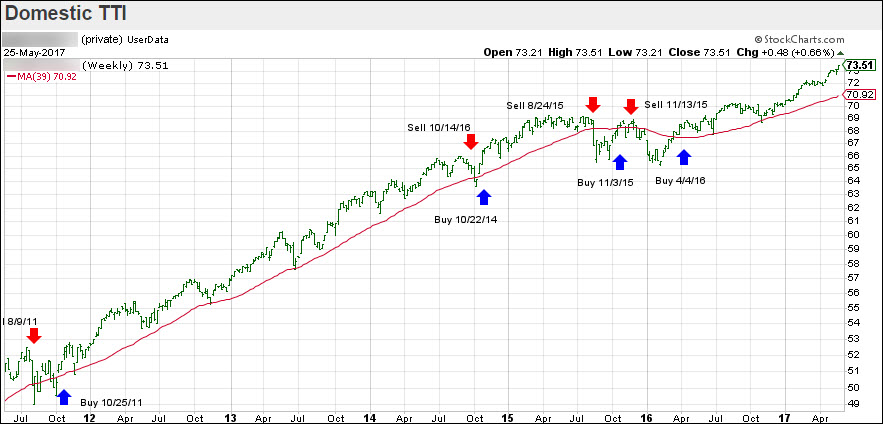
Our main directional indicator, the Domestic Trend Tracking Index (TTI-green line in the above chart) is positioned above its long-term trend line (red) by +2.95% after having generated a new Domestic Buy signal effective 4/4/2016 as posted.
Read More

Coming Off The Sugar High

Ulli Market Commentary Contact

[Chart courtesy of MarketWatch.com]
  1. Moving the Markets

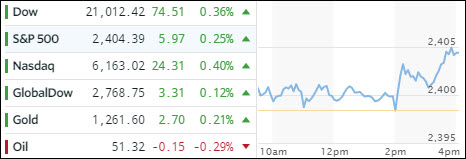
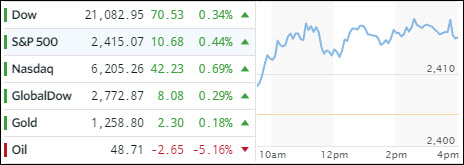
While the jury is still out in regards to me considering yesterday’s market ramp a “blow-off” top, today’s pullback did not come as a surprise with the major indexes having been on 12-day parabolic rampage supported by not a lot of real news to justify it.

Of course, today could have been a simple case of profit taking, which has been long overdue. Consider that ever since the election, any kind of selling has been met with relentless buying pushing stocks to new records highs for days on end, without as much as a 1% correction in over 90 trading days.

Today’s pullback took back about 50% of yesterday’s gains. In summary, interest rates rose and bonds got clobbered; gold got hammered while the US dollar rallied. Rate hike odds surged to 90% after the Fed mouthpieces Brainard, Williams, Dudley and Kaplan jawboned hawkish statements. Translation: It’s almost certain that a hike in March will happen when the Fed meets on March 15. But you never know for sure, so let’s wait and see if they actually follow through or if they start walking back market expectations—again.

Read More

WS Critic: “Trump Makes America ‘Wait’ Again”

Ulli Market Commentary Contact

[Chart courtesy of MarketWatch.com]
  1. Moving the Markets

One of the funnier headlines I’ve seen in a while was featured by a Bloomberg writer, who in a note titled “Still No Details as Trump Makes America Wait Again” opined that, while the market was surging on a sugar high this morning, no details on how Trump plans to achieve his lofty goals were given.

Here’s the full note:

The longer the market has to process Trump’s speech, the less impressed it’ll be. It was rhetoric packed with hopes and dreams, but light on details and concrete plans.

Sadly, it feels like this outcome was all too predictable. Although, the possibility that he could have surprised us all means that the market has not yet fully priced in today’s disappointment.

Trump did manage to sound presidential and statesmanlike, and avoid getting bogged down in partisan or petty attacks. This is a positive.

It’s also supportive that infrastructure returned to the core of the agenda. Although, it seemed a resurrection of vague plans from three months ago rather than a step further along the path to implementing a program.

Financial bubbles, most notably the dotcom era, have proven that hopes and dreams can keep the market irrational longer than most of us can remain solvent.

At some point though, reality catches up. And 40 days in to Trump’s administration, there’s little sign that he’ll deliver much of a boost to the U.S. economy on any imminent horizon.

Optimistic soundbites from the speech don’t have the ability to drive the market higher on a sustainable basis. As analyst notes flow in to investors’ inboxes during the next 24 hours, asset prices may start reflecting a far more negative outcome.

Beware downside moves in the dollar, in U.S. yields, and even in equities. At some point, traders may realize the new emperor has no clothes.

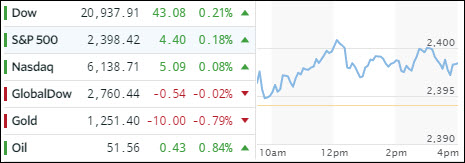
While his view may turn out to ultimately be correct, right now the markets were surging to new all-time highs. A lot of support came from the bearish Wall Street crowd which had, in anticipation of a negative market reaction from Trump’s speech, engaged in setting up huge short positions that needed to be covered in a hurry this morning thereby supporting the bullish cause.

To me, today’s entire ramp had the smell of a “blow-off” top to it but, for the time being, upward momentum rules, and we will stay on board for the ride.

Read More

Snapping The Winning Streak

Ulli Market Commentary Contact

[Chart courtesy of MarketWatch.com]
  1. Moving the Markets

I did not expect much upside market action ahead of Trump’s speech, and that is exactly what happened. The Dow broke its 12-day record streak while all major indexes closed marginally to the downside. Not helping matters was Target’s report that profit for the quarter, including the holiday season, had fallen by an astonishing 43%. The punishment for such miss was immediate as the stock fell 12% pulling other retailers down as well.

For the short month of February, the major indexes gained with the S&P 500 sporting +3.7%, supported by hope that Trump’s promises of massive infrastructure spending, reduced regulations and tax reform will be forthcoming shortly. As I said yesterday, Wall Street will be analyzing his every word during tonight’s speech not only as to how he’s going to achieve those promises but just as importantly what the timeline will be along with how things will be paid for.

Remember, markets run on hope, optimism and euphoria. We’ll find out tonight if Trump can keep Wall Street appeased and thereby keep the rally going. Anything perception that he will not be able to deliver as promised will likely have a negative effect on market momentum.

Read More

Dow Inches To 12th Record High Close

Ulli Market Commentary Contact

[Chart courtesy of MarketWatch.com]
  1. Moving the Markets

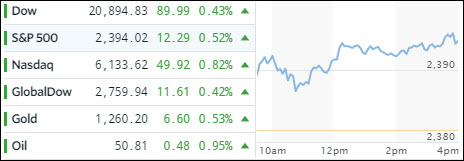
The wining streak continued despite a weak opening, but the bulls were determined not to interrupt the current march towards new record highs, and mid-day the major indexes slowly crawled above the unchanged line and eked out a tiny gain; but a gain nonetheless.

Throwing in an assist was President Trump when he upped the ante by stating that he’d make a “big” infrastructure statement on Tuesday. Additionally, he uttered those words that Wall Street wanted to hear, namely that he is seeking a “historic” increase in military spending of more than 9% while also reinforcing that his administration would be “moving quickly” on regulatory reforms.

All of this was a warm-up or a priming of the pump ahead of his first address to a joint session of Congress tomorrow night. If he provides more specifics on his plans and meets current hyped up expectations, we could see more upside in the markets. If, however, the picture remains murky with vague details combined with an uncertain time line, we could see a long overdue pullback set in confirming what is believed by some to be a “suckers” rally.

Read More

One Man’s Opinion: There Is A Cost To Fed Policy!

Ulli Market Review Contact

By ZeroHedge

The Federal Reserve has pursued the unprecedented monetary policy of lowering rates to zero and increasing their portfolio from 500 billion to over 4 trillion.  These are policies aiming to achieve maximum employment and low inflation. By many measures, they were successful. Growth of around 2% is at the long term US average and recent core inflation measures are coming in around 2%. But as the Fed reminds us, there is a cost to their policies. However, they do not lay out explicitly what those costs are, nor how expensive they can be. They just try to reassure the public by saying they are monitoring them.

I recently had conversations with novice market participants who were stunned by the size and rapid growth of a number of hedge funds and financial firms.  Some firms that recently had capital in the low billions are now in the hundreds of billions with assets in the trillions. This made these novices nervous, and rightfully so. Though most have no idea what “there are costs to Fed policy” means, these people have identified the biggest costs to Fed policy without realizing it.

Read More