Nasdaq Gets Whipped And Bonds Get Clipped

Ulli Market Commentary Contact

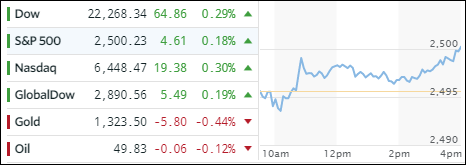
[Chart courtesy of MarketWatch.com]
  1. Moving the Markets

There simply weren’t any news reports positive enough to keep the major indexes above the unchanged line. First, it was the Fed and its mouthpieces pretty much talking down the markets. ZH summed it up as follows:

Yellen – “We have been in an economy with low interest rates for some time, and that influences asset prices… Asset valuations are somewhat rich by traditional valuations like price-earnings ratios… Some asset valuations look high. There is no certainty about that.”

 Williams – “I am somewhat concerned about the complacency in the market. If you look at these measures of uncertainty, like the VIX measure, or other indicators, there seems to be a priced-to-perfection attitude out there… The stock market still seems to be running very much on fumes…”

 Fischer – Calls for “close monitoring” of rising risk appetites…”Equity P/E ratios are near top of historical levels… it would be foolish to think all risks eliminated… Sees notable uptick in risk appetites in asset markets… Corporate sector notably leveraged…”

Later in the session, downward momentum accelerated when Republican Senate leaders postponed the vote on the controversial health-care bill until after the July 4th holiday, which did not exactly instill confidence in its outcome.

The Nasdaq got clobbered the most by losing -1.61% and is now showing a negative return for June. It’s not surprising that the FANGs were hammered as well dropping 4% from yesterday’s close.

Bonds got hit hard as the 10-year yield jumped 7 basis points to 2.21%, which sent the 20-year T-Bond (TLT) sliding and surrendering -1.07%. Not to be outdone, the US Dollar tumbled along losing -1.11% (UUP) in the process wiping out recent gains and ending up back at October 2017 lows. In other words, the entire “Trump US dollar bump” has been more than wiped out with only equities not having gotten the message.

Read More

Skidding Off The Highs

Ulli Market Commentary Contact

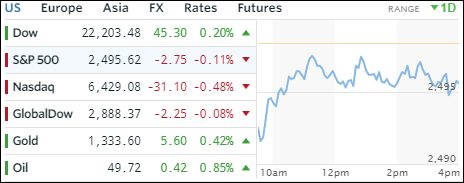
[Chart courtesy of MarketWatch.com]
  1. Moving the Markets

It was another roller coaster session with the major indexes ramping higher right out of the gate, only to see early gains evaporate, as Dow ended a string of daily losses at four, but only by the tiniest of margins. So did the S&P 500, but the Nasdaq stumbled and closed the day in the red. Emerging markets reigned superior with SCHE adding a solid +1.13% in an otherwise momentum-less trading session.

However, some momentum was present in the precious metals markets but, unfortunately, it was the downside. Gold flash-crashed this morning plunging $18, or 1.6%, to $1,236 on massive volume, as someone dumped $2 billion (over 18,000 contracts) in a matter of seconds. Naturally, silver was dragged down with it in what was an obvious attempt to manipulate prices. After all, if you wanted to sell at the highest price you would do it carefully and deliberately and not all at once.

Economic data points continued their nose dive with Durable Goods and the Chicago Fed’s National Activity Index both tumbling and missing expectations by a huge margin. As a result, the Citi Macro Surprise Index slumped to its lowest level since the middle of 2011.

Treasury yields fell with the 10-year bond now yielding 2.14%, which is its lowest since November 2016. The US dollar had its own roller-coaster ride, first sharply dropping on the weak economic data points and then rallying to manage a gain of +0.06%, as measured by UUP.

Read More

One Man’s Opinion: “Nobody In Power Is Paying Attention To How Close We Are To The Edge”

Ulli Market Review Contact

By Howard Kunstler

As our politicos creep deeper into a legalistic wilderness hunting for phantoms of Russian collusion, nobody pays attention to the most dangerous force in American life: the unraveling financialization of the economy.

Financialization is what happens when the people-in-charge “create” colossal sums of “money” out of nothing — by issuing loans, a.k.a. debt — and then cream off stupendous profits from the asset bubbles, interest rate arbitrages, and other opportunities for swindling that the artificial wealth presents. It was a kind of magic trick that produced monuments of concentrated personal wealth for a few and left the rest of the population drowning in obligations from a stolen future. The future is now upon us.

Financialization expressed itself in other interesting ways, for instance the amazing renovation of New York City (Brooklyn especially). It didn’t happen just because Generation X was repulsed by the boring suburbs it grew up in and longed for a life of artisanal cocktails. It happened because financialization concentrated immense wealth geographically in the very few places where its activities took place — not just New York but San Francisco, Washington, and Boston — and could support luxuries like craft food and brews.

Read More

ETFs On The Cutline – Updated Through 06/23/2017

Ulli ETFs on the Cutline Contact

Below please find the latest High Volume ETFs Cutline report, which shows how far above or below their respective long-term trend lines (39 week SMA) my currently tracked ETFs are positioned.

This report covers the HV ETF Master List from Thursday’s StatSheet and includes 366 High Volume ETFs ETFs, defined as those with an average daily volume of more than $5 million, of which currently 276 (last week 277) are hovering in bullish territory. The yellow line separates those ETFs that are positioned above their trend line (%M/A) from those that have dropped below it.

Take a look:

The HV ETF Master Cutline Report            

In case you are not familiar with some of the terminology used in the reports, please read the Glossary of Terms.

If you missed the original post about the Cutline approach, you can read it here.

ETF Tracker Newsletter For June 23, 2017

Ulli ETF Tracker Contact

ETF Tracker StatSheet

https://theetfbully.com/2017/06/weekly-statsheet-etf-tracker-newsletter-updated-06222017/

EKING OUT A TINY GAIN

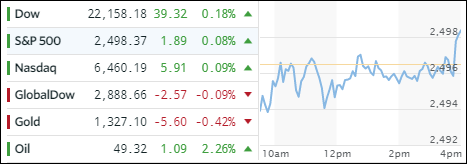
[Chart courtesy of MarketWatch.com]
  1. Moving the Markets

Another roller coaster day ended just about at the unchanged line for the Dow with the S&P 500 and Nasdaq managing to climb back into positive territory. For the week, the story was very similar with only the Nasdaq scoring a newsworthy gain of +1.8%.

The financial sector (XLF) slipped -0.4% with the Regional Banking ETF (KRE) also surrendering -0.64%, despite the Fed’s release of the results of stress tests on the health of the banking sector touting “that all 34 banks assessed to have strong levels of capital and would be able to keep lending even during a severe recession.”

For the week, healthcare (biotech) and technology were the winners while energy and financials were the laggards. Interest rates dropped this week with the 10-year bond ending the day unchanged at 2.15%. The US Dollar ETF (UUP) ended up slightly higher for the past 5 trading sessions but closed down the last 3 days in a row helping gold squeeze out a small gain and climb back above its 200-day M/A.

Read More

Weekly StatSheet For The ETF Tracker Newsletter – Updated Through 06/22/2017

Ulli ETF StatSheet Contact

ETF Data updated through Thursday, June 22, 2017

Methodology/Use of this StatSheet:

  1. From the universe of over 1,800 ETFs, I have selected only those with a trading volume of over $5 million per day (HV ETFs), so that liquidity and a small bid/ask spread are assured.
  2. Trend Tracking Indexes (TTIs)

Buy or Sell decisions for Domestic and International ETFs (section 1 and 2), are made based on the respective TTI and its position either above or below its long-term M/A (Moving Average). A crossing of the trend line from below accompanied by some staying power above constitutes a “Buy” signal. Conversely, a clear break below the line constitutes a “Sell” signal. Additionally, I use a 7.5% trailing stop loss on all positions in these categories to control downside risk.

  1. All other investment arenas do not have a TTI and should be traded based on the position of the individual ETF relative to its own respective trend line (%M/A). That’s why those signals are referred to as a “Selective Buy.” In other words, if an ETF crosses its own trendline to the upside, a “Buy” signal is generated. Since these areas tend to be more volatile, I recommend a wider trailing sell stop of 7.5% -10% depending on your risk tolerance.

If you are unfamiliar with some of the terminology, please see Glossary of Terms and new subscriber information in section 9.


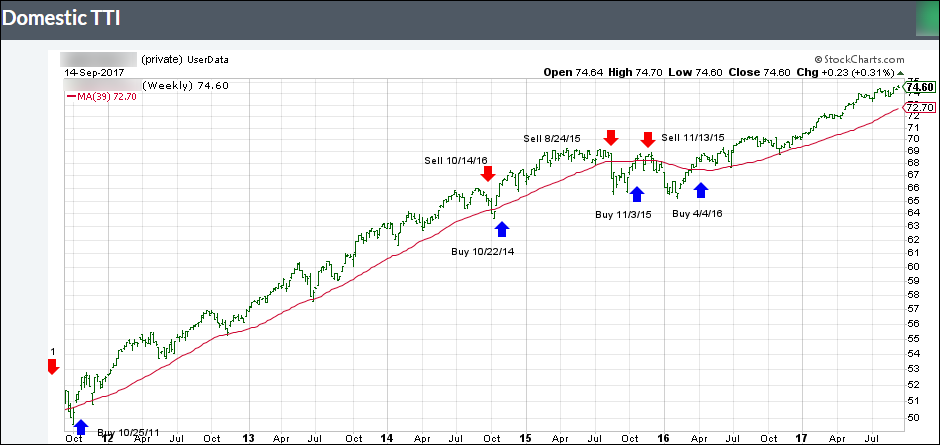
  1. DOMESTIC EQUITY ETFs: BUY — since 4/4/2016

Click on chart to enlarge

Our main directional indicator, the Domestic Trend Tracking Index (TTI-green line in the above chart) is positioned above its long-term trend line (red) by +3.55% after having generated a new Domestic Buy signal effective 4/4/2016 as posted.

Read More