Broad Weakness Can’t Stop Nasdaq From Setting New Record

Ulli Market Commentary Contact

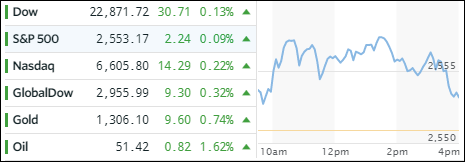
[Chart courtesy of MarketWatch.com]
  1. Moving the Markets

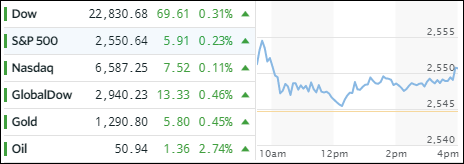
It was a nip and tuck kind of day with a rise in bond yields keeping any equity advances in check as hope prevailed that its impact on stocks would be ephemeral. The yield on the 10-year bond rose 2 basis points to 2.26% after having declined from a recent high of 2.39% set in early July.

The Nasdaq managed to shake off broad market uncertainty and finished the session in record territory by adding +0.36%. All eyes remain on upcoming earnings with nearly 200 S&P 500 companies being scheduled to show their report card this week.

Across all markets, it was a quiet day. The transportation index (IYT) headed south again as the VIX crashed to a new record closing low confirming total complacency in investor sentiment. The retail sector slipped with XRT losing -1.49%, but the financials (XLF) managed to eke out a gain of +0.36%. Both, the US dollar and gold, meandered all day but went nowhere.

The Fed is scheduled to begin its 2-day meeting on interest rates tomorrow but, while no change in rates is expected, the linguistic experts on Wall Street will surely dissect the Wednesday statement for any clues as to when the Fed intents to reduce its $4.5 trillion balance sheet.

Read More

One Man’s Opinion: Stockman Warns Of The Imperial City’s Fiscal Waterloo

Ulli Market Review Contact

By David Stockman

It’s all over now except the shouting about Obamacare repeal and replace, but that’s not the half of it.

The stand by Senators Lee and Moran was much bigger than putting the latest iteration of McConnell-Care out of its misery. The move rang the bell loud and clear that the Imperial City has become fiscally ungovernable.

That means there is a chamber of horrors coming. With it, an endless political and fiscal crisis that will dominate Washington for years to come. Its cause is deep and structural.

Founding Fathers, Fiscal Crisis and the Washington of Today

The founders, in fact, were small government de-centralists and non-interventionists. That’s why they agreed to Madison’s contraption of redundant checks and balances.

Aside from ruthlessly ambitious Alexander Hamilton, the founders wanted a national government that was hobbled by levels of hurdles and vetoes. They wanted a government that could act sparingly and only after thorough deliberation and consensus building.

Read More

ETFs On The Cutline – Updated Through 07/21/2017

Ulli ETFs on the Cutline Contact

Below please find the latest High Volume ETFs Cutline report, which shows how far above or below their respective long-term trend lines (39 week SMA) my currently tracked ETFs are positioned.

This report covers the HV ETF Master List from Thursday’s StatSheet and includes 366 High Volume ETFs ETFs, defined as those with an average daily volume of more than $5 million, of which currently 285 (last week 277) are hovering in bullish territory. The yellow line separates those ETFs that are positioned above their trend line (%M/A) from those that have dropped below it.

Take a look:

The HV ETF Master Cutline Report            

In case you are not familiar with some of the terminology used in the reports, please read the Glossary of Terms.

If you missed the original post about the Cutline approach, you can read it here.

ETF Tracker Newsletter For July 21, 2017

Ulli Market Commentary Contact

ETF Tracker StatSheet

https://theetfbully.com/2017/07/weekly-statsheet-etf-tracker-newsletter-updated-07202017/

LOWER ON THE DAY BUT HIGHER ON THE WEEK

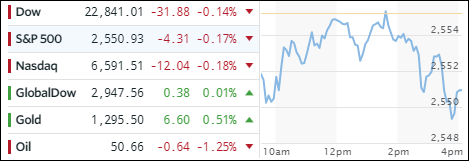
[Chart courtesy of MarketWatch.com]
  1. Moving the Markets

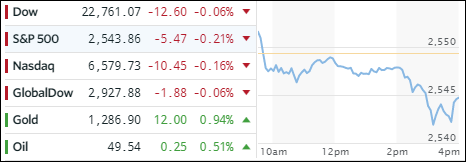
The major indexes, especially the Nasdaq, made a valiant effort to dig themselves out of an early hole in an attempt to conquer the unchanged line in order to keep the 10 day winning streak alive. Traders were “stunned” when the Nasdaq failed to achieve its 11th day of gains in a row. Of course, I am being facetious, but in the face of a market about as complacent as I have ever seen it, the indexes simply fell short despite manipulation to the contrary.

Things started out very poorly in Europe when concerns about alleged antitrust collusion for the past 20 years sent stock prices of the German Big-3 car makers (VW, Mercedes, BMW) into a tail spin, which was followed by their major indexes sinking sharply. The German DAX took the lead and lost -1.66%, as news spread across the Atlantic pushing the S&P 500 down by about -0.33%.

Even clubbing the VIX (Volatility Index) like baby seal in order to pump up stocks did not get the desired result and the VIX closed at 9.31, its lowest in history! Such are the methods being used to keep equities elevated. Utilities (XLU) were the week’s best performer obviously a result of sinking interest rates, which also assisted the 20-year bond to continue its bullish 2-week rebound. The whipping boy of the year, AKA the US dollar (UUP), extended its slide and lost another -0.33% to its lowest point since May 2016. It is now on target for the 6th monthly drop out of the last 7.

Read More

Weekly StatSheet For The ETF Tracker Newsletter – Updated Through 07/20/2017

Ulli ETF StatSheet Contact

ETF Data updated through Thursday, July 20, 2017

Methodology/Use of this StatSheet:

  1. From the universe of over 1,800 ETFs, I have selected only those with a trading volume of over $5 million per day (HV ETFs), so that liquidity and a small bid/ask spread are assured.
  2. Trend Tracking Indexes (TTIs)

Buy or Sell decisions for Domestic and International ETFs (section 1 and 2), are made based on the respective TTI and its position either above or below its long-term M/A (Moving Average). A crossing of the trend line from below accompanied by some staying power above constitutes a “Buy” signal. Conversely, a clear break below the line constitutes a “Sell” signal. Additionally, I use a 7.5% trailing stop loss on all positions in these categories to control downside risk.

  1. All other investment arenas do not have a TTI and should be traded based on the position of the individual ETF relative to its own respective trend line (%M/A). That’s why those signals are referred to as a “Selective Buy.” In other words, if an ETF crosses its own trendline to the upside, a “Buy” signal is generated. Since these areas tend to be more volatile, I recommend a wider trailing sell stop of 7.5% -10% depending on your risk tolerance.

If you are unfamiliar with some of the terminology, please see Glossary of Terms and new subscriber information in section 9.


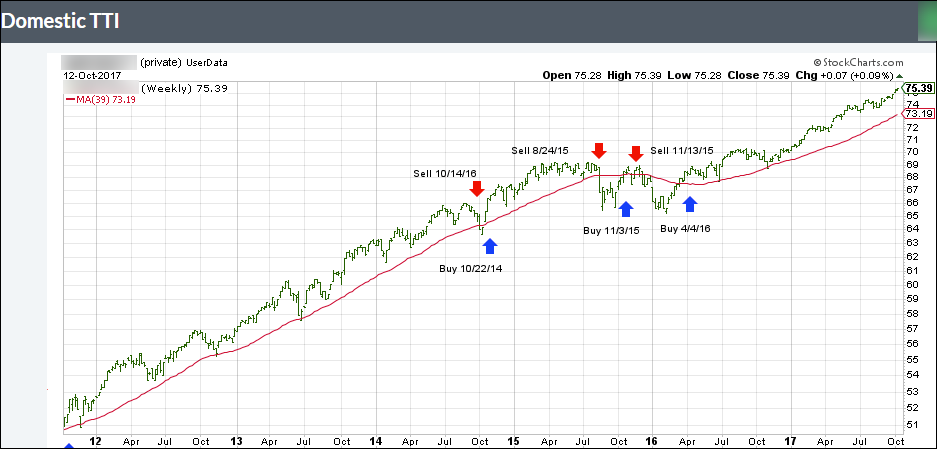
  1. DOMESTIC EQUITY ETFs: BUY — since 4/4/2016

Click on chart to enlarge

Our main directional indicator, the Domestic Trend Tracking Index (TTI-green line in the above chart) is positioned above its long-term trend line (red) by +3.87% after having generated a new Domestic Buy signal effective 4/4/2016 as posted.

Read More

Nasdaq Continues Ascent Into Record Territory

Ulli Market Commentary Contact

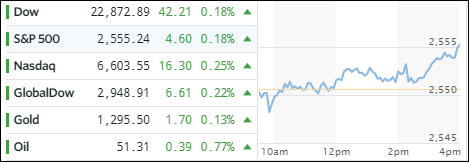
[Chart courtesy of MarketWatch.com]
  1. Moving the Markets

The major indexes limped around their respective unchanged lines all day with only the Nasdaq crawling above it and in the process setting another record close (10 up days in a row). Another soft economic data point disappointed as the Philly Fed survey missed expectations and slumped to its lowest point since November 2015. The survey summed up that “new orders collapsed, employees tumbled and the average work week slumped.” Not exactly awe inspiring, but in this new normal environment, any type of news are good for stocks.

The VIX tanked and thereby was the savior of the day as hawkish talk from BoJ and ECB could not derail the major indexes. However, what was derailed was the US dollar, which took another hit as UUP (-0.61%) dove to its lowest level since last August and making it 8 down days out of the last 10 sessions.

Interest rates leaked lower helping utilities (XLU) gain +0.69% while the 20-year T-Bond managed to tack on +0.29% and keeping its rebound off the 200-day M/A alive and well for the time being. Gold knee jerked and closed in the green while Crude oil went the other way and lost -0.83%.

Read More