Market Dumps As Volatility Pumps; Buy Signals Remains Intact

Ulli Market Commentary Contact

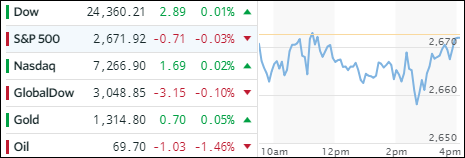
[Chart courtesy of MarketWatch.com]
  1. Moving the markets

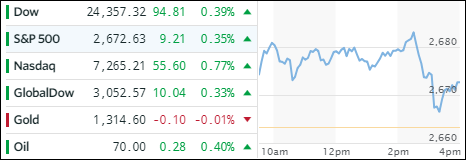
After last week’s pullback, today’s session had the major indexes hovering slightly below their unchanged lines right after the opening, when suddenly at mid-day the floodgates opened and equities went into freefall mode. Of course, the reason was not that individual investors all of a sudden decided to sell, but the more likely was catalyst that the computer algos played ping-pong and pushed equities south. Besides, we’ve come way too far too fast in terms of past year’s rally that a correction was way overdue.

As ZH reports, in terms of records, this was the biggest drop for the S&P 500 since August 2011 and the 410-day record streak without a 5% correction is over. Nasdaq is over 7% off its highs; Dow & S&P are over 8% off their highs. The VIX exploded to reach 37, which is quite a jump from the lows of just above 9 back in November.

One of the causes of the increased volatility has been the spike in interest rates since last September. Today, the 10-year yield jumped again touching 2.84% intra-day but pulled back to close down 7 basis points to end at 2.77%. Again, bucking the trend was the US Dollar (UUP), which has been in a bear market for the past year, but managed to bounce higher by +0.43%.

Our Trend Tracking Indexes (TTIs) remain on the bullish side of their respective trend lines (see section 3 below) but several of our trailing sell stops were triggered for some of our holdings and will be liquidated tomorrow. That is, unless a rebound rally is in the making in which case I will hold off another day.

Read More

ETFs On The Cutline – Updated Through 02/02/2018

Ulli ETFs on the Cutline Contact

Below please find the latest High Volume ETFs Cutline report, which shows how far above or below their respective long-term trend lines (39 week SMA) my currently tracked ETFs are positioned.

This report covers the HV ETF Master List from Thursday’s StatSheet and includes 366 High Volume ETFs ETFs, defined as those with an average daily volume of more than $5 million, of which currently 232 (last week 249) are hovering in bullish territory. The yellow line separates those ETFs that are positioned above their trend line (%M/A) from those that have dropped below it.

Take a look:

The HV ETF Master Cutline Report

In case you are not familiar with some of the terminology used in the reports, please read the Glossary of Terms.

If you missed the original post about the Cutline approach, you can read it here.

ETF Tracker Newsletter For February 2, 2018

Ulli ETF Tracker Contact

ETF Tracker StatSheet

https://theetfbully.com/2018/01/weekly-statsheet-etf-tracker-newsletter-updated-01-25-2018/

 S&P 500 AND DOW SPORT LARGEST WEEKLY DECLINE IN 2 YEARS

[Chart courtesy of MarketWatch.com]
  1. Moving the markets

There was simply no place to hide. After having broken all kinds of records during the past year, it was time for the bears to have their moment in the spotlight—at least for this week. The major indexes got spanked with the S&P 500 dropping -2.12% for the day, its biggest one-day drop since September 2016, and -3.9% for the week. Not helping matters was the VIX, which saw its largest spike since August 2015. However, the correction was orderly with no sense of panic.

Today’s pullback was not limited to US stocks, but equities around the world (China, Europe, Asia) confronted the long-known reality that nothing goes up forever. The question now is whether this is the beginning of a new bearish trend or merely a hiccup in this aging bull market. At this point it’s too early to tell, and we will need more data points to make that decision.

Contributing to this week’s market drop were a variety of reasons with rising interest rates being on top of the list. I have pointed out in previous posts that once a certain threshold is passed, bond yields will have a negative impact on equity prices. The 10-year yield is one of those indicators, and it shot higher again today by 6 basis points to close at 2.84%, its highest level since January 2014. That resulted in another pounding of the 20-year bond (TLT), which lost -0.93%.

Also not assisting the bulls was today’s stronger than expected jobs report (200k added) showing that wages grew at the fastest pace in more than 8 years, causing inflation fears to spread and pushing yields higher. As MarketWatch pointed out correctly, “the market is now pricing in tighter monetary policy if inflation driven by wage growth accelerates.”

Needless to say, red was the color of choice for the day. Interestingly, the US Dollar (UUP) vacillated around the unchanged line but managed to eke out a gain of +0.61%.

Read More

Weekly StatSheet For The ETF Tracker Newsletter – Updated Through 02/01/2018

Ulli ETF StatSheet Contact

ETF Data updated through Thursday, February 1, 2018

Methodology/Use of this StatSheet:

  1. From the universe of over 1,800 ETFs, I have selected only those with a trading volume of over $5 million per day (HV ETFs), so that liquidity and a small bid/ask spread are assured.
  2. Trend Tracking Indexes (TTIs)

Buy or Sell decisions for Domestic and International ETFs (section 1 and 2), are made based on the respective TTI and its position either above or below its long-term M/A (Moving Average). A crossing of the trend line from below accompanied by some staying power above constitutes a “Buy” signal. Conversely, a clear break below the line constitutes a “Sell” signal. Additionally, I use a 7.5% trailing stop loss on all positions in these categories to control downside risk.

  1. All other investment arenas do not have a TTI and should be traded based on the position of the individual ETF relative to its own respective trend line (%M/A). That’s why those signals are referred to as a “Selective Buy.” In other words, if an ETF crosses its own trendline to the upside, a “Buy” signal is generated. Since these areas tend to be more volatile, I recommend a wider trailing sell stop of 7.5% -10% depending on your risk tolerance.

If you are unfamiliar with some of the terminology, please see Glossary of Terms and new subscriber information in section 9.


  1. DOMESTIC EQUITY ETFs: BUY — since 4/4/2016

Click on chart to enlarge

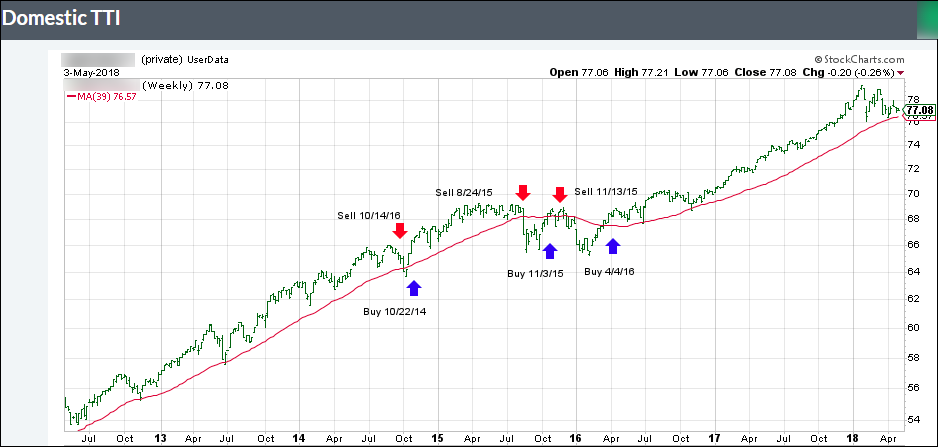
Our main directional indicator, the Domestic Trend Tracking Index (TTI-green line in the above chart) is positioned above its long-term trend line (red) by +4.64% after having generated a new Domestic Buy signal effective 4/4/2016 as posted.

Read More

Uncertainty Reigns Ahead Of Jobs Report

Ulli Market Commentary Contact

[Chart courtesy of MarketWatch.com]
  1. Moving the markets

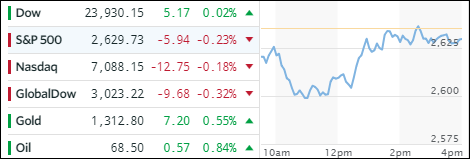
It was another roller coaster ride with the indexes vacillating around their unchanged lines. A nice mid-day rally fizzled out and accelerated to the downside in the last hour when dip buyers stepped in to limit the damage. Volatility picked up due to rising interest rates and inflation along with uncertainty ahead of tomorrow’s jobs report.

The mixed picture carried over to ETF land where winners and losers were just about evenly matched. Bucking the bearish trend were Financials (XLF +0.94%), Aerospace & Defense (ITA +0.57%) and International SmallCaps (SCHC +0.42%). On the other end of the spectrum, we saw Emerging Markets (SCHE -1.41%), Semiconductors (SMH -0.61%) and Transportations (IYT -0.56%) closing in the red.

The bond arena saw a bloodbath today with the yield on 10-year jumping 6 basis points to 2.78%, a level last seen in April 2014, while the 30-year climbed above the 3% level to end the session at 3.01%. As a result, bond prices plunged with the widely held 20-year (TLT) losing -1.45%, which it had last visited in May last year.

If you are wondering how the US dollar (UUP) fared in this environment, it should come as no surprise that it got spanked as well (-0.52%), or monkey hammered as some analysts referred to it. But, but, as President Trump recently confirmed, we have a strong dollar policy. Go figure…

Read More

Stumbling But Closing In The Green

Ulli Market Commentary Contact

[Chart courtesy of MarketWatch.com]
  1. Moving the markets

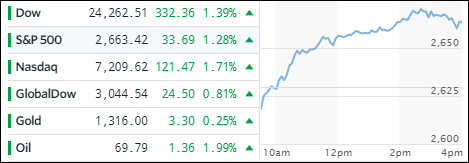
An early rebound faltered, and the major indexes declined below the unchanged line but managed to crawl back into positive territory to close out the month with solid gains. The Dow added +5.8%, its best January since 1997, while the S&P 500 and Nasdaq rallied +5.6% and +7.4% respectively. The culprit for the weakness was the Fed hinting that it is “set to raise interest rates as early as its next meeting in March.

As a result, bonds were spooked with the 10-year yield bouncing to 2.74%, which is its highest level since early 2014, but closing at 2.72%. In the end, equities closed mixed along with our ETFs. Emerging markets (SCHE) were the clear leader with a solid gain of +1.26%, which was closely followed by Semiconductors (SMH +0.84%). Closing in the red were US SmallCaps (SCHA -0.50%) and International SmallCaps (SCHC -0.10%).

Gold and Crude Oil both closed up, but the US Dollar (UUP) lost another -0.13% and had its worst January since 1987.

Read More