Weekly StatSheet For The ETF Tracker Newsletter – Updated Through 07/26/2018

Ulli ETF StatSheet Contact

ETF Data updated through Thursday, July 26, 2018

Methodology/Use of this StatSheet:

  1. From the universe of over 1,800 ETFs, I have selected only those with a trading volume of over $5 million per day (HV ETFs), so that liquidity and a small bid/ask spread are assured.
  2. Trend Tracking Indexes (TTIs)

Buy or Sell decisions for Domestic and International ETFs (section 1 and 2), are made based on the respective TTI and its position either above or below its long-term M/A (Moving Average). A crossing of the trend line from below accompanied by some staying power above constitutes a “Buy” signal. Conversely, a clear break below the line constitutes a “Sell” signal. Additionally, I use a 7.5% trailing stop loss on all positions in these categories to control downside risk.

  1. All other investment arenas do not have a TTI and should be traded based on the position of the individual ETF relative to its own respective trend line (%M/A). That’s why those signals are referred to as a “Selective Buy.” In other words, if an ETF crosses its own trendline to the upside, a “Buy” signal is generated. Since these areas tend to be more volatile, I recommend a wider trailing sell stop of 7.5% -10% depending on your risk tolerance.

If you are unfamiliar with some of the terminology, please see Glossary of Terms and new subscriber information in section 9.


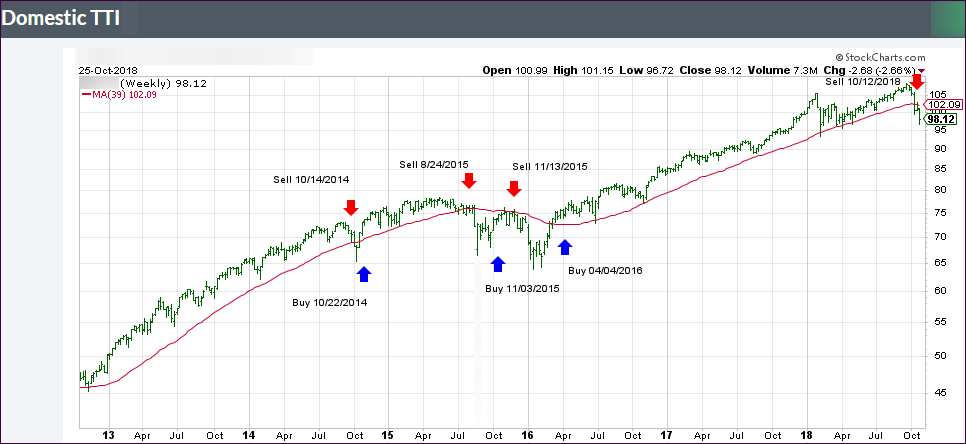
  1. DOMESTIC EQUITY ETFs: BUY — since 4/4/2016

Click on chart to enlarge

Our main directional indicator, the Domestic Trend Tracking Index (TTI-green line in the above chart) is positioned above its long-term trend line (red) by +2.82% after having generated a new Domestic Buy signal effective 4/4/2016 as posted.

Read More

Diverging Markets

Ulli Market Commentary Contact

[Chart courtesy of MarketWatch.com]
  1. Moving the markets

As I pointed out yesterday, Facebook’s (FB) horrific earnings report and news of further revenue deceleration for the second half of this year did spread to the Nasdaq, which stumbled and surrendered most of yesterday’s gains. Not only did FB end up losing $123 billion of its market cap, insider trading rumors are sure to be pursued.

The fallout from FB’s jaw dropping one-day loss goes even deeper, as the stock has been the darling of the hedge fund industry, which lost an estimated $6 billion in a matter of hours. Surely, FB will very likely not appear in their top 10 list for a while.

Quipped ZH: FB’s Zuckerberg lost $15 billion overnight. How will he get by on just $70 billion?

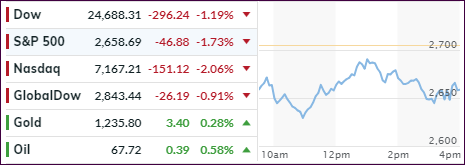
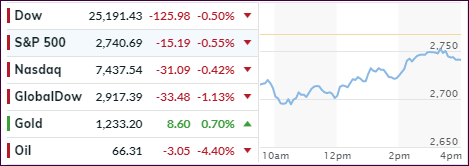
The S&P 500 followed to the downside with a modest -0.30% loss, while the Dow diverged and closed in the green as the earnings season continued in full force. Some major companies reported better-than-expected results, which may offset some of the negativity spread by FB.

While unexpected surprises, such as FB, can rock the markets, they may very well be isolated events and not reflective of overall market direction. Of course, more bad tech news (Amazon earnings are on deck), along with trade war talks, can make their presence known at any time and suddenly increase uncertainty and risk—something that we simply must live with.

If the risk gets too high in any one asset class, our trailing sell stops will point the way to the exit door to reduce exposure and therefore limit portfolio damage.

Read More

Easing EU Trade Tensions Propel Equities; International “Buy” generated

Ulli Market Commentary Contact

[Chart courtesy of MarketWatch.com]
  1. Moving the markets

Trade tensions were on the front burner again, but this time not with China but with the EU, as President Trump and EU President Juncker met and hailed a new phase in trade relations. The White House meeting ended with the following positive joint statement:

“We agree today, first of all, to work together toward zero tariffs, zero non-tariff barriers, and zero subsidies on non-auto industrial goods.”

While negotiations will go on, the outcome was nevertheless presented as a new phase of trade relations with more eliminations of tariffs on the horizon.

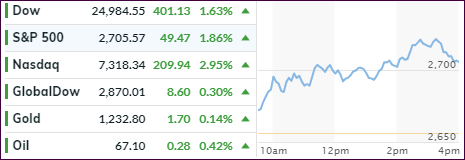
Without diving into details, this announcement was all that was needed to power the markets higher with the major indexes gaining solidly as the S&P 500 approached its January highs (2,873). The advances were broad, and not isolated as we’ve seen in the recent past, pushing all of our positions to a green close.

Transportations (IYT) took top billing by sprinting ahead +2.34% followed by the Nasdaq (QQQ) with +1.40%. However, as I am writing this, there is trouble in tech land with Facebook (FB) being in the process of doing a faceplant, with its stock taking a dive (now down -23% and counting). It has officially entered bear market territory as FB’s growth rates continue to decelerate. Ouch!

This will make for an interesting market opening tomorrow with the tech sector appearing to give back possibly more than its hard-fought gains of today. It also goes to show that asset direction can turn on a dime these days, and no event in the markets can be assumed as having any permanence. To me, these are all signs of a topping formation, brought on by an aging bull market, where volatility is a constant companion caused by the latest headline hockey.

Read More

Shrugging Off A Massive Tech Reversal

Ulli Market Commentary Contact

[Chart courtesy of MarketWatch.com]
  1. Moving the markets

Something odd is going on in the markets besides the Chinese Yuan having crashed more in the last 30 days than at anytime in history not counting the 2008 Great Financial Crisis. Yesterday, it was the sudden 10-year bond yield spike to its highest level in 5 months.

Today, it was a huge reversal in the Nasdaq, which had advanced some 1.1% intraday early on to a new record high, but these solid gains evaporated, and the index limped below the unchanged line by -0.01%. Even Google’s “beat” and subsequent rally could not stem the slide. Strangely enough, the Dow and S&P 500 were not affected at all and closed with decent gains.

Transportations (IYT) gave back some of their recent advances, and the Commodity Index (DBC) rallied because of a modestly weaker US Dollar. Activity in the 10-year bond yield slowed down from yesterday’s hectic pace, and the yield perked up 1 basis point to 2.95%.

Volatility and wild unexpected swings in different asset classes appear to be here to stay making me wonder not only as to “who’s next?” but also “will there be spillover effects?” Only time will tell.

Read More

Dow Skids; S&P 500 And Nasdaq Advance

Ulli Market Commentary Contact

[Chart courtesy of MarketWatch.com]
  1. Moving the markets

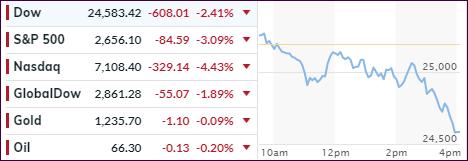
The tech and banking sector combined forces to put a floor under an early slide that helped the S&P 500 and Nasdaq to modest gains, but the Dow fell short of reaching the unchanged line by -0.06%, as 3M proved to be the baggage by sliding -1.5%.

While trade war rhetoric with China was noticeably absent, the warring factions simply changed, as Trump now traded barbs on Twitter Sunday evening with Iranian President Rouhani regarding alleged hostilities. That certainly did not give Wall Street traders the warm fuzzies and markets meandered for a while before settling down and cutting early losses.

At the same time, finance ministers and central bankers from the G20 had nothing to show for after a weekend meeting in Buenos Aires on trade tensions. That event reminded me of a tug-of-war with both parties digging in but neither one managing to get control of the rope.

As noted last week, earnings season will be kicking into high gear over the next few trading sessions. So far, earnings are up 21% this quarter, which is supposed to be a floor for further stock market advances. Of course, economic data points will have an influence as well and today’s existing home sales were anything but awe inspiring, as they suffered their worst losing streak since 2014. In June, they tumbled 0.6% MoM vs expectations of a 0.2% rise. Ouch!

Interest rates spiked with the 10-year yield jumping 7 basis points to 2.96%, its highest level in 5 weeks. That brings a total different meaning to my favorite chart in that the 30-year yield has now caught up to the level of the Nasdaq, when it would have been more likely for the Nasdaq to catch down to the level of the yield.

That simply goes to show that you can never be too certain, but we’ll have to wait and see if those two remain in sync or if this was just an aberration.

Read More

ETFs On The Cutline – Updated Through 07/20/2018

Ulli ETFs on the Cutline Contact

Below, please find the latest High Volume ETFs Cutline report, which shows how far above or below their respective long-term trend lines (39 week SMA) my currently tracked ETFs are positioned.

This report covers the HV ETF Master List from Thursday’s StatSheet and includes 366 High Volume ETFs ETFs, defined as those with an average daily volume of more than $5 million, of which currently 150 (last week 158) are hovering in bullish territory. The yellow line separates those ETFs that are positioned above their trend line (%M/A) from those that have dropped below it.

Take a look:

The HV ETF Master Cutline Report

In case you are not familiar with some of the terminology used in the reports, please read the Glossary of Terms.

If you missed the original post about the Cutline approach, you can read it here.