3rd Up Day In A Row

Ulli Market Commentary Contact

[Chart courtesy of MarketWatch.com]
  1. Moving the markets

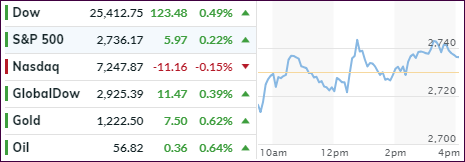
Sentiment was predominantly bullish with the major indexes scoring another winning session supported by a couple of billion-dollar mergers. At the same time, optimism reigned supreme that a solution will be found to bring the trade-tug-of-war between the US and China to a mutually acceptable conclusion.

As the WSJ reported Friday, negotiators are mapping out talks with the aim to have a resolution in place by November. If this comes to pass, a lot of market uncertainty would be removed, which would increase the odds of renewed strength in the equity markets. On the other hand, Trump just announced that he “does not anticipate much progress from the trade talks” and “there was not timeframe” for ending the dispute.

Right now, however, the reality looks quite different in that 25% tariffs on $16 billion of Chinese imports will be implemented later this week. That for sure will provoke a retaliatory move from China.

Outside the US, the events in Turkey continue to be troubling, as the lira and the stock market have been hammered and high inflation, political instability and debt, along with potential contagion, remain a constant focal point for global investors.

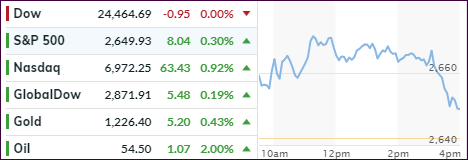
Bond bears were the ones that suffered some losses today, as yields weakened, and bonds rallied. The 10-year lost 5 basis points to close at 2.82%, its lowest since the end of May. It’s not clear yet if that was the result of reports announcing that Trump accused the Fed of not being dovish enough.

On deck for this Wednesday is the release of the minutes from the Fed’s most recent meeting. Every word will be scrutinized to gain insight into the path of intended interest rate policy over the remainder of the year.

Read More

ETFs On The Cutline – Updated Through 08/17/2018

Ulli ETFs on the Cutline Contact

Below, please find the latest High-Volume ETF Cutline report, which shows how far above or below their respective long-term trend lines (39-week SMA) my currently tracked ETFs are positioned.

This report covers the HV ETF Master List from Thursday’s StatSheet and includes 366 High Volume ETFs ETFs, defined as those with an average daily volume of more than $5 million, of which currently 162 (last week 165) are hovering in bullish territory. The yellow line separates those ETFs that are positioned above their trend line (%M/A) from those that have dropped below it.

Take a look:

The HV ETF Master Cutline Report

In case you are not familiar with some of the terminology used in the reports, please read the Glossary of Terms.

If you missed the original post about the Cutline approach, you can read it here.

ETF Tracker Newsletter For August 17, 2018

Ulli ETF Tracker Contact

ETF Tracker StatSheet

https://theetfbully.com/2018/08/weekly-statsheet-for-the-etf-tracker-newsletter-updated-through-08-16-2018/

TRADE TALK OPTIMISM CONTINUES

[Chart courtesy of MarketWatch.com]
  1. Moving the markets

While we were off to a slow start, market direction changed in a hurry on continued optimism over the upcoming trade talks with China pushing the major indexes in the green for the second straight day. The Nasdaq lagged while the Dow closed at its highest since February.

The upcoming trade talks with China were reinforced by optimism that a mutually beneficial solution will eventually be found, which proved to be again the force that supported upward market momentum. Especially, news of a road map to reach a deal that could lead to a summit between Trump and Xi Jinpin later this year helped the positive sentiment.

Putting a bit of a downer on the mood on Wall Street were the latest headlines from Turkey, as their currency headed south again at the tune of 4%. It appears that the story is far from being over and will continue to create market headwinds, the severity of which will depend on the magnitude of the events.

Not helping matters was Moody’s, which joined S&P and Fitch in downgrading Turkey’s long-term foreign debt rating to Ba3 from Ba2 and shifting their outlook to “negative” from “watch negative.” Then S&P unleashed the truth by forecasting “a recession next year. Inflation will peak at 22% over the next 4 months, before subsiding to below 20% by mid-2019.” Ouch!

Despite global turmoil in the markets, with global stocks being down 14% from their all-time highs in January, US equities have been dominating YTD as this chart shows. That means we are still the cleanest dirty shirt in the dirty laundry basket, which to me begs the question is “how long can we remain isolated?

Read More

Weekly StatSheet For The ETF Tracker Newsletter – Updated Through 08/16/2018

Ulli ETF StatSheet Contact

ETF Data updated through Thursday, August 16, 2018

Methodology/Use of this StatSheet:

  1. From the universe of over 1,800 ETFs, I have selected only those with a trading volume of over $5 million per day (HV ETFs), so that liquidity and a small bid/ask spread are assured.
  2. Trend Tracking Indexes (TTIs)

Buy or Sell decisions for Domestic and International ETFs (section 1 and 2), are made based on the respective TTI and its position either above or below its long-term M/A (Moving Average). A crossing of the trend line from below accompanied by some staying power above constitutes a “Buy” signal. Conversely, a clear break below the line constitutes a “Sell” signal. Additionally, I use a 7.5% trailing stop loss on all positions in these categories to control downside risk.

  1. All other investment arenas do not have a TTI and should be traded based on the position of the individual ETF relative to its own respective trend line (%M/A). That’s why those signals are referred to as a “Selective Buy.” In other words, if an ETF crosses its own trendline to the upside, a “Buy” signal is generated. Since these areas tend to be more volatile, I recommend a wider trailing sell stop of 7.5% -10% depending on your risk tolerance.

If you are unfamiliar with some of the terminology, please see Glossary of Terms and new subscriber information in section 9.


  1. DOMESTIC EQUITY ETFs: BUY — since 4/4/2016

Click on chart to enlarge

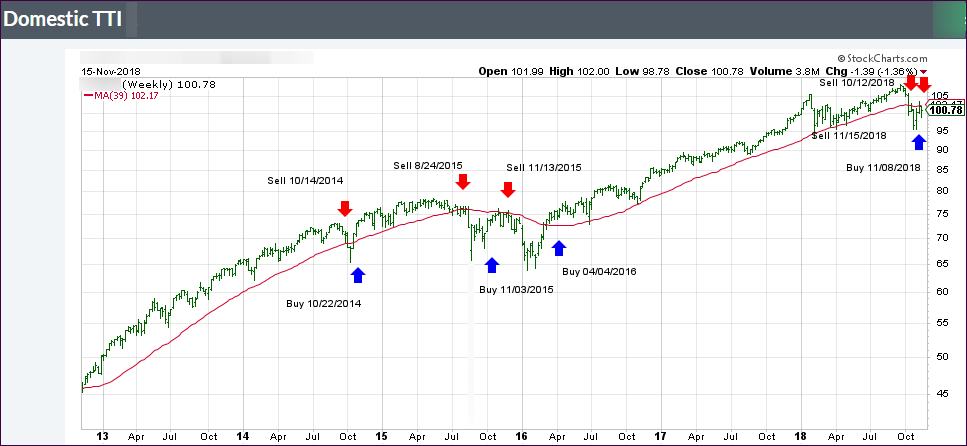
Our main directional indicator, the Domestic Trend Tracking Index (TTI-green line in the above chart) is positioned above its long-term trend line (red) by +2.57% after having generated a new Domestic Buy signal effective 4/4/2016 as posted.

Read More

Hope Of Trade Talk Resumptions Powers Markets

Ulli Market Commentary Contact

[Chart courtesy of MarketWatch.com]
  1. Moving the markets

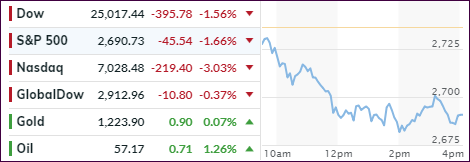
It didn’t take much to get the markets going after yesterday’s drubbing and the see-saw action we’ve seen over the past week. Strong earnings from Walmart and Cisco set the tone early on, and reports of a resumption of US/China trade talks next week provided the ammo to push the major indexes up with the Dow having its best day in some 4 months.

Please note the absurdity in that the trade wars with China have not been resolved in any way, shape or form. It was merely the mention of these talks being reopened again that helped boost overall sentiment and motivated the bulls to come out full force.

The Turkish currency turmoil subsided somewhat as the lira rallied for a 3rd straight session against the dollar. Throwing an assist was Qatar, which provided a lifeline by investing $15 billion in Turkey, after Turkey’s FinMin soothed raw nerves by announcing that “capital controls would be ruled out as a policy option.” That’s a good thing as these would likely promote broad capital flight from an Emerging Market space.

Not all stocks participated in today’s rebound as the FANGs resumed their downtrend thanks to a 3% stumble in Facebook. The FANGs are now within shouting distance of touching their 10% correction level, as you can see here.

Looking at the big picture, there is only one thing that has been responsible for the recent weakness in the markets as well as for the strength over the past 3 years. Take a guess and then see the answer presented in this chart.

Read More

Turkey Turmoil Returns; A-Dead-Cat Bounce Dies

Ulli Market Commentary Contact

[Chart courtesy of MarketWatch.com]
  1. Moving the markets

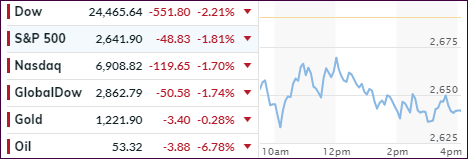
I felt that yesterday’s rebound had the smell of a dead-cat-bounce and, based on today’s carnage, that seems to have been accurate—at least for the time being. Despite assurances to the opposite, the “C” word, as in contagion, was suddenly on investors’ minds, as concerns about Turkey’s currency crisis and US/China trade tensions made their presence felt.

The damage was not limited to equities but also to energy, which was the worst performing sector in the S&P with crude oil getting pounded at the rate of over 3%. The major indexes, while off to a poor start after the opening, managed to limit some losses by crawling back but not reaching the unchanged line.

Globally, the outcome was similar with stocks not just falling to 6-week lows but also breaking below major averages, which affected our Domestic TTI by confirming that a new “Sell” signal indeed has been triggered. More in section 3 below.

Contagion is a distinct possibility as a result of the fallout from Turkey’s currency destruction, which already has affected the European banks and, which are now in bear market territory meaning they have come off their highs by more than 20%.

Taking this a step further, stocks of GSIBs, also known as Globally Systemic Important Banks, have dropped 23% off their highs with no end in sight. Remember, these are banks that must be supported by governments at all costs, or things may turn real ugly very fast—economically speaking that is.

Even the VIX appeared to have woken up from a summer snooze by spiking to 17 but settling back down to the 15 area. Benefiting from this wild trading day were interest rates, which dropped as the 10-year bond yield settled down 3 basis points to 2.86%.

As I pointed out yesterday, only a few US banks have direct involvement in Turkey, so this is currently viewed only as one more addition to global uncertainties, of which there are plenty. I don’t think this will simply go away or be resolved quickly, so we must be alert to this being only one domino that can have serious effects on the European banking system and by extension, US banks as well.

Read More