ETF Tracker Newsletter For August 31, 2018

Ulli ETF Tracker Contact

ETF Tracker StatSheet

https://theetfbully.com/2018/08/weekly-statsheet-for-the-etf-tracker-newsletter-updated-through-08-30-2018/

A CHOPPY END TO A GOOD MONTH

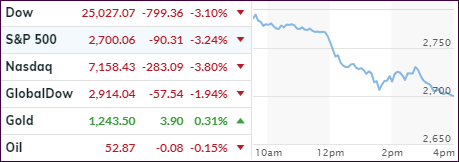
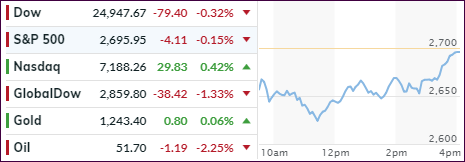
[Chart courtesy of MarketWatch.com]
  1. Moving the markets

You could have pretty much counted on what happened today, namely that the major indexes vacillated aimlessly around their respective unchanged lines just to make it to the closing bell. While the Dow slipped a tad, the S&P 500 and Nasdaq ended in the green, but for the month, all three of them showed solid gains.

Never mind that the Emerging Markets’ bloodbath not only continued but spread to other currencies. Besides the weakness in the list of EMs I described yesterday, we saw a newcomer on the scene. The Indonesian Rupiah plunged to a two-decade low against the US Dollar, while Italy took a step in the limelight again with its 10-year bond getting hit hard as interest rate surged.

The Canadian dollar was in the spotlight indirectly and saw its currency slide as trade negotiators turned sour last night and were concerned whether a deal would be possible.

But, the focus continued to remain on other EMs, such as Turkey and Argentina, whose currency crises, if left to their own devices, will certainly have a domino effect across developed countries.

In the end, US stocks showed the greatest performance with especially the Nasdaq shining brightly by having its best August since the DotCom bubble, thanks to Apple and Amazon, which combined accounted for 25% of the entire Nasdaq gain in August. Talk a about a concentrated move…

This euphoric performance was helped by the biggest drop in bond yields since March leaving me pondering of the odds of this bullishness continuing as we enter the notoriously volatile months of September and October. Only time will tell…

Read More

Weekly StatSheet For The ETF Tracker Newsletter – Updated Through 08/30/2018

Ulli ETF StatSheet Contact

ETF Data updated through Thursday, August 30, 2018

Methodology/Use of this StatSheet:

  1. From the universe of over 1,800 ETFs, I have selected only those with a trading volume of over $5 million per day (HV ETFs), so that liquidity and a small bid/ask spread are assured.
  2. Trend Tracking Indexes (TTIs)

Buy or Sell decisions for Domestic and International ETFs (section 1 and 2), are made based on the respective TTI and its position either above or below its long-term M/A (Moving Average). A crossing of the trend line from below accompanied by some staying power above constitutes a “Buy” signal. Conversely, a clear break below the line constitutes a “Sell” signal. Additionally, I use a 7.5% trailing stop loss on all positions in these categories to control downside risk.

  1. All other investment arenas do not have a TTI and should be traded based on the position of the individual ETF relative to its own respective trend line (%M/A). That’s why those signals are referred to as a “Selective Buy.” In other words, if an ETF crosses its own trendline to the upside, a “Buy” signal is generated. Since these areas tend to be more volatile, I recommend a wider trailing sell stop of 7.5% -10% depending on your risk tolerance.

If you are unfamiliar with some of the terminology, please see Glossary of Terms and new subscriber information in section 9.


  1. DOMESTIC EQUITY ETFs: BUY — since 4/4/2016

Click on chart to enlarge

Our main directional indicator, the Domestic Trend Tracking Index (TTI-green line in the above chart) is positioned above its long-term trend line (red) by +5.26% after having generated a new Domestic Buy signal effective 4/4/2016 as posted.

Read More

Sliding Into The End Of The Month

Ulli Market Commentary Contact

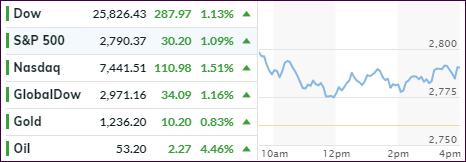
[Chart courtesy of MarketWatch.com]
  1. Moving the markets

All good things must end eventually. That was the case today, as the 4-day win streak was snapped with the major indexes slipping modestly ahead of the Labor Day weekend. Sure, after scoring repeated record highs, a pause was in order, but at mid-day other factors contributed to the sudden downside acceleration.

Abruptly, tariff troubles were on everybody’s mind when news headlines announced, what everyone already knew, that $200 billion of China tariffs were set to be implemented next week after the expiration of the ‘comment’ period. That was enough to finally give the bears some ammunition and south we went, as the VIX and S&P 500 continued their decoupling.

Not reported much by MSM was the bloodbath in the Emerging Markets’ currencies (EM), which accelerated throughout the day. The problems seem to be deepening with the Indian Rupee, Brazilian Real, and the Turkish Lira getting spanked hard. Topping off the charts as the biggest loser of the day was the Argentinian Peso, which crashed, despite a rate hike, but bounced into the close.

These are critical development and, while in their early stages, will spread and likely affect the European banking system and then move eventually across the Atlantic. For right now, they appear to be localized events until, one day, investors realize that we are all financially connected and affected, and that there is no true isolation.

While I don’t expect much enthusiasm tomorrow, it being the last trading day of August when volume will likely slow to a crawl, the EM currencies may continue their radical moves. I for one think that these are important developments, maybe representing the infamous canary in the coalmine, and will stay on top of their changes and the havoc they may be creating.

Read More

Bulls Clearly In Charge

Ulli Market Commentary Contact

[Chart courtesy of MarketWatch.com]
  1. Moving the markets

And the beat goes on. At least for the moment, the major indexes act like a run-away train with nothing being able to stop it. The S&P 500 and Nasdaq are continuing to rip higher and scored a 4th straight record close while the Dow finished at its highest point since February.

Helping equities levitate to ever higher levels was a revised 2nd Qtr. GDP number, with a second estimate of 4.23% (annualized) vs. the original 4.0%. That makes it the highest since the summer of 2016. Then there was renewed optimism that a new trade deal with Canada may be forthcoming, possibly in a similar fashion like the one just announced with Mexico.

On the downside, we saw that pending home sales slumped for the 7th straight month by -0.7% missing expectations (+0.3%) by a wide margin and confirming that housing has hit the broadest slowdown in years. Remember that recent reports showed similarly dismal results for Existing- and New-home sales as well as mortgage applications.

With all that euphoria going on, it’s worthy to note that the decoupling continues. There is the Chinese Yuan which, after staging a nice rally, has recently shown weakness again. Bond yields have come off their highs and are showing this picture when charted against the S&P 500. And last, but not least, the Emerging Market currencies are collapsing again, as shown here in today’s chart.

When this type of decoupling occurs, it’s just a matter of time that these discrepancies will correct to fair value. The open-ended question is: In which direction will the correction occur? We will have to wait and see, but let’s enjoy the present moment of being on the ‘right’ side of the market.

Read More

Taking A Breather

Ulli Market Commentary Contact

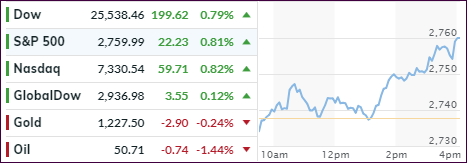
[Chart courtesy of MarketWatch.com]
  1. Moving the markets

It comes as no surprise that, after yesterday’s strong run-up, the major indexes took a bit of a breather, however, they still managed to close in the green, despite dipping below the unchanged line several times during the session.

So far, it looks that this month may turn out to be the second-best August since 2009, a very interesting occurrence, especially when considering the ever widening gap between the S&P 500 and the collapse of US economic data, which is hardly awe inspiring (hat tip to ZH for these charts).

So, the markets appear to be driven by other factors, and not sound fundamentals. Today, a small assist came from a measure of consumer confidence that hit a nearly 18-year high and was an exception to the slumping data points of the recent past.

The foreign currency debacle continued today led by the Turkish lira plunging -2.35%. This escalated predominantly in the Latin American countries as this chart shows. However, the shakeup was not big enough to make the headlines nor did it affect domestic equities.

Nevertheless, after a slow start, stocks came alive during the second half of August and put in a good performance, despite this being the dog days of summer. With only 3 trading days left, let’s see if traders’ appetites remain bullish.

Read More

Equities Shift Into Overdrive

Ulli Market Commentary Contact

[Chart courtesy of MarketWatch.com]
  1. Moving the markets

So much for the dog days of summer, as the S&P 500 and Nasdaq closed at record highs for the second day in a row powered by excitement over the new trade deal between the US and Mexico.

The Dow successfully reclaimed the 26k level for the first time since February, while the Nasdaq conquered the 8k milestone, which took only some 5 months to accomplish after the 7k landmark was breached. This makes it the second 1,000-point advance this year, a feat last seen in 1999.

While the new trade deal with our southern neighbor sparked today’s solid advance, optimism from Friday’s Fed announcement that they would “continue its strategy of gradually normalizing its monetary policy,” carried over into today’s session and contributed to the bullish mood.

Additionally, traders are convinced that the economy remains on solid footing, which helped them disregard a variety of headwinds ranging from signs of a weakening housing market, negative headlines, emerging market currency crises and the ever-present trade policy uncertainty.

Interest rates rose with bond yields crawling higher, as the decoupling of the stock market and bond market continues, but the 30-year remains below the 3% level. After peaking mid-August, the US Dollar continued doing an about face by having retreated to the level where it started the month.

Goldman Sachs shed some light as why the markets ripped higher in August. They pointed out that August is typically the busiest month for corporate buy-backs when measured over the last decade. And I thought it was the resilient economy…

Read More