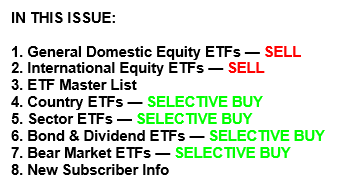
Weekly StatSheet For The ETF Tracker Newsletter – Updated Through 09/13/2018

Ulli ETF StatSheet Contact

ETF Data updated through Thursday, September 13, 2018

Methodology/Use of this StatSheet:

  1. From the universe of over 1,800 ETFs, I have selected only those with a trading volume of over $5 million per day (HV ETFs), so that liquidity and a small bid/ask spread are assured.
  2. Trend Tracking Indexes (TTIs)

Buy or Sell decisions for Domestic and International ETFs (section 1 and 2), are made based on the respective TTI and its position either above or below its long-term M/A (Moving Average). A crossing of the trend line from below accompanied by some staying power above constitutes a “Buy” signal. Conversely, a clear break below the line constitutes a “Sell” signal. Additionally, I use a 7.5% trailing stop loss on all positions in these categories to control downside risk.

  1. All other investment arenas do not have a TTI and should be traded based on the position of the individual ETF relative to its own respective trend line (%M/A). That’s why those signals are referred to as a “Selective Buy.” In other words, if an ETF crosses its own trendline to the upside, a “Buy” signal is generated. Since these areas tend to be more volatile, I recommend a wider trailing sell stop of 7.5% -10% depending on your risk tolerance.

If you are unfamiliar with some of the terminology, please see Glossary of Terms and new subscriber information in section 9.


  1. DOMESTIC EQUITY ETFs: BUY — since 4/4/2016

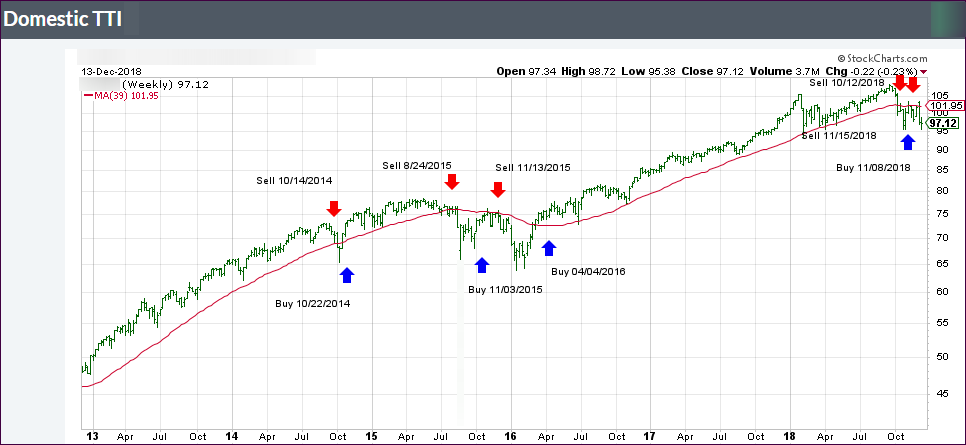
Click on chart to enlarge

Our main directional indicator, the Domestic Trend Tracking Index (TTI-green line in the above chart) is positioned above its long-term trend line (red) by +5.35% after having generated a new Domestic Buy signal effective 4/4/2016 as posted.

Read More

Bulls Dominate For Fourth Straight Day

Ulli Market Commentary Contact

[Chart courtesy of MarketWatch.com]
  1. Moving the markets

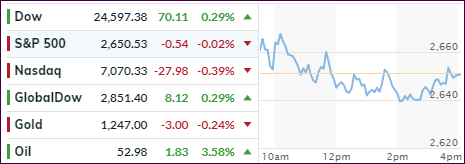
The bulls dominated again and pushed the major indexes higher with the S&P 500 scoring its fourth straight win. Yesterday’s laggard turned into today’s leader, as the tech sector picked up steam with the Nasdaq adding +0.75%, after spiking during the last few minutes of the session.

Helping set the bullish tone were reports suggesting that China was more receptive to the latest propositions from the US regarding trade talk issues. Of course, as we’ve seen in the past, these types of headlines tend to come and go and have, so far, not produced any tangible results.

In Europe, the ECB made no change to interest rates and announced that it has no plans to do so till summer 2019. That seemed to sooth markets despite them trimming the GDP forecast for 2018 and next year as well. Market reaction was muted.

Looking at the big picture, we see that US stocks continue to decouple from the rest of the world. That simply means that the US markets are still considered the least dirty shirt in the dirty laundry basket.

Again, as trend followers, we don’t really care about that. We are only concerned with one thing, which is the major direction of the domestic markets, as calculated by our Domestic TTI (section 3), and that remains “up,” so we’ll stay invested until that fact changes.

Read More

Hanging On To The Unchanged Line

Ulli Market Commentary Contact

[Chart courtesy of MarketWatch.com]
  1. Moving the markets

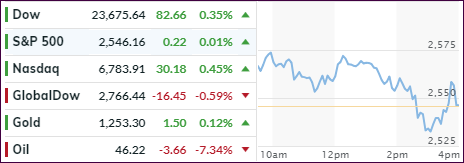
After yesterday’s rebound, the major indexes struggled to crawl above their respective unchanged lines after a weak start to the session. The Dow and S&P 500 succeeded, while the Nasdaq lagged and closed slightly in the red due to Apple’s struggles. Overall, it was simply a lackluster day with neither bulls nor bears showing any interest in flexing their muscles.

Apple was the center of attention presenting new products, but the “lack of innovation” sent the shares to a -1.24% loss. Other areas of the tech sector got clobbered too, namely semiconductors (SMH), which used to my favorite holding until we sold it back in February. SMH not only gave back -1.15% but also broke below a 4-month support line, although it managed to close above it.

In the financial arena, Goldman Sachs stood out by recording its 11th down day in a row, a new record losing streak that helped the GSIBs (Global Systemically Important Banks) to drop -23% from January.

Not to be outdone, the Asia Pacific Stock Index fared only slightly better by having fallen 10 straight days, which equals the longest losing streak in its history. Looks like that record will be beaten…

Treasury yields dropped modestly, while the dollar headed south after a weaker CPI reading and renewed hopes that trade talks will begin again in earnest.

Read More

Snapping A 4-Day Losing Streak

Ulli Market Commentary Contact

[Chart courtesy of MarketWatch.com]
  1. Moving the markets

An early rally weakened mid-day with the Dow slipping back into the red, while the S&P 500 and Nasdaq showed more staying power and managed to end a 4-day losing streak, as the tech sector showed signs of life again. 9 of the 11 primary industry groups closed above the unchanged line making this ‘rebound’ a broad based one.

MarketWatch reminded us that “both the S&P and the Nasdaq are coming off four straight daily declines. Last week was the S&P’s first negative week of the past four, and it represented the biggest weekly percentage drop since June. The Nasdaq suffered its biggest weekly drop since March.” Given that, a bounce was overdue.

Despite the sell-off, we are still near all-time highs, but the causes of last week’s pullback remain the same. This is the time to be aware as to what’s going on not just in the financial arena but also on a global scale regarding unexpected events and whether they will have an immediate domini effect or possibly a delayed one. The Emerging Markets’ currency crisis is just one occurrence, that may not be spreading right now, but it will eventually.

Additionally, tariffs, trade disputes, interest rates, US dollar strength/weakness and economic data points are all moving parts that can combine forces and swing the pendulum from bullish to bearish at some point. The timing of this process is the challenging part, but our Trend Tracking Indexes (TTIs) will contribute in identifying the major trend of equities.

On the other hand, the see-saw effect of the past few weeks could very well blow over leading to much higher prices by the end of this year.

Read More

ETFs On The Cutline – Updated Through 09/07/2018

Ulli ETFs on the Cutline Contact

Below, please find the latest High-Volume ETF Cutline report, which shows how far above or below their respective long-term trend lines (39-week SMA) my currently tracked ETFs are positioned.

This report covers the HV ETF Master List from Thursday’s StatSheet and includes 366 High Volume ETFs ETFs, defined as those with an average daily volume of more than $5 million, of which currently 161 (last week 186) are hovering in bullish territory. The yellow line separates those ETFs that are positioned above their trend line (%M/A) from those that have dropped below it.

Take a look:

The HV ETF Master Cutline Report

In case you are not familiar with some of the terminology used in the reports, please read the Glossary of Terms.

If you missed the original post about the Cutline approach, you can read it here.