Stuck In A Sideways Pattern

Ulli Market Commentary Contact

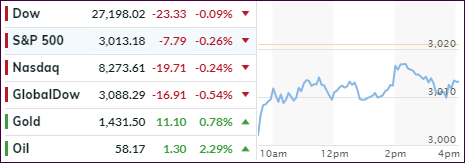
[Chart courtesy of MarketWatch.com]
  1. Moving the markets

The major indexes took an early dive before slowly rebounding in an attempt to crawl back above their respective unchanged lines. The S&P 500 and Nasdaq succeeded in that effort by a tiny margin, while the Dow just fell short.

It was a repeat performance of what we saw all last week with a narrow trading range continuing to be the theme of the day. With bond yields rising a tad, conservative equity ETFs endured their slump as rising rates, which are the conservative component in these instruments, pulled back more than the indexes they are based on.

Case in point is the S&P 500, represented by SPY, which managed to eke out a gain of +0.10% during today’s session. It’s conservative cousin, namely SPLV, gave back -0.39% due to the spike in bond yields. Once that scenario reverses, and the markets correct, you will see the exact opposite, as SPLV will hold up better than SPY.

On the economic front, we saw housing starts collapse, as February’s -8.7% plunge was revised to an unreal -12%. For March, expectations were high that a rebound of some 5.4% would be a sure thing, but no, the number came in at -0.3%, making the annual drop the worst since 2011.

This is indeed a strange environment with trading volume extremely low and stocks simply being stuck. Consider that during April, the S&P 500 has not risen or fallen more than 1% on any given day. This atmosphere almost has the feeling of the calm before the storm.

Of course, some slowdown effect came from Europe, where markets were closed due to the extended Easter Holiday. Regarding earnings, things will accelerate next week with 153 S&P 500 companies being scheduled to release their report cards.

In the meantime, a market mover could be the advanced Q1 2019 GDP reading due out this Friday.

Read More

ETFs On The Cutline – Updated Through 04/18/2019

Ulli ETFs on the Cutline Contact

Below, please find the latest High-Volume ETF Cutline report, which shows how far above or below their respective long-term trend lines (39-week SMA) my currently tracked ETFs are positioned.

This report covers the HV ETF Master List from Thursday’s StatSheet and includes 322 High Volume ETFs, defined as those with an average daily volume of more than $5 million, of which currently 267 (last week 276) are hovering in bullish territory. The yellow line separates those ETFs that are positioned above their trend line (%M/A) from those that have dropped below it.

Take a look:

The HV ETF Master Cutline Report

In case you are not familiar with some of the terminology used in the reports, please read the Glossary of Terms.

If you missed the original post about the Cutline approach, you can read it here.

Weekly StatSheet For The ETF Tracker Newsletter – Updated Through 04/18/2019

Ulli ETF StatSheet Contact

ETF Data updated through Thursday, April 18, 2019

Methodology/Use of this StatSheet:

  1. From the universe of over 1,800 ETFs, I have selected only those with a trading volume of over $5 million per day (HV ETFs), so that liquidity and a small bid/ask spread are assured.
  2. Trend Tracking Indexes (TTIs)

Buy or Sell decisions for Domestic and International ETFs (section 1 and 2), are made based on the respective TTI and its position either above or below its long-term M/A (Moving Average). A crossing of the trend line from below accompanied by some staying power above constitutes a “Buy” signal. Conversely, a clear break below the line constitutes a “Sell” signal. Additionally, I use a 7.5% trailing stop loss on all positions in these categories to control downside risk.

  1. All other investment arenas do not have a TTI and should be traded based on the position of the individual ETF relative to its own respective trend line (%M/A). That’s why those signals are referred to as a “Selective Buy.” In other words, if an ETF crosses its own trendline to the upside, a “Buy” signal is generated. Since these areas tend to be more volatile, I recommend a wider trailing sell stop of 7.5% -10% depending on your risk tolerance.

If you are unfamiliar with some of the terminology, please see Glossary of Terms and new subscriber information in section 9.


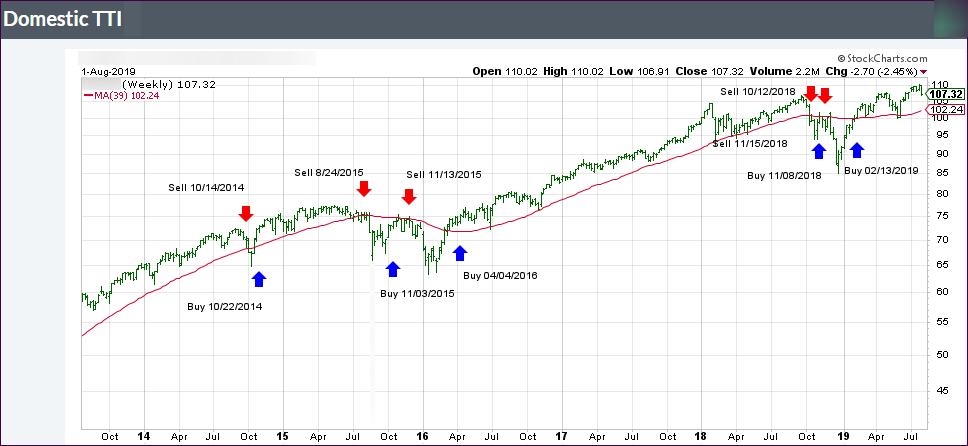
  1. DOMESTIC EQUITY ETFs: BUY — since 02/13/2019
Click on chart to enlarge

Our main directional indicator, the Domestic Trend Tracking Index (TTI-green line in the above chart) is now positioned above its long-term trend line (red) by +5.87% after having generated a new Domestic “Buy” signal effective 2/13/19 as posted.

Read More
Nearing Record Highs—On The Lowest Volume In Months

Ulli Market Commentary Contact

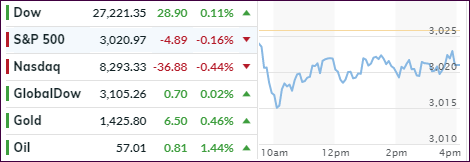
[Chart courtesy of MarketWatch.com]
  1. Moving the markets

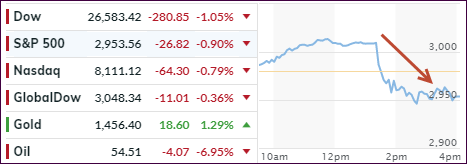
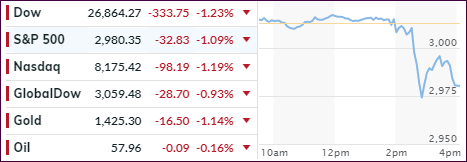
The major indexes, led by the Dow, made another attempt at breaking into record territory but failed with upward momentum lacking. Trading volume was the lowest in months meaning there was not much conviction to drive the markets higher. The theme was a repeat of what we’ve seen over the past five trading day with the direction being more sideways than up.

To wit, here’s what the S&P 500 did: 2,907, 2,906, 2,907, 2,900, 2,905.

That is not exactly a representation of a bullish market but more of one with questionable durability. Or, it could simply be a matter of Wall Street having the Easter Holiday blues. Be that as it may, next week all traders should be back on the job, and we will see if “buy” or “sell” buttons will be pushed.

Healthcare and Small Caps suffered the most this week, while the tech sector continued its role as the best performer of the year. The only potential fly in the ointment is that tech has now reached 19.2 times forward 12-months earnings, a level that was last seen in 2007, as ZH pointed out.

Looking at the big picture, I never get tired of looking at this chart, which demonstrates the discrepancy between the Economic Surprise Index and the S&P 500. Today, one line has been added, namely the Global Money Supply, which clearly shows who is behind the ferocious rebound from the December 2018 lows.

Makes you wonder how long this can go on, doesn’t it?

Enjoy the Easter weekend.

Read More

Directionless Wavering

Ulli Market Commentary Contact

[Chart courtesy of MarketWatch.com]
  1. Moving the markets

It was a weak Wednesday with the major indexes wandering aimlessly after the release of the Fed’s Beige book showed that “economic activity grew at a slight-to-moderate pace” in March and early April. Upward pressure on wages indicated a tight labor market, however, retail and auto sales were sluggish.

Speaking of the former, U.S retailers have already closed more stores than they did all last year:

This year, US retailers have announced that 5,994 stores will close. That number already exceeds last year’s total of 5,864 closure announcements, according to a recent report from Coresight Research.

And:

“I expect store closures to accelerate in 2019, hitting some 12,000 by year end,” Deborah Weinswig, founder and CEO of Coresight, said.

This is nothing new, as we have been getting many signs that the economy has been slipping and sliding and, with GDP growth declining and Manufacturing falling, the dreaded “R-word” (as in recession) appears to be coming into focus by the Main Stream Media.

Not helping the markets today was the Healthcare sector, which took another beating, as changes to the health policy landscape appear on the horizon. Political pressure over hefty drug prices brought on new proposals from Bernie Sanders suggesting a single payer system with unknown effects on the entire industry.

In the end, the major indexes had another sluggish day and ended slightly in the red. That did not keep the Nasdaq 100 from making a new record high—in the face of tumbling earnings.

Go figure…

Read More

Stumbling Towards Record Highs

Ulli Market Commentary Contact

[Chart courtesy of MarketWatch.com]
  1. Moving the markets

An early rally petered out as the S&P 500 slowly but surely drifted towards its unchanged line and suddenly dropped below it. However, thanks to a last minute levitation, the index managed to crawl back above it to close fractionally in the green.

The other two major indexes showed a little more staying power and remained above their respective unchanged lines throughout the session. The Nasdaq bounced around its 8,000 marker and ended up closing above it by the tiniest of margins.

Today we saw a lack of upside follow through along with little enthusiasm as earnings provided a mixed picture. Analysts have now resigned themselves to the fact that a YoY reduction in S&P 500 corporate profits for the first quarter is pretty much assured, which would mean the first decline in 3 years.

Still, we are within striking distance of taking out the 2018 highs, and I am sure that the computer algos are set to accomplish this feat—all in due time. Again, current market levels are in no way related to the strength of the underlying economy.

The direction of the economic surprise index made that very clear last year, after the spread with the S&P 500 simply widened too much, and the bears ended up having a field day.

As a result, the Fed was forced to step on the emergency brakes by doing a U-turn with their interest policy in order to “save” the markets.

Are we in for a repeat, or will we see new all-time highs first?

Read More