Spiking Into The Close

Ulli Market Commentary Contact

[Chart courtesy of MarketWatch.com]
  1. Moving the markets

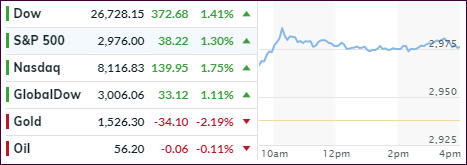
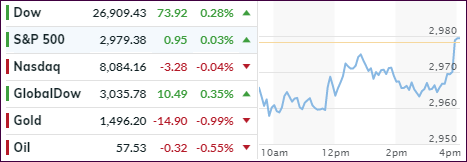
Throughout the session, the major indexes hovered below their respective unchanged lines, as US-China trade news offered a mixed picture, while a look ahead to the upcoming central bank policy meetings kept traders on edge.

Except for a last-minute spike in equities, interest rates kept a lid on advances with the 10-year bond yield rising over 8 basis points to end the day at 1.73%, which is quite a rebound considering that just recently we breached the 1.5% level to the downside.

These are huge moves, as the bond bloodbath continues, so it comes as no surprise that the victims over the past few days have been bond prices, as well as the low volatility ETFs (SPLV and USMV), which have been surrendering some of their superior gains. For context, 10-year yields are up 5 days in a row, gaining an amazing 24 basis points, which is the biggest jump since Trump’s election in 2016.

There seems to be a global re-shuffling of assets going on, as the unwind has pushed cyclicals higher and defensives lower with Transportations and SmallCaps suddenly surging, while the Nasdaq tumbled most of the day, but it was pushed to almost even at the close.

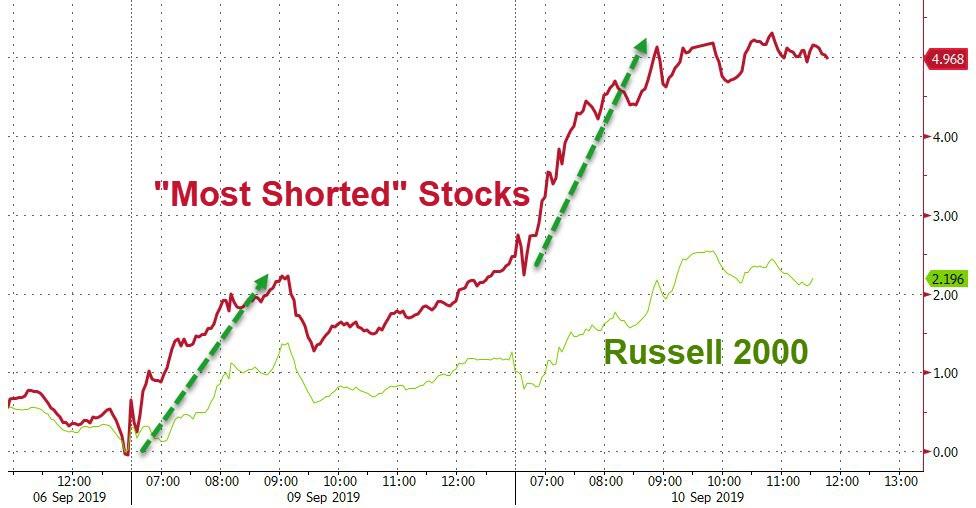
ZH reports that the most shorted stocks went on a rampage by soaring this week and actually registering the biggest 5-day short squeeze since the beginning of this year.

It was a rollercoaster kind of day, and I would not be surprised to see the Volatility Index (VIX) make a move again, as Fed policy uncertainty has hit record highs.

Read More
No Market Commentary

Ulli Uncategorized Contact

Due to a variety of business commitments, I will not be able to write today’s market commentary. Regular posting will resume. tomorrow.

Ulli…

ETFs On The Cutline – Updated Through 09/06/2019

Ulli ETFs on the Cutline Contact

Below, please find the latest High-Volume ETF Cutline report, which shows how far above or below their respective long-term trend lines (39-week SMA) my currently tracked ETFs are positioned.

This report covers the HV ETF Master List from Thursday’s StatSheet and includes 322 High Volume ETFs, defined as those with an average daily volume of more than $5 million, of which currently 240 (last week 211) are hovering in bullish territory. The yellow line separates those ETFs that are positioned above their trend line (%M/A) from those that have dropped below it.

Take a look:                                                                   

The HV ETF Master Cutline Report

In case you are not familiar with some of the terminology used in the reports, please read the Glossary of Terms. If you missed the original post about the Cutline approach, you can read it here.      

ETF Tracker Newsletter For September 6, 2019

Ulli ETF Tracker Contact

ETF Tracker StatSheet          

You can view the latest version here.

SHRUGGING OFF A POOR JOBS REPORT

[Chart courtesy of MarketWatch.com]
  1. Moving the markets

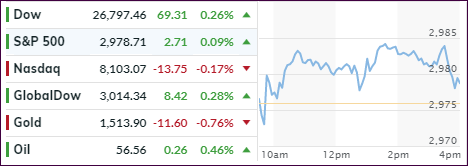
Today’s jobs report came in weaker than expected, as only 130k jobs were created in August vs. a hoped for 170k. Stocks shrugged off the poor number with traders and algos alike seeing the positive in increased odds that the Fed will indeed cut rates (maybe even the whisper number of 0.5%?) when it meets in 2 weeks.

As a consequence, bond yields dropped, after spiking yesterday, while the dollar dumped and reached a level that was a starting point for Thursday’s rally. In other words, nothing was gained.

The mid-day rebound lost steam in the end with the S&P 500 barely hanging on to a green close, while the Nasdaq slipped slightly into the red. Still, for the week, the S&P eked out a gain of some +1.8%.

Trying to keep things calm were words from Fed head Powell, who said that “he is not forecasting or expecting a recession,” though he sees “significant” downside risks that the Central Bank will monitor.  

Interestingly, as ZH posted, since the last Fed rate-cut, the US dollar and stocks are unchanged, while bonds and gold are up some 6%, as this chart shows.

Hmm, does that mean rate cuts are no longer providing the fire power to support stocks? We’ll find out after the next Fed meeting if this proposition holds true.

Read More

Weekly StatSheet For The ETF Tracker Newsletter – Updated Through 09/05/2019

Ulli ETF StatSheet Contact

ETF Data updated through Thursday, September 5, 2019

Methodology/Use of this StatSheet:

1. From the universe of over 1,800 ETFs, I have selected only those with a trading volume of over $5 million per day (HV ETFs), so that liquidity and a small bid/ask spread are assured.

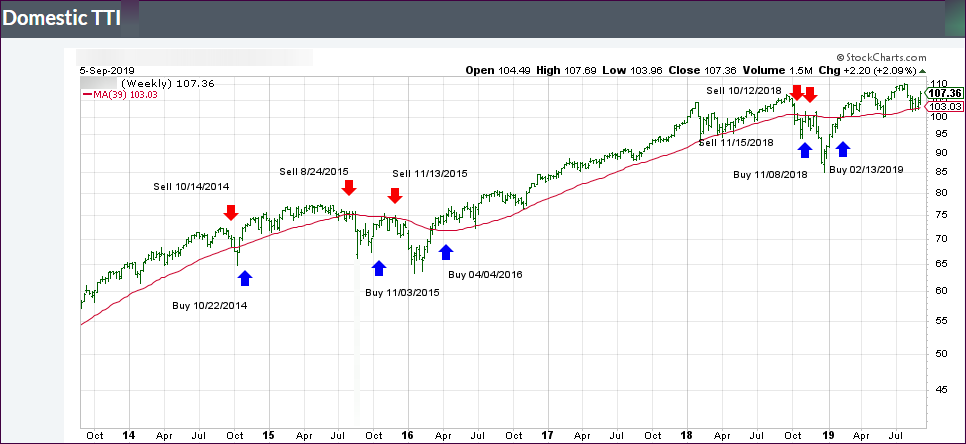
2. Trend Tracking Indexes (TTIs)

Buy or Sell decisions for Domestic and International ETFs (section 1 and 2), are made based on the respective TTI and its position either above or below its long-term M/A (Moving Average). A crossing of the trend line from below accompanied by some staying power above constitutes a “Buy” signal. Conversely, a clear break below the line constitutes a “Sell” signal. Additionally, I use a 7.5% trailing stop loss on all positions in these categories to control downside risk.

3. All other investment arenas do not have a TTI and should be traded based on  the position of the individual ETF relative to its own respective trend line (%M/A). That’s why those signals are referred to as a “Selective Buy.” In other words, if an ETF crosses its own trendline to the upside, a “Buy” signal is generated. Since these areas tend to be more volatile, I recommend a wider trailing sell stop of 7.5% -10% depending on your risk tolerance.

If you are unfamiliar with some of the terminology, please see Glossary of Terms and new subscriber information in section 9.     

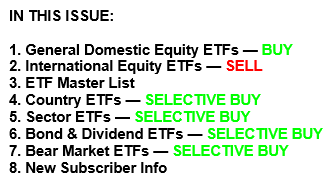
1. DOMESTIC EQUITY ETFs: BUY — since 02/13/2019

Click on chart to enlarge

Our main directional indicator, the Domestic Trend Tracking Index (TTI-green line in the above chart) is now positioned above its long-term trend line (red) by +4.50% after having generated a new Domestic “Buy” signal effective 2/13/19 as posted.

Read More

Breakout!

Ulli Market Commentary Contact

[Chart courtesy of MarketWatch.com]
  1. Moving the markets

Just when you thought the trade deal was dead, news that US and Chinese officials declared a tentative resumption of tariff talks made the headlines, and off to the races we went with the computer algos pushing the indexes sharply higher.

Mind you that nothing worthwhile was accomplished. The warring parties simply agreed to talk again around “early October,” which these days is considered enough of a progress in the yearlong trade conflict for equities to surge.

To be fair, bullish sentiment was boosted by a couple of economic reports. First, ADP estimated that the private sector added some 195k jobs in August, which raised expectations for a good number tomorrow when the BLS releases its jobs report.

Second, despite recent surveys pointing to weakness in the manufacturing sector, the ISM rebounded, even though 60% of its components weakened. Nevertheless, for the day, the markets treated ‘good news’ as ‘good news’ with equities spiking.

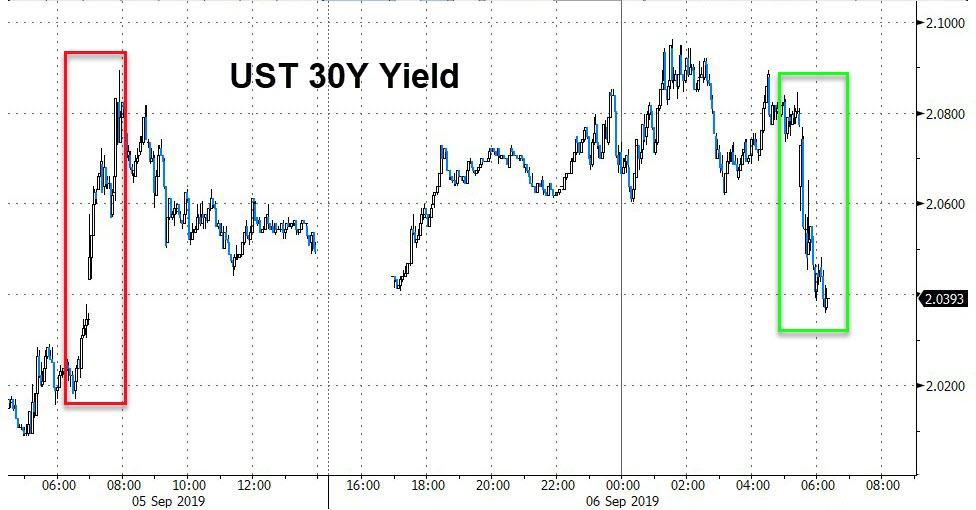
That spike came in the face of sharply surging bond yields with the 30-year heading back above 2%, while the benchmark 10-year dashed 10 basis points to 1.58% before pulling back into the close.  

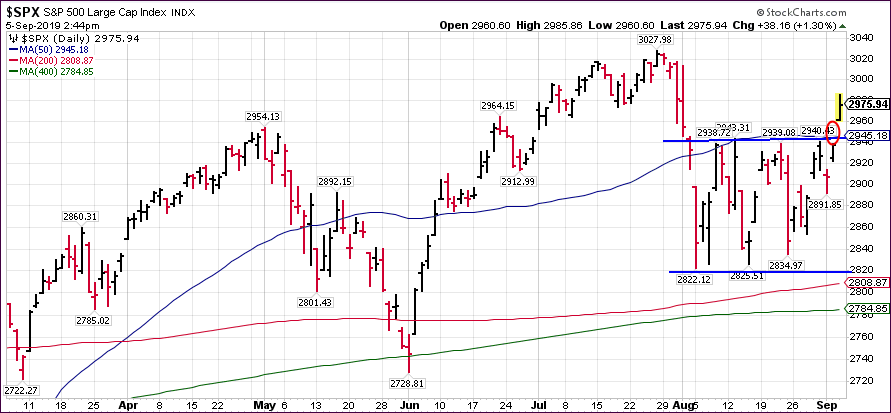
The S&P 500 broke out of its 5-week trading range (upper blue line) leaving a break-away gap behind (red circle). This gap will need to be closed at some point, so it’s questionable at this moment in time whether this breakout has enough legs to take out July’s highs.

This strong up move in the face of dramatically rising bond yields is unusual and, while this push benefited the S&P 500, it’s low volatility cousin SPLV, which I have preferred during this ‘Buy’ cycle, lagged and did not participate.

This means for this current cycle, which started on 2/13/19, the S&P 500 (SPY) has made up some ground and is now showing an +8.28% gain, which is still substantially behind the SPLV’s +12.89%.

Tomorrow’s jobs numbers are bound to affect market direction. The question is “which way?”

Read More