Weekly StatSheet For The ETF Tracker Newsletter – Updated Through 02/27/2020

Ulli ETF StatSheet Contact

ETF Data updated through Thursday, February 27, 2020
Methodology/Use of this StatSheet:

1. From the universe of over 1,800 ETFs, I have selected only those with a trading volume of over $5 million per day (HV ETFs), so that liquidity and a small bid/ask spread are assured.

2. Trend Tracking Indexes (TTIs)

Buy or Sell decisions for Domestic and International ETFs (section 1 and 2), are made based on the respective TTI and its position either above or below its long-term M/A (Moving Average). A crossing of the trend line from below accompanied by some staying power above constitutes a “Buy” signal. Conversely, a clear break below the line constitutes a “Sell” signal. Additionally, I use a 7.5% trailing stop loss on all positions in these categories to control downside risk.

3. All other investment arenas do not have a TTI and should be traded based on  the position of the individual ETF relative to its own respective trend line (%M/A). That’s why those signals are referred to as a “Selective Buy.” In other words, if an ETF crosses its own trendline to the upside, a “Buy” signal is generated. Since these areas tend to be more volatile, I recommend a wider trailing sell stop of 7.5% -10% depending on your risk tolerance.

If you are unfamiliar with some of the terminology, please see Glossary of Terms and new subscriber information in section 9.     

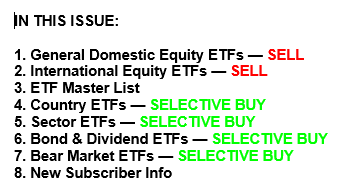
1. DOMESTIC EQUITY ETFs: SELL — since 02/27/2020
Click on chart to enlarge

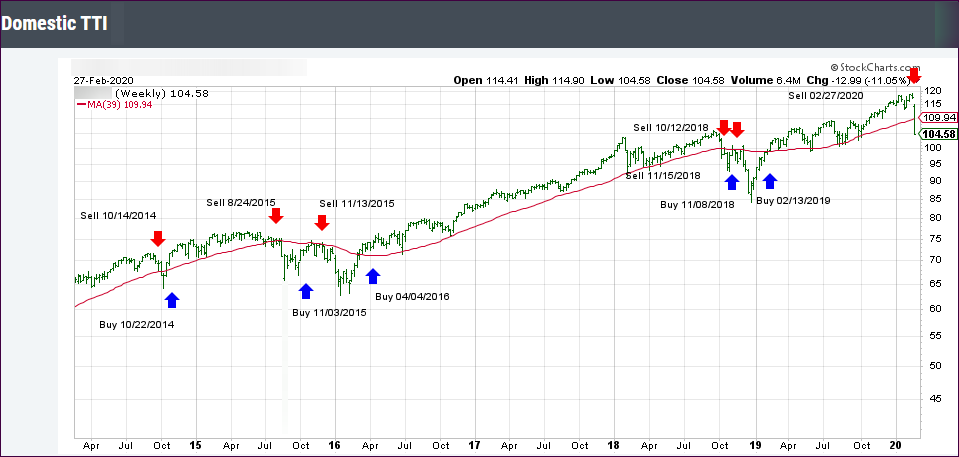
Our main directional indicator, the Domestic Trend Tracking Index (TTI-green line in the above chart) is now positioned below its long-term trend line (red) by -4.75% after having generated a new Domestic “Sell” signal effective 2/27/20 as posted.

The link below shows all High Volume (HV) Domestic Equity ETFs. The sorting order is by M-Index ranking. Prices in all linked tables below are updated through 02/27/2020, unless otherwise noted. Price data not yet available at publication is indicated with 00.00% or -100.00%. Please note that distributions are not included in the current momentum numbers.

Whenever the TTI is above the trend line, and therefore in “Buy” mode, you can either use the tables in the link below to make your selections or choose from the 10 ETFs in the Spotlight, which are featured daily as part of the market commentary:

http://www.successful-investment.com/SSTables/HVDomETFs022720.pdf

2. INTERNATIONAL ETFs: SELL since 02/26/2020

Click on chart to enlarge

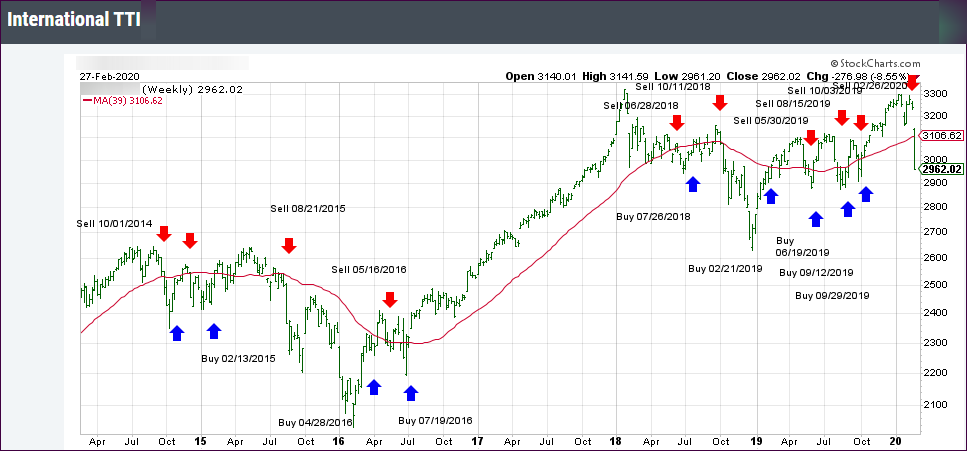
The International Trend Tracking Index (green) has now moved -4.58% below its long-term trend line (red) after having generated a new SSell” signal effective 10/29/2019. It’s been on a wild rollercoaster ride all year, since international markets showed far more uncertainty and volatility than the US environment.

The listings in the link below represent the High Volume (HV) International ETFs I track to be used during a Buy cycle. They are sorted by M-Index ranking:

http://www.successful-investment.com/SSTables/HVInternETFs022720.pdf

3. ETF MASTER LIST

This ETF Master list shows the total of all ETFs listed, which allows you to get a quick overview of leaders and laggards. The sorting order is by M-Index. Momentum figures for all ETFs are not adjusted for dividends.

http://www.successful-investment.com/SSTables/HVETFMaster022720.pdf

4. COUNTRY ETFs: SELECTIVE BUY

The link below contains a list of HV ETFs for countries/regions, which I am tracking weekly. Please note that data in this table does not include adjustments due to distributions.

http://www.successful-investment.com/SSTables/HVCountryETFs022720.pdf

Country funds, especially over the past few years, have been volatile. So, the use of a trailing stop loss (I use 10%) is imperative to protect your portfolio from severe downside moves.

5. SECTOR ETFs: SELECTIVE BUY

To diversify our portfolios, we always need to look for different opportunities to invest our money. The table of HV Sector ETF listings in the following link covers a broad spectrum of possibilities. The sorting order is by M-Index:

http://www.successful-investment.com/SSTables/HVSectorETFs022720.pdf

Here too, I recommend the use of a 10% trailing stop loss to minimize the risk.       

6. BOND & DIVIDEND ETFs: SELECTIVE BUY

If you prefer using ETFs for the generation of income, here’s a list of bond and dividend paying ETFs. It’s important to first look at how these instruments have held up in terms of momentum figures. Then you should visit your favorite financial web site to examine yield and other details.

Please note that data in this table does not include adjustments due to distributions.

http://www.successful-investment.com/SSTables/HVBond_DivETFs022720.pdf

7. BEAR MARKET ETFs: SELECTIVE BUY

Below are the most commonly available bear market ETFs and their momentum figures:

http://www.successful-investment.com/SSTables/HVBearETFs022720.pdf

Please note that some of the above funds try to outperform the index they are tied to by the percentage stated. While this can enhance your returns, it can certainly accelerate your losses as well. No matter which way you choose, be sure to work with a trailing sell stop (I suggest 10%) and be aware that volatility will be your constant companion.

8. NEW SUBSCRIBER INFORMATION

To get a head start on more successful investing, please click on:

http://www.successful-investment.com/SellStopDiscipline.pdf

In case you missed it, you can download my latest e-book “How to beat the S&P 500…with the S&P 500,” here. If you are investing your 401k and must use mutual funds, I suggest you primarily stick with the S&P 500 as described in my book. Of course, you can always use the above tables to find sector or country ETFs to your liking and use the equivalent mutual funds as offered by your custodian.

Disclosure:

I am obliged to inform you that I, as well as my advisory clients, own some of the ETFs listed in the above table. Furthermore, they do not represent a specific investment recommendation for you, they merely show which ETFs from the universe I track are falling within the guidelines specified.
Domestic TTI “Sell” Signal Confirmed—Back To Bear Market Territory

Ulli Market Commentary Contact

[Chart courtesy of MarketWatch.com]
  1. Moving the markets

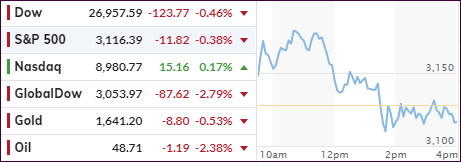
The adage that “sometimes nothing happens in a decade and sometimes a decade happens in a week” sure rang true, as the coronavirus induced sell fest continued with utter abandon with downward momentum accelerating.

As I posted yesterday, my planned limited liquidation of broadly diversified domestic ETFs turned into a “Sell All” early in the session, as the major indexes continued with their best imitation of a swan dive. Besides some hedged holdings and gold, we are now in cash watching this debacle unfold from the sidelines.

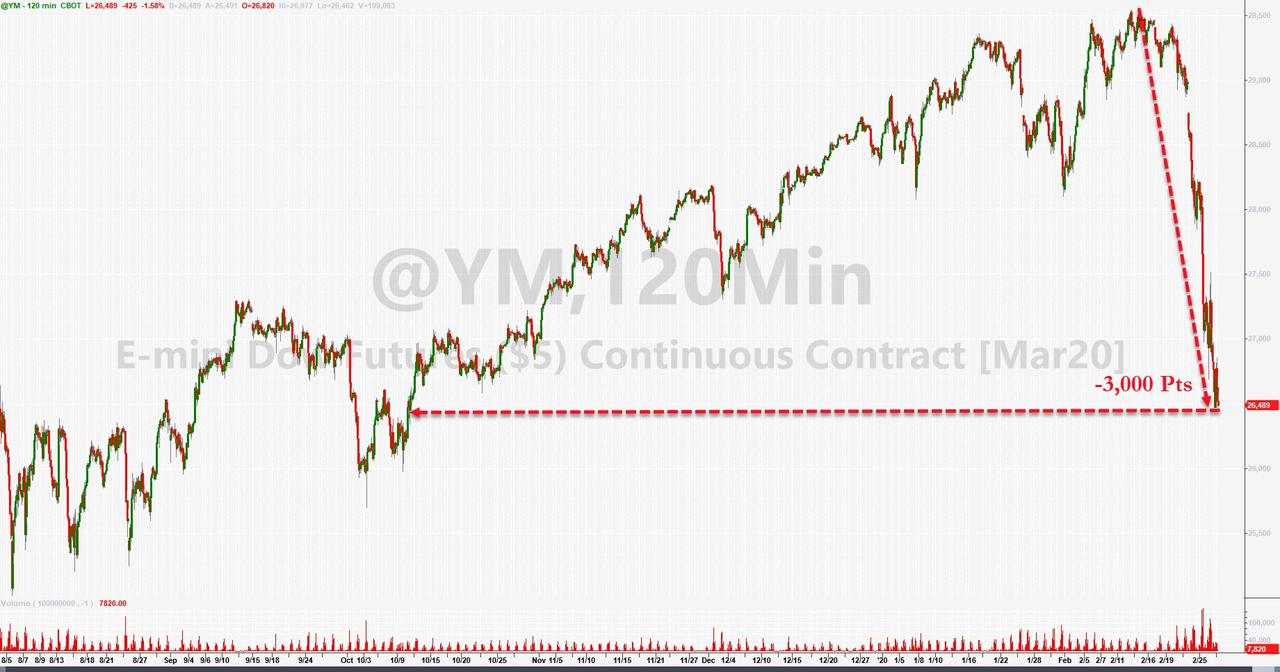
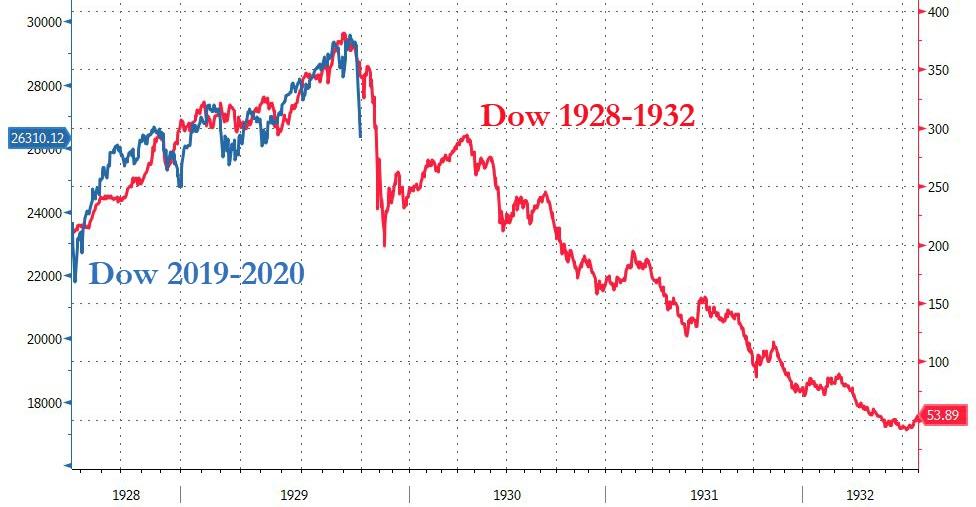
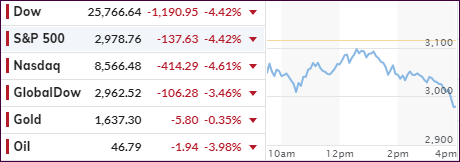
As ZH elaborated, in the space of just six days, we went from a record high to a correction with the Dow down over 3,000 points or -10.5%). At the same, the eerily familiar comparisons to the events of 1928-1932 are making the rounds, with this chart providing the comparison to current market activity.

Then this:

The market is already pricing in at least 3 rate-cuts in 2020 and the odds of March cut are soaring, despite the obvious fact that The Fed can’t print vaccines to ‘salve’ the supply-chain block and if lower rates are supposed to spark more consumption, where are you going to consume? Not at crowded public places like theaters, restaurants, and sports stadiums?

It’s seems to become more well known that global economies are facing an unexpected and unprecedented supply chain shock that can’t be fixed quickly and will leave the Central Banks somewhat powerless, although I expect the liquidity spigots to be wide open soon.

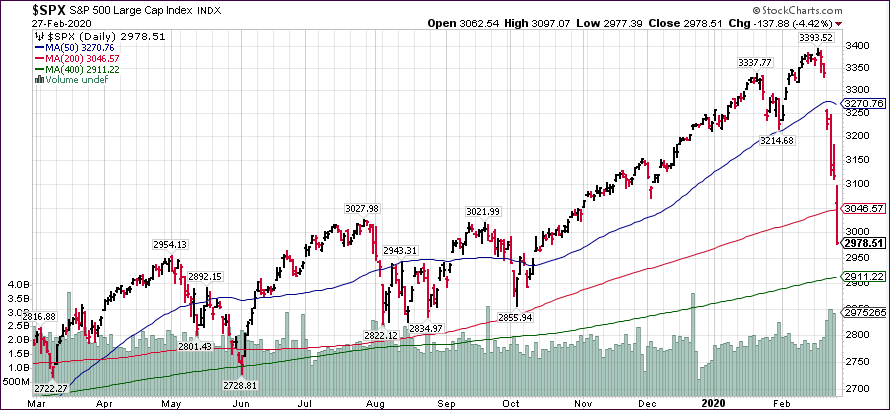
To add insult to injury was the fact that the widely followed S&P 500 “lost” it’s 200-day moving average, as this chart shows. This means that downward momentum could worsen and deepen this newly formed bear market.

It’s good to be on the sidelines for the time being.  

Read More

Dow Surrenders An Early 400-Point Gain—Domestic TTI Goes Negative

Ulli Market Commentary Contact

[Chart courtesy of MarketWatch.com]
  1. Moving the markets

The sudden turnaround in then markets kept me from liquidating those holdings that had come close to their trailing sell stops. It’s a known fact that sharp market drops can be followed by violent rebounds, which we saw early in the session. The only problem was that this move had the smell of a dead-cat bounce, which is exactly how it turned out.

Still, it was some relief from the selling stampede of the past few days, but it does not mean the economic effects of the coronavirus have been nullified. Far from it, as the confirmed cases of infections and deaths outside of China have continued to spread, there will be a financial hangover for some time to come.

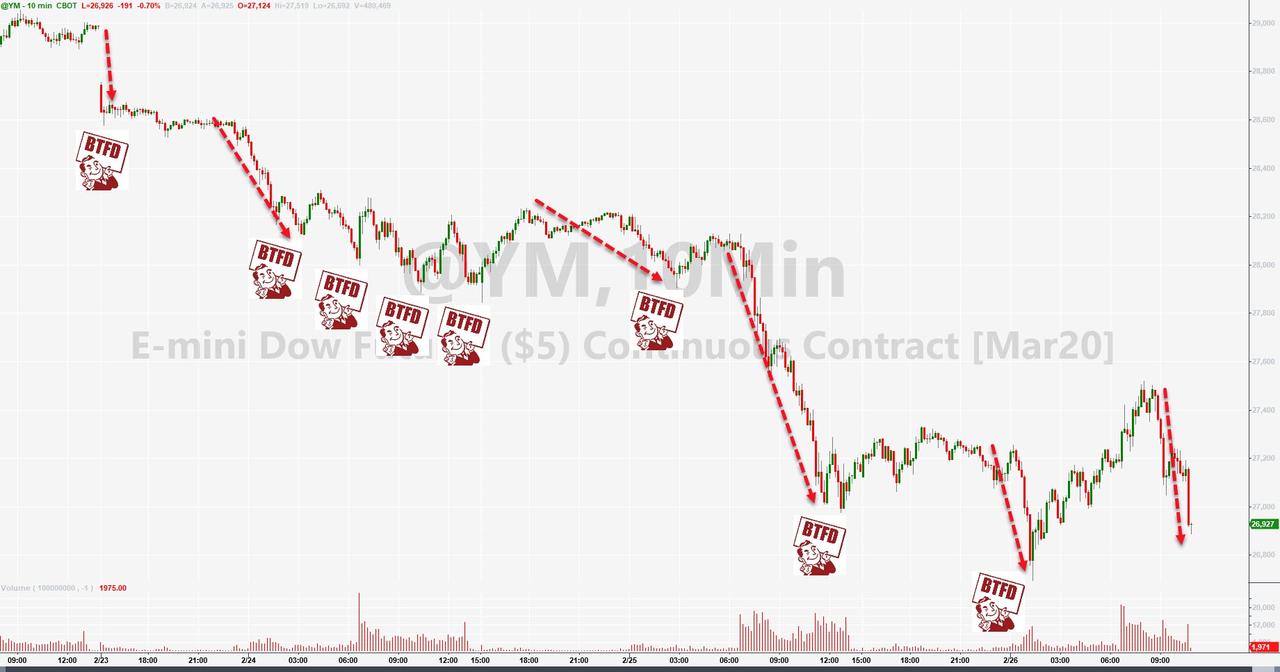
Those investors that got motivated by buying the dips over the past few days were, with the benefit of hindsight, much too early and disappointed, as the dip-buy fest did not turn out well so far. To me, it’s doubtful that a V-shape type of recovery is possible soon.

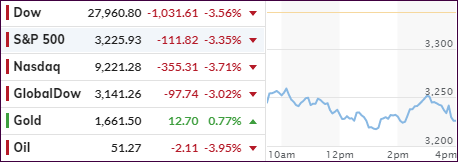
In the end, it was only the Nasdaq which managed a green close with the other 2 major indexes slipping slightly in the red, which was somewhat disheartening given the early race out of the blocks.

As a result of today’s action, our main directional indicator, the Domestic Trend Tracking Index (TTI), dropped below its long-term trend line into bearish territory, although by only a modest -0.62%. That means that the odds of a bear market facing us have grown considerably.

Since this is the TTIs first dip “below the line,” I will start reducing our domestic equity exposure and will issue an all-out “Sell” signal, once the TTI shows some staying power in bear territory.

Again, I will hold off with any corrective measures, should the major indexes again be in rally mode during tomorrow’s session. However, if downward momentum accelerates, I will adjust my liquidations accordingly.  

Read More

Markets Continue The Path Of Least Resistance—Down

Ulli Market Commentary Contact

[Chart courtesy of MarketWatch.com]
  1. Moving the markets

For those hoping for a turnaround Tuesday, it did not happen, as virus headwinds continued to spread around the world. An early rebound proved to be meaningless with the downward trend remaining intact.

Internationally, it was worse than domestically, with our International TTI diving below its long-term trend line by a margin large enough to generate a “Sell” signal for that arena. Please see section 3 for details.

Market sentiment was mixed, as dip buyers try to step in to prop up the indexes, but volume was not heavy enough to accomplish anything other than a temporary halt in the downward swing.

After Monday’s drubbing, traders expected a bounce back, or at least a pause in downward momentum, but the tumble continued unabated. Of course, investor complacency, caused by the Fed’s support policy of the markets, has many in shock, as realization set in that markets can go down, and that corrections of 5-10% are a perfectly normal occurrence.

Not helping the mood were some economic news showing that the Fed Business Survey crashed in February with new orders collapsing, while Subprime Credit Card Delinquencies spiked to record highs and surpassed the financial-crisis peak.

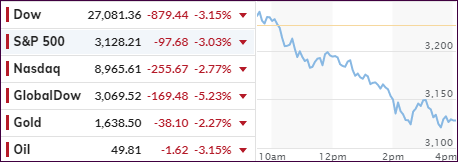
The S&P 500 price of 3,200 was considered by some analysts a crucial support level and, once broken, could lead to higher volatility and more downside risk, in the -10% area. Well, the level did not put up any fight, and the index sliced right through it closing the session at 3,130.

As a result, our Domestic TTI, the main directional indicator, headed south as well and has now reached a point that is within striking distance of a “Sell” signal. As you can see in section 3 below, we are currently only 0.35% away from this event becoming reality.

If it does, and the trendline is clearly pierced to the downside, we will move out of the markets and to the safety of the sidelines, as the odds of this turning into a full-blown bear market will have increased.

Fed vice-chair Clarida did not help matters by saying:

US economy and monetary policy are in a good place, noting that it is still too soon to speculate on whether the coronavirus will lead to a material change in US economic outlook.

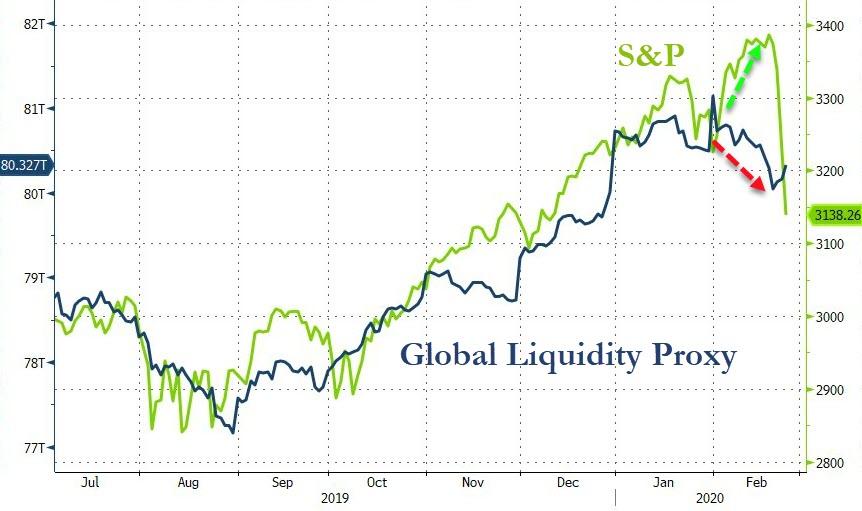
Despite a temporary pause in the drop, while Clarida was talking, downward momentum picked up again, as it became clear that there were no solutions or promises forthcoming. Interestingly, the chart I posted last week, proved to be an accurate prognosticator, as the S&P 500 finally caught down to global liquidity.

In my advisor practice, we will start liquidating some of those positions, whose trailing sell stops were triggered, and will prepare for an all-out domestic “Sell” signal.

Read More

Coronavirus Infects Markets

Ulli Market Commentary Contact

[Chart courtesy of MarketWatch.com]
  1. Moving the markets

World markets joined in unison by selling off with weekend news about the coronavirus continuing worries that global economies will not escape unscathed and take a hit of unknown proportions.

Sure, news media and markets tend to overreact, but the negative virus effects can’t be denied, as the struggle with containment policies and massive unknowns seem to get worse.

It’s no surprise that markets are feeling nervous this morning, given the known facts, which analyst Bill Blain summarized as follows:

The economic damage in terms of cancelled tourist trips to Asia and vice-versa, empty container ships, global supply chain breakdown shuttering factories across the globe, commodities tumbling, raising fears of mass defaults as just-in-time manufacturers fail to make interest payments is clear.

He went on to elaborate:

This crisis comes at the top of massive bubbles in stocks and bonds, fueled by 10-years of accommodative monetary experimentation – just at a time when the global monetary authorities are increasingly understanding the urgent need undo the unintended negative consequences, end QE, to normalize interest rates and take the pressure out of asset bubbles.

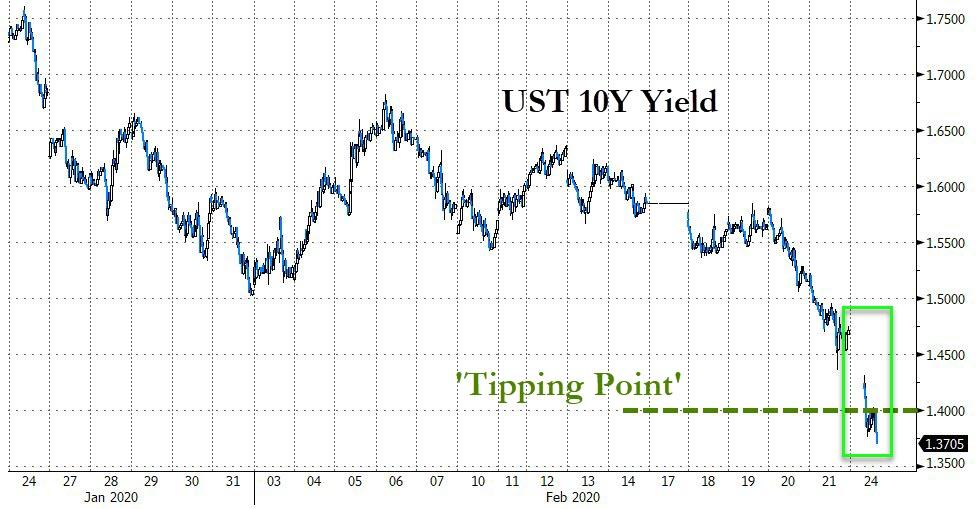
Forget about normalizing interest rates, it will be the opposite with bond yields crashing this morning, as the 10-year dropped some 10 basis points to below 1.40%. Considering the above, I believe the Central Banks will go all out and provide further “accommodative” policy support meaning yields will be heading towards the zero bound, as is the case in many developed countries.

As ZH points out in the above chart, a break below this “tipping point,” increases the probability to more than 50% of the Fed cutting back rates to 0%.

Along those lines, we may very well witness a well-known mantra come into play, set in motion by former ECB president Draghi, for the Fed to do “whatever it takes” to avoid an economic breakdown.

In the end, for us trend trackers, the only things that matter are: Is the major trend is still intact and/or have any sell stops been triggered?

For right now, the answer to both is no (see section 3 below), so we will continue to hold until either one of these two conditions come into play.

Despite today’s snapping of complacency, it’s also noteworthy that the S&P 500 closed today at the same price it had when the month of February started and remains within 5% of its all-time highs.

Read More

ETFs On The Cutline – Updated Through 02/21/2020

Ulli ETFs on the Cutline Contact

Below, please find the latest High-Volume ETF Cutline report, which shows how far above or below their respective long-term trend lines (39-week SMA) my currently tracked ETFs are positioned.

This report covers the HV ETF Master List from Thursday’s StatSheet and includes 322 High Volume ETFs, defined as those with an average daily volume of more than $5 million, of which currently 272 (last week 279) are hovering in bullish territory. The yellow line separates those ETFs that are positioned above their trend line (%M/A) from those that have dropped below it.

Take a look:                                                                   

The HV ETF Master Cutline Report

In case you are not familiar with some of the terminology used in the reports, please read the Glossary of Terms. If you missed the original post about the Cutline approach, you can read it here.