Surfing The Stimulus Wave; Who Is That Elephant In The Room?

Ulli Market Commentary Contact

[Chart courtesy of MarketWatch.com]
  1. Moving the markets

Looking at today’s news headlines, you would think we’re back to last year’s theme of “bad news is good news” for the markets.

Here’s a sample of what we faced today:

  1. More Than 500k Covid-19 Cases Diagnosed Worldwide: “From 0 to 250,000 cases in 4 months. From 250,000 cases to 500,000 cases: 1 week.”
  2. US Vehicle Sales Are Down 50%-75% in March
  3. Oil Plunges
  4. LIBOR Rate Increase Points to One Or More Banks In Trouble.
  5. Italy Reports Largest Jump In New Cases; Deaths Decline
  6. Morgan Staley: “We Are Underwhelmed By This Low Participation Rally”
  7. China Shuts All Border To Foreigners
  8. A Record 3.3 million Americans Just Filed For Unemployment Benefits

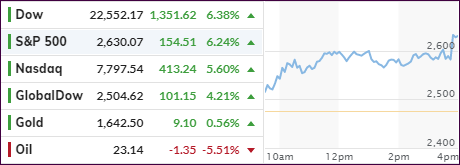
Considering the above, the markets should have sold off sharply but just the opposite occurred. A massive rally, right after the opening bell, slowed down mid-day but was pumped into the close. If that does not make sense to you, you’re not alone.

Sure, some euphoria over the anticipated stimulus bill, assumed to be signed tomorrow, kept the bullish mood intact. However, traders’ optimism was fueled by another powerful force, namely quarter-end rebalancing by the big boys.

As ZH reports, according to estimates, balanced or 60/40 mutual funds, as well as sovereign wealth funds, representing a US and global universe of $6 trillion dollars, needed to buy some $850 billion in mandated stocks to revert to previous equity allocations.  

In the end, ZH summarized the day as follows:

Of course, whether or not today’s action is the result of a giant pension/sovereign wealth fund whale lifting all offers in what has been the most illiquid market in history…and thus resulting in overly pronounced moves, won’t be known until the end of the month.

While this rebound is in the books, we will find out soon if it indeed has staying power once we cross into April.

Right now, given the surge of $3.3 million in unemployment filings while markets exploding to the upside, makes only sense when considering the rebalancing efforts by the whales.

That view is further supported by ZH’s commentary pointing out that “…while the month-end pension rebalance suddenly appeared in the last 10 minutes of trading, sending the ES up by 40 points in literally one trade after it emerged that the Market on Close imbalance was $7 billion!

I wonder what will happen once these whales are done buying.

Read More
A Tug Of War: Fiscal Stimulus Plan Vs. Corona Virus Fears

Ulli Market Commentary Contact

[Chart courtesy of MarketWatch.com]
  1. Moving the markets

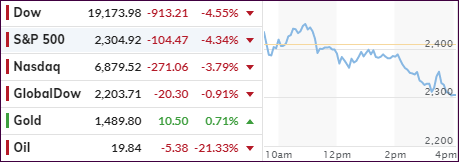
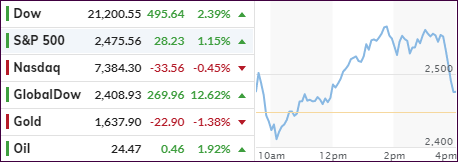
Another strong rally lost half of its early gains late in the session, as the upbeat mood waned with some chart watchers confirming what I said yesterday, namely that big rebounds are not necessarily a sign that a bottom has been formed.

More importantly, the indexes plunged into the close based on news that a potential snag in the $2 trillion stimulus package may delay its adoption and implementation, something that did not go over well on Wall Street, as urgency to battle the corona virus economic fallout effects have taken front and center.

Bernie Sanders turned out to be the culprit spoiling the party by threatening to hold up the rescue package “until stronger conditions are the imposed on the $500 billion corporate welfare fund.” Who knows how long that battle will go on?

As a result, it’s a tug-of-war between the hopefully positive effects of the stimulus plan, once passed, and the negative impact from the corona virus. I am sure that the stimulus plan will give an assist, but I doubt that the package is even close to being enough to reverse the damage done, so I expect more proposals over the next month or so.

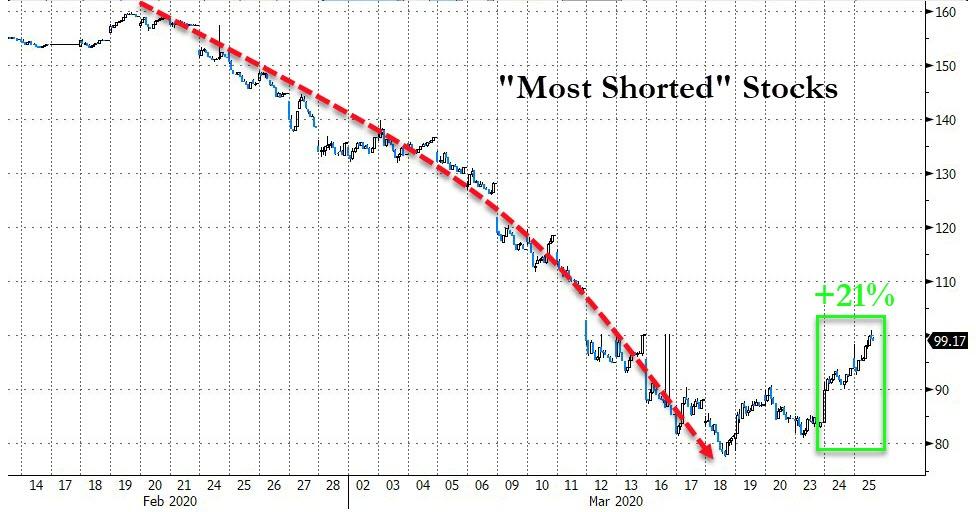
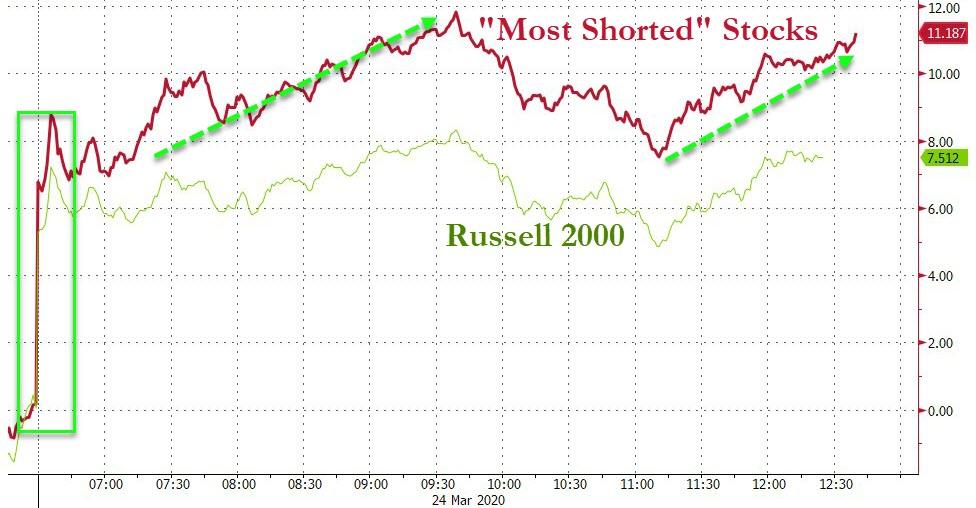
Again, as ZH reported, the giant short squeeze continued pushing the most shorted stocks up by an amazing +21% in two days, which Bloomberg demonstrated in this chart.

Overnight, we saw extreme shifts again:

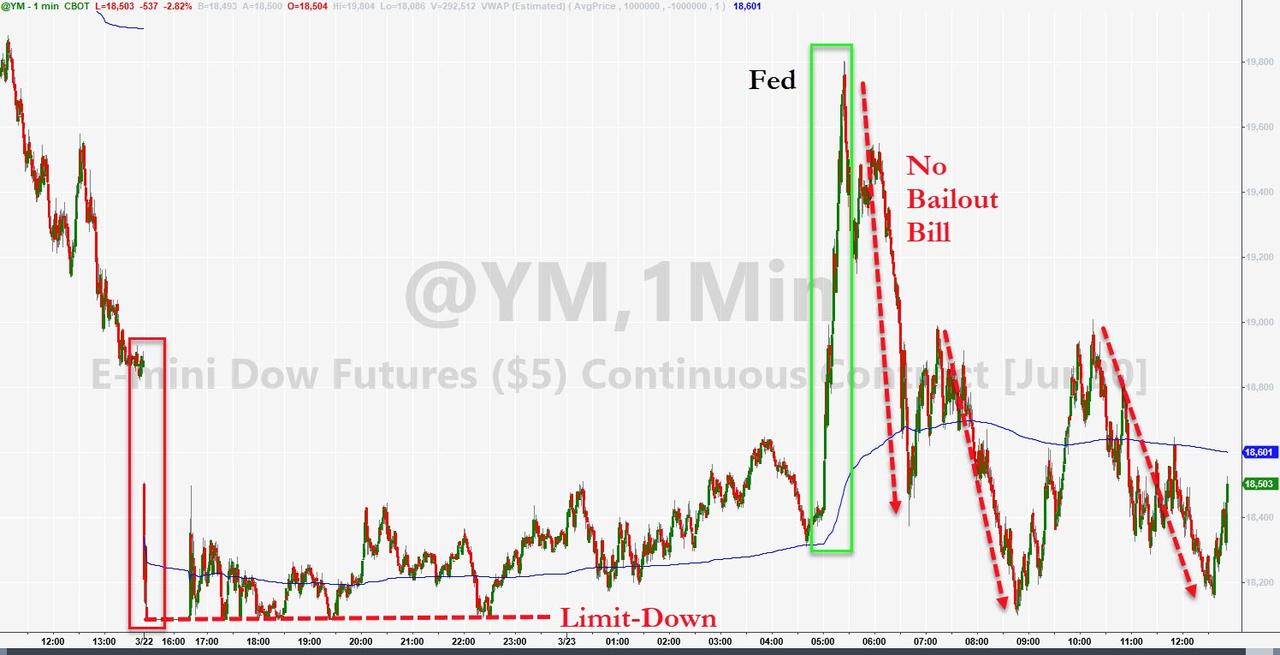
Dow futures show the insane scale of today’s moves best – a 1000 point surge into yesterday’s close, a failed 1000 point surge overnight (on the “deal”), another failed 1000 point surge into and through the cash open, and then a 1500 points surge that almost held into the close…

With all that uncertainty causing markets to behave in the most unpredictable manor I have ever seen, the safest place to watch this debacle unfold is from the sidelines.

Read More

Hope For A Fiscal Rescue Package Rescues Equities

Ulli Market Commentary Contact

[Chart courtesy of MarketWatch.com]
  1. Moving the markets

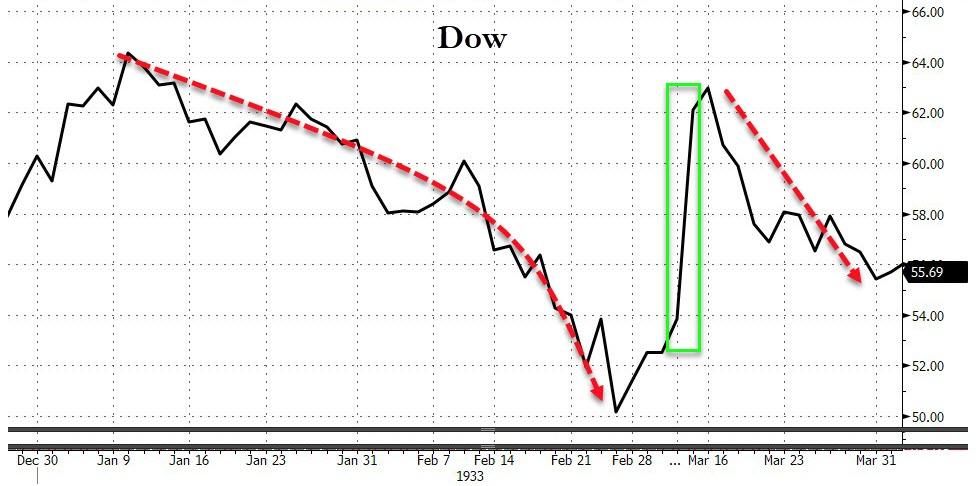
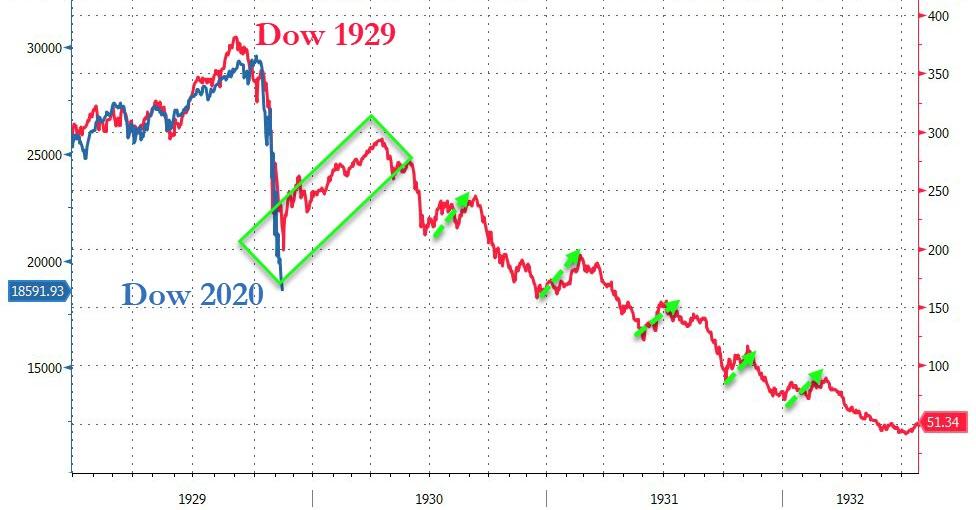
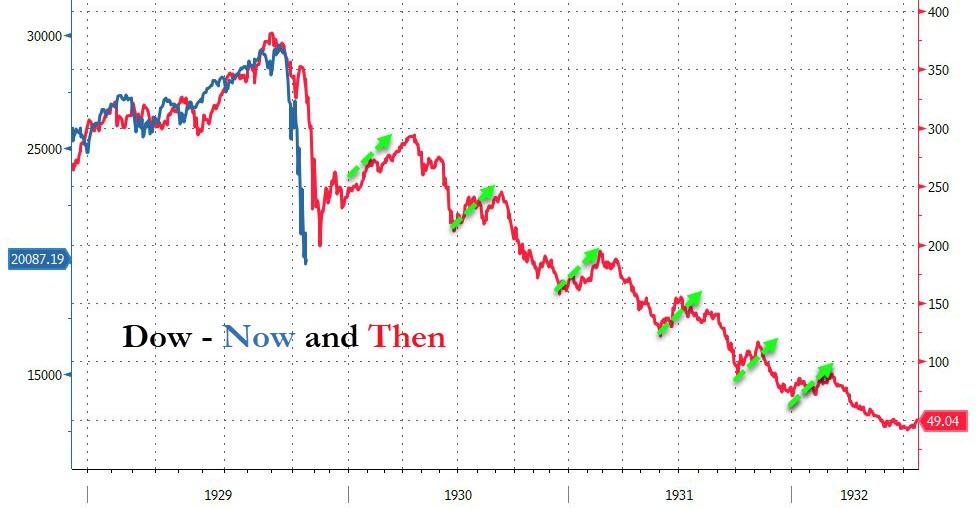
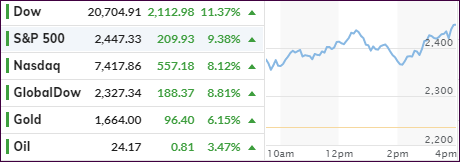
The markets finally managed a solid comeback by using nothing but hope for a $2.5 trillion stimulus package as a springboard with the Dow scoring its best percentage gain (11%+) since 1933. However, history throws a shadow on that event, if you look at this chart and become aware of what happened afterwards.

Optimism grew that congress would come to an agreement on a giant fiscal package focused on alleviating the devastating economic impact from the coronavirus.

After the relentless selling of the past 3 weeks, it’s not unexpected to see such a snap back, as bear markets historically can demonstrate rebounds of a far greater magnitude than what we see during bull markets. Of course, as we’ve observed all of last year, the biggest ever short squeeze gave an assist today with the most shorted stocks soaring 11%, according to ZH.

While the Fed has gone all out to unleash its stimulus efforts, as I posted over the past few days, it’s now up to congress to grease the wheels for fiscal and monetary stimulus to operate in sync.

Does that mean it will work, and the bear market is over?

I don’t believe so, although some MSM reports and a bunch of traders expect a V-shape type of recovery. While that is possible, I don’t think its likely, and we must wait and see how markets react, once congress gives its nod. Let’s hope we don’t witness the old “buy the rumor, sell the fact” reaction, which can easily put today’s rally back into reverse.

Looking at the analog chart of 1929, we can clearly recognize that a sharp correction was followed by a fake 2-month rebound, before bearish tendencies prevailed in a subsequent 2-year brutal downturn.

Will history repeat itself? Who knows, but no matter how much of a one-day rebound we experience, it’s most likely not the return to the good old days.

Read More

Tumbling Into A New Week

Ulli Market Commentary Contact

[Chart courtesy of MarketWatch.com]
  1. Moving the markets

Despite the Fed saying that “aggressive action is needed” and subsequently proved it by introducing unlimited QE via purchases of $125 billion in securities every day, the markets managed to swing wildly but only “below” their respective unchanged lines.

Analyst Graham Summers summed it up best:

As I warned two weeks ago, the Fed is going to start buying “everything”… AKA Weimar lite.

The Fed has faced a choice… either let debt deflation clear the bad debts from the system, even if it means major corporations and banks failing, OR start buying “everything” in an effort to prop up the system (even if it induces raging inflation).

Well, the Fed officially crossed the Rubicon over the weekend. Going into the weekend the Fed had already…

1)    Cut interest rates from 1.25% to 0.15%.

2)    Launched a $1.5 trillion repo program.

3)    Launched a $700 billion QE program.

4)    Begun buying commercial paper debt instruments.

5)    Opened the discount window to the eight largest banks in the US.

6)    Expanded the repo program to $1 trillion per day.

7)    Opened dollar swaps with international central banks.

8)    Opened credit windows to the money market funds market.

9)    Begin buying municipal bonds.

Well, buckle up, because over the weekend, the Fed announced it would make its QE program “open ended” meaning it would buy Treasuries and Mortgage Backed Securities as needed.

Put another way, the Fed announced unlimited QE. And to top it off, the Fed ALSO added that it was expanding its QE mandate to buy corporate debt (for the first time in history).

Put another way, the Fed has announced it is going to effectively monetize “everything,”… Treasuries, Mortgage Backed Securities, Municipal debt, Corporate debt, etc. The only thing debt assets left are student debt, auto loans, and credit card debt.

In simple terms, the Everything Bubble burst… and now the Fed is dealing with it by buying EVERYTHING.

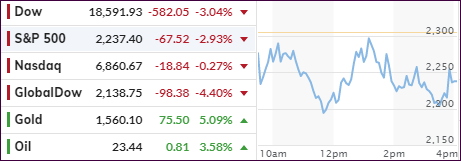
Given all that QEternity effort, the markets tanked anyway with the major indexes declining, but the Nasdaq withstood the brunt of the sell-off best by only slipping -0.27%. Of course, hopes springs eternal that Washington’s divided politicians will eventually come together and offer a rescue package. Whether that will affect the markets positively, or merely elicit another sell-off, remains to be seen.

Still, serious damage has been done and reality struck hard and fast. AS ZH confirms, in mid-February, the Dow was almost up 60% from Trump’s election…and now it’s gone. Joining the Dow are SmallCaps and Transports, which are now in the red since Trump was elected, as this chart demonstrates. So much for the idea of investing without an exit strategy.

Hedge fund manager Scott Minerd, when asked to explain if there is more pain to come, tweeted this:

How do we know when we have not reached the bottom? When the talking heads on CNBC are buying.”

Read More

ETFs On The Cutline – Updated Through 03/20/2020

Ulli ETFs on the Cutline Contact

Below, please find the latest High-Volume ETF Cutline report, which shows how far above or below their respective long-term trend lines (39-week SMA) my currently tracked ETFs are positioned.

This report covers the HV ETF Master List from Thursday’s StatSheet and includes 322 High Volume ETFs, defined as those with an average daily volume of more than $5 million, of which currently 20 (last week 31) are hovering in bullish territory. The yellow line separates those ETFs that are positioned above their trend line (%M/A) from those that have dropped below it.

Take a look:                                                                   

The HV ETF Master Cutline Report

In case you are not familiar with some of the terminology used in the reports, please read the Glossary of Terms. If you missed the original post about the Cutline approach, you can read it here.

ETF Tracker Newsletter For March 20, 2020

Ulli ETF Tracker Contact

ETF Tracker StatSheet          

You can view the latest version here.

CRASHING INTO THE WEEKEND

[Chart courtesy of MarketWatch.com]
  1. Moving the markets

Despite an early bounce along the green side of the unchanged line, reality set in, supported by the always unpredictable quad options expirations day, sending the markets reeling—again.

The major indexes were hammered, with the S&P 500 getting skunked by -15%—for the week! Not helping matters late in the day was the fact that a death-cross in the Dow had occurred, meaning its 50-day moving average had dropped below its 200-day M/A, which can be a sign of more weakness ahead.

Of course, some clueless analysts were quick to point out that the last death cross appeared three days before the Christmas Eve 2018 bottom. So, what difference does that make? All the gains from that point forward have now been given back and then some, which is a clear representation of the buy-and-hold idiocy.  

ZH points to the fact that today was a historic one. The Fed bought a record $107 billion in securities today alone, as its balance sheet exploded some 50% in the last six months. It becomes clearer by the day that the Fed’s scramble to stabilize the Treasury market is not working.

As I said before, there is some big player (to be named later), like a bank or Hedge fund, that got caught on the wrong side of a severely leveraged trade and needs to be bailed out. Hence the monetization of various securities, including now the Muni bond market. Something appears to be broken beyond repair, and I am sure we will find out soon what it is.

ZH added more color:

This was the worst week since Lehman (and worst 4 weeks since Nov 1929) for The Dow Jones Industrial Average…(Dow was down 18% during the Lehman week and 17.35% this week), despite The Fed gushing a stunning $307 billion into the markets – almost double its previous biggest liquidity injection (in March 2009)…

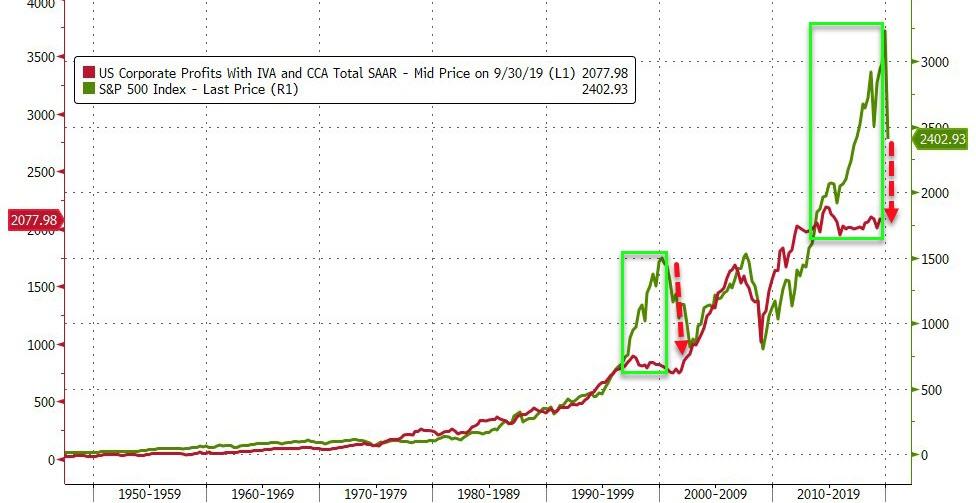
And here’s Bloomberg’s updated chart showing where we might be going, and that is towards the 1,700 level on the S&P 500. And longer term, we may even see history repeat itself.

In the meantime, enjoy the popcorn while watching this movie from the sidelines.

Read More