Questions To Ponder

Ulli Uncategorized Contact

MarketWatch featured some interesting “Questions to ponder while awaiting bailout:”

We have a new administration in Washington and a new power structure on Wall Street.

We’re getting $800 billion in stimulus and $1 trillion more to get rid of bad loans.

Yes, good times are right around the corner. Wait for it.

We’re going to feel good soon.

Until then, here’s a set of questions and thoughts to chew on:

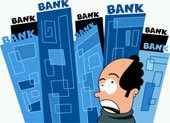
What’s all this fuss about starting a “bad bank”? Don’t we already have Citigroup?

Will the new bad bank get a brand-new $50 million jet, too?

Speaking of jets, does U.S. Airways pilot Chesley “Sully” Sullenberger, who saved all 155 lives in an emergency landing on the Hudson River recently, know anything about mortgages? We could use a soft landing.

Could Sully climb into the cockpit of Citi 1, finish that flight down to Charlotte and rescue Bank of America Corp. CEO Ken Lewis by showing him how to use a parachute? He may soon need it.

It seems Lewis shops at Ikea, but does he eat the meatballs?

By the way, does this mean former Merrill Lynch CEO John Thain isn’t going to be on MTV’s “Cribs”?

Moving to Davos, considering how well past forums — which included such luminaries as Thain and former Lehman Brothers CEO Dick Fuld — have prepared us for economic challenges, who’s presenting this year? Alleged bilker Bernie Madoff and rogue trader Jerome Kerviel?

If Wall Street bonuses totaled $18 billion but the industry showed a net loss of $35 billion, as the New York state comptroller’s office said Wednesday, does that mean bonus payouts will double next year if the industry loses $70 billion?

What does it say about the state of the strategic merger that Pfizer Inc. is willing to pay a total consideration of $67.1 billion for Wyeth but Dow Chemical has cold feet about its $15.3 billion deal to buy Rohm & Haas Co.?

How are the final-year MBA students at Wharton and Harvard feeling about job prospects this spring?

Interesting questions indeed. The greatest focus will be on the creation of a ‘bad bank,’ which seems to instill the false hope that the end of the recession is near as soon as this toxic asset dump has been established.

In my view, the initial effect on the markets will be one of relief at first followed by a rally before the reality sets in that simply shifting bad assets onto the back of the already burdened taxpayer will not end this bear market prematurely.

Sunday Musings: The Case For Bank Nationalization

Ulli Uncategorized Contact

The idea of creating a ‘bad bank’ designed to absorb the toxic assets from banks’ balance sheets is gaining momentum. Of course, we all know that the tax payers ultimately will be fronting the money and will be carrying the burden for generations to come.

An alternative would be to nationalize all troubled banks. Dr. Housing Bubble presented some interesting thoughts as to why nationalization would be the lesser of the two evils:

The one thing that is very troubling is the bad bank idea that is now floating out there in dark and gloomy space. Of course, this is a wet dream for the CNBC crowd but is quite possibly the dumbest idea in the world!

Nouriel Roubini and others are calling for a nationalization of banks and as much as it pains me to say, I agree. We either have the choice of being Sweden or having our lost two decades like Japan. If we go with the bad bank model, you can rest assured we are going to have zombie institutions probably until 2020 since there is so much crap on the balance sheet of banks. Take a look at some Real Homes of Genius and see if you are comfortable taking these mortgages onto your balance sheet. The reason the market has been rallying recently is because of this absurd notion. It isn’t because jobs are growing. They are accelerating on the downside. It isn’t because of earnings. Companies are missing left and right. This rally again ignores the silent depression of the vast majority of Americans while catering to the small crony capitalist group who argued for supply side economics and thinks this is a great idea. It isn’t, at least not for 95% of the population.

Now why is nationalization a better use of money? Well first, we are much too far down the road to discuss hands off policies (even though I advocated for this long ago because I knew things like TARP and Ben Bernanke’s nutty work were simply money being flushed down the toilet). First, with nationalization we own the banks flat out. We can then do the following:

-Shareholders get eliminated

-Bondholders get eliminated

-Management gets the boot

-Then and only then, do we separate out the good and bad assets. The good assets we try to sell them off to the market. The bad assets, we assess and slowly process a pricing model and get rid of them. Yet we know since the ownership is now ours that we’ll try to mitigate the loss for taxpayers. Right now with TARP and possibly the bad bank, banks are trying to off load as much of the crap at the highest cost to taxpayers while keeping the caviar assets all for themselves.

-This will get credit moving again because now instead of absurd capital injections, banks will now need to lend money because guess what, we freakin own them and we can decide whether we loan or not!

There is nothing more preposterous than a bad bank. It falls under the SIIV mentality that each progressive bail out gets dumber and dumber. In fact, this notion was what made the TARP fail during its first round. The idea that banks were going to dump the most toxic assets on the backs of taxpayers. Here we are, discussing that damn idea again.

Let us nationalize it and be done with it. Will the market feel pain? Yes! But those who face the most pain will be the banks and Wall Street who deserve it anyway. Wall Street is so disconnected from Main Street that they don’t realize that half our country is already struggling with hard economic times, even before the bust. We already know that they are not looking out for you and if you spend 2 seconds to think about what I just discussed, you’ll understand how horrible a bad bank would be. It is a one-way ticket to a Japan like recession and why are we to expect a different result? Keep in mind that in Japan they had a much higher savings rate which is buffer we do not have. If you think Japan is a picnic think again:

“Over the last few years, temporary employees have gone from being a rarity in Japan to accounting for one-third of the workforce of 67 million. They enjoy far fewer protections than full-time workers — placing their necks squarely on the layoff chopping block.”

We are already seeing the part-time number of workers jump into the stratosphere. Interestingly enough, Japan’s lost decade came after a real estate and stock market bubble. Sound familiar?

So going back to how this interconnects with the paradox of thrift, we are now spending taxpayer money through our government. Not all of it is bad but certainly the TARP and bad bank are horrific ideas. The money we are spending is on the backs of future generations. So much damage has been caused over the last 30 years with acceleration this past decade that we will have years to get this thing back on track. Americans are only now starting to save more (a little) because their credit has been shut off. That is it. That was the end game.

Anyone thinking we’ll be back to the old spending ways when you can get access to your HELOC with one phone call or simply buy a new car every two years is smoking purified financial crack. Those days are gone. The days of zero down NINJA turtle loans on homes are gone. I say good riddance. They have led us to this cliff and have rewarded corruption, greed, and the destruction of our country’s financial stability. I think it is apt to remember what Thomas Jefferson once said:

“If the American people ever allow private banks to control the issue of their currency, first by inflation then by deflation, the banks and the corporations will grow up around them, will deprive the people of all property until their children wake up homeless on the continent their fathers conquered. The issuing power should be taken from the banks and restored to the people, to whom it properly belongs.”

We are in an economic mess that simply does not allow us to look for and pick out elegant and pleasing solutions. Too much money has been wasted already and much will be still flushed down the drain. While bank nationalization may not be the ultimate solution, it’s the best approach at this point to quickly get the ‘bad asset problem’ over with sooner rather than prolonging it forever.

The Latest Forecast

Ulli Uncategorized Contact

The World’s Economic Forum yearly retreat in Davos, Switzerland attracted the usual cadre of high-flying financiers and CEOs from around the world. No question that the egos of many participants were bruised last year as a crippled financial system and a deep global downturn changed the tone of the seminars and meetings.

Nouriel Roubini, who forecasted much of the current economic malaise, had this to say in an interview leading up to the annual gathering:

[youtube=http://www.youtube.com/watch?v=mG4g04J-xYQ]

No Load Fund/ETF Tracker updated through 1/29/2009

Ulli Uncategorized Contact

My latest No Load Fund/ETF Tracker has been posted at:

http://www.successful-investment.com/newsletter-archive.php

Further sell offs caused the major indexes to lose for the week and for the month.

Our Trend Tracking Index (TTI) for domestic funds/ETFs remains below its trend line (red) by -11.01% thereby confirming the current bear market trend.


The international index now remains -19.74% below its own trend line, keeping us on the sidelines.


For more details, and the latest market commentary, as well as the updated No load Fund/ETF StatSheet, please see the above link.

I Want Some TARP

Ulli Uncategorized Contact

Thanks to reader John for submitting the below video clip titled “I want some TARP.”

Now that the only requirement to get on the federal TARP program (Troubled Assets Relief Program) seems to be an extreme high level of debt along with near insolvency, there are bound to be many others asking for free money.

Enjoy!

[youtube=http://www.youtube.com/watch?v=yGfQk9XXm24]

Ranting

Ulli Uncategorized Contact

Random Roger had some interesting thoughts in his recent post titled “Monday Musings:”

This may come off as an unpleasant rant. Between a couple of articles I found over the weekend and watching the Consuelo Mack show on PBS I came away with a very low regard for the way some folks do things.

First up was an article from Morningstar about what they got wrong in 2008. I have been writing about how worthless the analysis is for as long as I have been writing. They are a bottom up shop and from what I can tell it is a rare day when bottoms up warns of a bear market. Low PEs and other ratios don’t matter when the market is going to rollover into a bear. When the market is going up most stocks go up so a good bottoms up might find stocks that go up more than market but being right about the market would seem to be more important. So with that backdrop Morningstar says the learned a bunch of things in 2008. I would wonder what they learned in 2001 and why that seemingly did not help in 2008.

I have mentioned before that Morningstar’s ratings are one of the most useless tools in an investor’s arsenal yet millions follow them blindly. Whatever approach they use to determine the rankings does not really matter, what matters is that it simply represents a different twist of the buy and hold mentality, which will subject its followers again and again to bear market disasters. Yes, I agree, Morningstar has not learned a thing since the last bear market in 2001, which caused their followers huge portfolios haircuts in 2008.

This article from Seeking Alpha contributor Marc Gerstein posits that collectively the crew at Morningstar is just too young. He believes that experience matters a lot when it comes to navigating the market. I find his take interesting because at 42 I am probably in between his definition of too young and experienced. One reader commented that Morningstar has a bullish bias which hurts them. I don’t know if that is true or not but there might be something to the youth angle but I do think it is bigger than that. Look at Larry Kudlow who must be close to 60 either way or Art Laffer or even Brian Westbury (I think Brian is older than me) they are all experienced and all missed this coming in hideous fashion, bizarre really.

No, age has nothing to do with it; it’s the insistence on using a bullish stance in a bearish environment come hell or high water that is the problem.

This gets me to the Connie Mack show which this week featured Brian Rogers from T Rowe Price and Chris Davis from the Davis funds. Brian’s fund the T Rowe Price Equity Income Fund lost 35.8% in 2008 which was the worst year for the fund going back to 1985 “by a lot.” He said that when there is a severe credit contraction there are very few places to hide. Even safe areas like utilities were “traumatic.” Consuelo asked if there was anything he would have done differently or could have done differently and he answered “no I don’t think there is.” He said they would continue to focus on good quality companies that have struggled, with good balance sheets and valuations. He then said there are things he would have done differently but he didn’t say what.

So I guess the next time the market drops 38% his fund will be pretty close either way? Did he really not know that credit contractions cause problems in the markets? That is the entire idea behind the inverted yield curve.

In past posts I have mentioned that mutual fund managers are not the asset allocators. It is reasonable for a fund manager to invest all of the money in his fund so this post is a bit of a contradiction but I was dismayed by Rogers’ comments and to a lesser extent Davis’. So an active fund manager might be all in but these funds can invest at the sector level in any manner they want so they could have underweighted or avoided financial stocks (financials clearly hurt Davis, not sure about Rogers but JPM, GE and WFC show up in his top ten).

In a bear market there a few places to hide. Since the brokerage industry as a whole has itself dedicated to always being invested in something (so product can be sold continuously) under various disguises of asset allocation, bottom up or top down investing and MPT (Modern Portfolio Theory), they have to pay to price when the bear strikes. All of these themes never look at trends and major market turning points to assess whether ones ideas are still valid.

I am so critical here because I think well if I saw something bad coming (but did not correctly guess the magnitude) how did these guys miss it so badly? They both are smarter than I am and that is not false modesty. Davis might say something about the capital gains embedded in the positions (a point made on past episodes of the show) so maybe no one should buy the fund going forward but that would also mean he made taxes the priority which will lead to tears more often then not. Taxes should never be the first priority.

2008 was not a matter of “seeing something bad coming,” because it assumes that you have the special gift of foresight. It was simply a matter of following major trends in the market place and acting at the turning points.

That’s it; no more no less—no smarts required.

What was required was the realization and experience (from previous bear markets) that senseless holding of any investment, no matter what the economic circumstances or the Morningstar rankings, will have negative consequences when the trends turn south.

A bear market takes no prisoners and even the stock prices of the most bluest of all companies will go down—no exceptions. When the trends change, you simply act and get out. When we went to all cash on October 13, 2000, we had no idea about the magnitude of the following bear market nor did we last year when we exited on June 23, 2008. Trying to assess fundamental reasons when trends head south is simply an exercise in futility.