Should You Buy Oil Now?

Ulli Uncategorized Contact

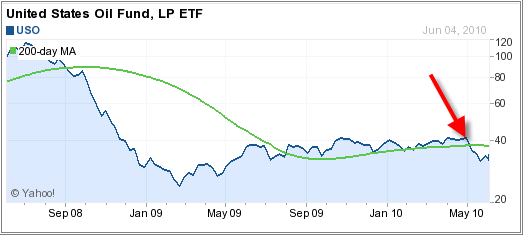
Several readers have emailed wondering whether oil would be a good buy at this level. The most obvious reason has been the devastating oil spill with all its implications. Let’s take a look at a 2-year chart of oil as represented by USO, the heavily traded ETF:


As you can see, oil has gone nowhere in the past year and has pretty much traded slightly above its long-term trend line before breaking it sharply to the downside late in April 2010 (red arrow).
Last Friday alone, USO dropped 4.61% and now resides below its long term trend line by -13.84%. Year to date, it’s down almost 17% and all of its momentum numbers are negative.

Apparently, many readers were of the opinion that oil should rally in view of the current oil spill. The reason that this did not happen, and the opposite occurred, is that oil prices fluctuate based on supply and demand in regards to economic activity.

The European debt crisis has again raised fears of a double-dip recession causing oil and energy products to head south. Look at the chart again. You can clearly see that this is what happened in September 2008, as the recession took hold, USO broke through its long-term trend line and those who held on suffered steep losses.

Given the fact that a resumption of the recession is a real possibility during the second half of this year, oil could head even lower. So, when would it be a buy?

I would consider it once it moves back above its long term trend line. At that point, at least you would have some assurance, although not a guarantee, that upward momentum has been restored. In the meantime, stay away from it as bottom fishing could be hazardous to your financial health.

Disclosure: No positions in USO

Sunday Musings: 5 Star Mutual Fund Ratings

Ulli Uncategorized Contact

In the new world of ETFs, it seems almost archaic to talk about Morningstar’s mutual fund ratings. But with many investors still being stuck in 401ks with only mutual funds a choice, it’s still a valid topic.

MarketWatch reports that “Five-star mutual funds don’t live up to their past:”

Tim Courtney decided he’d had enough. In meeting after meeting this year, he and his colleagues at Burns Advisory Group had recommended mutual funds to prospective clients, only to be hit with the same response almost every time: Why are you telling me to invest in a three-star rated fund?

That sums up the way many investors allocate money to funds — look at products that have four- or five-star ratings from investment researcher Morningstar Inc., take that as an imprimatur of quality and hope for the best. Such decisions are perhaps even more common in volatile markets, when anxious investors view top-ranked funds as somehow better-equipped to handle adversity.

Five-star funds in particular seem to have their own allure. Even in 2008’s brutal market, when the other star-rated funds saw net outflows ranging from $111 billion for three-star funds to $14 billion for four-star funds, five-star funds enjoyed $67.5 billion in net inflows.

The trouble is that investors seem to forget that star ratings look backward based on a fund’s past performance, and studies have shown the ratings have no predictive value.

“Having to get over that hurdle [explaining how star ratings shouldn’t influence choices], every time we recommended a fund that wasn’t five-star, is something we have to do time and time again,” said Courtney, chief investment officer of Burns Advisory, which manages about $300 million and advises about $150 million of 401(k) assets.

So Courtney and his colleagues went back to Dec. 31, 1999 and studied the subsequent 10-year performance of five-star funds. What he found might convince investors to kick their star-rating habit.

Of the 248 stock funds with five-star ratings at the start of the period, just four still kept that rank after 10 years. The 218 domestic stock funds with the rating typically lagged their category averages over the period — not just the benchmarks, but other mutual funds. The exceptions were 30 foreign large-cap funds, which had a 10-year annualized return of 1.44% compared with their category average of 1.32%.

In other words, it’s not just that five-star funds don’t, on average, continue to lead their peers, but they actually do worse in subsequent years.

There is much more to this article; if the subject interests you, be sure to read the entire link.

Personally, I have never seen the value of that rating system; I have found that if you wait long enough, your favorite 5-star fund may end up in the 2-star category and vice versa.

Using these ratings, investors get lulled into a false sense of security by believing that highly rated funds will hold up well in all types of market conditions. That false belief has turned into a very expensive lesson as the bear markets of 2001 and 2008 have clearly demonstrated.

I don’t care what rating a mutual fund has, whether it’s no load or load with high or low annual expenses; it will get clobbered when a bear market strikes—period. Only by being out of the market altogether during lengthy downturns can you avoid a serious portfolio haircut.

Sure, if you have assets in a 401k plan, you could use the ratings system to make your choices at the beginning of a bullish period, as long as you’re aware of the shortcomings once that trend comes to an end.

Better yet, use the 401k section of my StatSheet to verify that your selected 5-star fund is showing indeed upward momentum to justify a purchase.

The bottom line is that whether mutual funds or ETFs are on your equity menu, you need to recognize that neither will protect your principal during lengthy downward trends (unless they’re bear market funds). If you haven’t learned this valuable lesson from history, you’re doomed to repeat it.

The Tip Of The Iceberg

Ulli Uncategorized Contact

Jim Jubak wrote an interesting piece a week ago titled “Euro crisis is tip of the iceberg.” It’s a bit lengthy but well worth the read.

Someday the euro debt crisis that started in Greece and spread to engulf Europe will be over.

Politicians in the nations that use the euro will figure out the right mix of carrot and stick to get Greece, Portugal, Spain and other member states to adhere to European Monetary Union limits on debt. They’ll figure out how to balance national pride with the clear need for more-integrated fiscal systems among the members. They’ll gradually earn back the trust of financial markets, and someday we’ll all be back talking about the euro as a rival to the U.S. dollar as a global reserve currency.

Hard to believe right now, when the euro’s troubles are driving plunges in the world’s stock markets and rampant fears that the world is about to fall back into economic and financial crisis.

Hard to believe but true.

Here’s something, however, that may be even harder to believe: The euro debt crisis, for all its power to shake financial markets and the global economy, is just Chapter 1 in a story that will run for the next two decades. This crisis is only our introduction to the kinds of wrenching changes that virtually every nation’s economy will face over the next 20 years.

The euro debt crisis is a crisis coming to a nation near you. And let’s hope the next chapter suggests that there’s an ending to this story that doesn’t involve street riots and a long-term decline in living standards for entire populations.

Let’s hope. But the lesson from the euro debt crisis is that it’s not going to be easy. It may not even be possible.

You probably don’t think of the euro debt crisis as part of some larger global story that is going to pull in you and your family as starring characters. But it is. This isn’t just a story about some feckless Greeks who went on wild shopping sprees with money lent to them by hardworking Germans who didn’t check the books carefully. (But it is that story, too.)

Some basic economics make the Greek crisis universal.

From the first quarter of 2001 to the third quarter of 2009, unit labor costs in Greece — that’s how much a worker earned for producing one unit of something — rose 33%. That’s a 33% increase in the cost of producing one gimcrack in Greece after you’ve deducted all the benefits of any increase in the productivity of Greek workers. In other words, if a Greek worker went from making one gizmo an hour to making two an hour and got paid twice as much for that hour, the unit-labor-cost increase would be 0%.

Greek productivity did climb, at an average annual rate of about 2% from 2000 to 2010. Greece showed the same productivity growth as Germany, but wages climbed faster. According to Greece’s national collective labor agreement, wages rose 6.2% in 2006, 5.4% in 2007, 6.2% in 2008 and 5.7% in 2009.

The result was that Greece priced itself out of global export markets. If your unit labor costs climb 33% while those of Italy go up just 30% and those of Spain 28% — and while Germany’s costs increase just 6% and U.S. costs plummet 27% (as they did from 2001 to 2009) — you can be sure that selling your exports will get harder.

The combination of falling competitiveness and an aging population would be lethal enough — fewer workers making less-competitive products to support an increasing number of retired workers — but the Greek government has made it worse. To win voters’ support, governments of all parties not only promised those hefty wage increases, but they also promised generous pensions at earlier ages.

Before the crisis, for example, Greek civil servants employed before 1992 could retire after 35 years on the job if they were 58 or older. And the pension benefit is 80% of pre-retirement salary. The legal retirement age for all workers was just 61 before the crisis. In reaction to the crisis, the current government has proposed raising the retirement age to 63. (No wonder German taxpayers are steamed at the idea of having to fund a Greek rescue plan. The German retirement age is 67.

Greek politicians weren’t alone in promising future benefits to voters. The average burden of debt, plus liability for pension and other social-service promises, averages 434% of GDP across the European Union. France, with its relatively generous social benefits, comes in at 549%. The United Kingdom stands at 442% and Germany at 418%. Spain, which has a bigger current deficit but relatively modest promises to its citizens, shows up in Gokhale’s calculations at 244%.

And the United States? By these calculations, the debt-plus-promises burden comes to 890% of GDP. Move over Greece. Who’s your daddy?

Now governments could take the next decade or two to plan ways to meet or shirk this burden. Countries could set a schedule of raising the retirement age so that everyone would know what was coming and could plan for it. More-generous incentives for private savings for retirement and retirement health care could help make reductions in government-funded pensions less punishing. Subsidies could give some retirees incentives to choose less-expensive retirement housing.

Governments could do that.

But the evidence of the Greek crisis is that they won’t. Politicians in Greece didn’t take action until the country’s back was to the wall and they had the cover of a crisis to excuse their cuts to wages and future promises. It’s sad to think that a country’s leaders would prefer riots in the streets to proposing painful measures before the situation reaches a crisis, but that’s the conclusion I draw after watching how the Greek crisis has played out.

The transition that I’m describing from a world of glorious promises to an admission that we can’t pay for the promises to a long period of reneging on those promises would be painful enough if carefully planned and managed. But without that planning, I think we’re going to see most — but not all, I hope — countries lurch from crisis to crisis as governments downsize their promises to fit an aging world.

All industrialized nations are pretty much in the same boat as far as debt overload is concerned. It will take just one default, and the domino effect will take over.

Too farfetched?

I don’t think so. A few days ago, during my travels, I read on Bloomberg that the Greek government has engaged the services of a few British economists.

So far their unanimous recommendation has been for Greek to leave the EU and default on their debt. The jury is still out on that one, but watch out for stock market reaction once that possibility is not only seriously considered but actually executed.

It may not be a popular view, but I believe that much of today’s debt can’t possibly be repaid and will eventually be defaulted on. While I am not sure when the first shoe will drop, once it does, we will very likely find ourselves in bear market territory in a hurry.

Fortunately, there are a host of bear market funds/ETFs available, which are featured in my weekly StatSheet, to let us take advantage of that type of trend reversal, whenever it occurs.

No Load Fund/ETF Tracker updated through 6/3/2010

Ulli Uncategorized Contact

My latest No Load Fund/ETF Tracker has been posted at:

http://www.successful-investment.com/newsletter-archive.php

A rebound early in the week was annihilated today via a poor jobs report and negative news from Europe.

Our Trend Tracking Index (TTI) for domestic funds/ETFs remains above its trend line (red) to the upside by a scant +0.52% (last week +1.06%) keeping the current buy signal intact. The effective date was June 3, 2009.


The international index broke below its long-term trend line by -5.12% (last week -3.90%). A Sell Signal was triggered effective May 7, 2010. We are no longer holding any positions in that arena.

[Click on charts to enlarge]
For more details, and the latest market commentary, as well as the updated No load Fund/ETF StatSheet, please see the above link.

Rebounding Efforts

Ulli Uncategorized Contact


Finally, a rebound effort did not fail as we’ve seen so many times in the recent past. While yesterday’s rally lost some steam during mid-day, the bulls did not give up and the major indexes closed at their high points for the day as the chart (courtesy of MarketWatch.com) shows.

With no news out of Europe to rock the boat, the focus remained on domestic issues. Energy stocks provided the ammunition for the rally along with auto sales, which came in better than consensus estimate. Pending home sales rose as buyers tried to take advantage of the $8,000 homebuyer tax credits before the April 31st deadline.

Our domestic Trend Tracking Index (TTI) bounced off its trend line after coming within +0.49% of breaking it to the downside. The move into bear market territory therefore has been postponed as the index has now moved +1.45% above it.

We will have to wait and see if this rebound has legs or will turn out to be another head fake, which is likely to happen if Europe events move back onto the front page news menu.

Too Many Worries

Ulli Uncategorized Contact


Yesterday, the market started out with a hangover from last week by dropping over 1% at the opening on reports of slower manufacturing numbers in China. The Euro hitting a 4-year low against the dollar did not help the cause for a rebound.

Meanwhile, positive manufacturing and construction spending reports here in the U.S. seemed to put a floor under the selling, and the markets spent most of the day clawing back and briefly dipping into positive territory.

The last 90 minutes of trading, as we’ve seen quite a bit over the past few weeks, turned the rebound into a win for the bears as the major indexes headed straight down and closed near the lows for the day.

Weighing heavy on sentiment was the Attorney General’s announcement late in the day that the government was launching criminal and civil probes into the oil spill. That pretty much eliminated any upward bias by turning another rebound day into a losing proposition.

Our domestic Trend Tracking Index (TTI) slumped as well and moved to within +0.49% of breaking its long-term trend line to the downside. A couple more of these down days will certainly push the TTI into bear market territory where it will join the international index (currently at -4.52%), which signaled a sell back on 5/7/10.

Once that happens, bear market funds/ETFs will certainly become a consideration again. However, right now it’s too early to be concerned about that, and we will have to wait and see how things turn out before making any other investment decisions.