Platinum ETF Anyone?

Ulli Uncategorized Contact

Why buy gold when platinum is rarer, dearer and far more useful claims Forbes in “Platinum: Like Gold, Only Better:”

Gold might have history on its side, but when it comes to investing in precious metals platinum arguably makes more sense. Platinum is rarer, dearer and just as pretty. What’s more, unlike gold, it has an important industrial use in automotive catalytic converters and LCD TV screens. If that weren’t enough to recommend the white metal, the launch of new exchange-traded funds makes platinum easier than ever to buy and sell.

How does platinum compare to gold as an investment? It tends to trail its yellow sister when times are bad but outperform when industrial demand recovers. That’s been the case in the past three months, as platinum prices have outpaced gold’s by roughly 10 percentage points. These days, an ounce of platinum at $1,600 buys roughly 1.4 ounces of gold. That’s more than the average of 1.2 ounces last year, according to Bloomberg. Back in May 2008, an ounce of platinum bought 2.4 ounces of gold.

The ETF Securities Physical Platinum Shares (PPLT) fund is similar to the popular gold bullion SPDR Gold Shares ETF (GLD) in that it buys and holds raw bullion (safeguarded by JP Morgan Chase (JPM). Its shares track platinum’s spot price. You’ll incur lower transaction and storage fees in holding the ETF (annual expenses: 0.6%) than in holding and storing your own bullion bars.

Indeed, while this platinum ETF has been volatile (just like gold), it has been a better performer during the few months it’s been on the market. Take a look at the comparison chart:


Despite its short life span, volume has already soared to a daily average of some $25 million making it a feasible choice for most investors. If precious metals are of interest to you, be sure to read the entire link.

Disclosure: We currently have positions in GLD but not in PPLT.

Bond Fund Investors Beware

Ulli Uncategorized Contact

Income investors are reading “Bill Gross Warning May Catch Bond-Fund Investors Off Guard:”

Bill Gross’s warning that the almost three-decade rally in fixed-income has run its course may catch individual investors off guard after they poured $89 billion into bond funds this year.

The inflows through yesterday are running almost five times higher than deposits during the first three months of 2009, according to Brad Durham, co-founder of Emerging Portfolio Fund Research Inc., a Boston-based firm that tracks investor flows worldwide into mutual funds and exchange-traded funds. Investors reeling from losses during the financial crisis poured record amounts into fixed-income funds last year, missing the biggest stock market rally since the 1930s.

“The continued inflows make you scratch your head,” Miriam Sjoblom, a bond fund analyst at Chicago-based research firm Morningstar Inc. said in an interview. “We’ve seen time and again investors make these kinds of tactical decisions at the wrong time.”

Pacific Investment Management Co.’s Gross, manager of the world’s biggest bond fund, said yesterday in an interview with Tom Keene on Bloomberg Radio that “bonds have seen their best days.” Pimco, which announced in December that it would offer stock funds, is advising investors to buy the debt of countries such as Germany and Canada that have low deficits and higher- yielding corporate securities.

The prospect of a strengthening U.S. economy and rising interest rates makes an “argument to not own as many” bonds, Gross said in the interview.

Does this mean you should sell all bond funds now? Of course not. It’s just Bill Gross’s viewpoint that eventually interest rates will rise and bond funds will suffer as a result. The timing of it is totally unknown, and the assumption is based on the fact that the economy is indeed strengthening.

I could make the counterargument that with the scheduled tax increases in 2011, the economy could very easily slip back into a recession, which would bode well for bond funds.

Since no one has the answer, it pays to simply follow the trends. If you are concerned about higher rates, simply establish a trailing sell stop for your bond fund positions just like you would for your equity fund holdings. You may want to use a lesser percentage (maybe 5%) than my recommended 7% for equities.

That’s it! You now have a plan in place to deal with any market uncertainties and no longer need to spend your day worrying as to what your plan of action should be.

No Need To Unload Buy And Hold? Yeah Right…

Ulli Uncategorized Contact

MarketWatch is still supporting the buy and hold bandwagon as shown in a summary of “No need to unload buy-and-hold:”

For the many investors who are still smarting from the stock market’s 2008 meltdown, buy-and-hold tactics are the same as buy and fold — a deer in the headlights of impending disaster.

In truth, while buy and hold may disappoint stock traders, it’s still a viable long-term strategy for mutual fund investors. That’s because mutual fund managers are not buy and hold investors. A stock fund typically turns over its portfolio completely once a year. The fund’s underlying investments are constantly changing, for better or worse.

The lesson for fund investors is that if you’re comfortable with the job your funds are doing, leave the trading to the pros. Switching in and out of mutual funds invites performance chasing — buying high and selling low — and wreaks havoc on your financial and emotional well-being. The markets are volatile enough with you reacting to every twist and turn on Wall Street.

What wreaks havoc on your financial and emotional well being is being fully invested in a bear market and watching dumbfounded how fast your portfolio can get a 50% haircut. I have yet to find a reader/client who sat on the sidelines during the meltdown of 2008 while suffering from emotional issues.

The story is ignorance at its best. Yes, mutual fund companies typically turn over their entire portfolio once a year. So what? I fail to understand how that helps you avoid losing money? They can turn over their portfolio 10 times a year and it won’t matter. Yes, it will improve performance during bull markets but it will do nothing during bear markets.

Why?

Because the bear does not discriminate as we’ve seen in 2001 and 2008. All stock funds (and even bond funds) will get clobbered. The only way to avoid losses altogether is by being out of the market. Remember, based on their charter, equity mutual funds have to be invested at all times so that the investing public can buy their product.

The only way you can be exposed to mutual funds and avoid/minimize losses is by using bear market or Long/short funds that focus on making money in down markets. Straight equity funds can’t do that so you’re at their mercy when the trend heads south.

It’s amazing to me how articles like the one above still promote the same old theme knowing full well how much pain and agony it has caused for millions of investors. Nothing has been learned from the past, and I am afraid many will repeat their mistakes of holding on for dear life when the next downturn occurs.

Sunday Musings: Idle Cash

Ulli Uncategorized Contact

Over time, I have received my share of emails from readers wondering how to deploy idle cash for which they have a short-term purpose. Here’s what reader TJ had to say on the topic:

I am in the process of having to deal with many renewing Certificates of Deposits from several institutions. My wife and I are in the process of building a home and need to have the cash available in the next 6 -12 months.

Obviously I do not want to take any undue risk with these funds, but I am seeking a larger yield than Fidelity’s Cash position of 0.70%. What is an appropriate parking spot for this cash? It is currently $500K and will ramp up to $1.2M by end of the year. Is the PCEF ETF appropriate for any of this?

I thank you for your past assistance.

Generally speaking, I am against “investing” funds that have a short-term need using a long-term investment discipline. All investment disciplines by nature are long-term to better deal with short-term market volatility.

Needing funds within 6-12 months for an important project such as a building a home requires safety first, unless you have very deep pockets. As I have recommended before, using instruments with no market risk such as CDs and money market funds are the only way to guarantee that your principal stays intact and will be available when you need it.

Income generating funds such as PCEF will bring market risk into the equation. While you may get lucky and hit a winning streak and make a decent return, it’s a bit of a gamble.

Here’s where you’re risk tolerance and overall financial situation comes into play. If you can afford to take some risk using income producing funds, and your capital is sufficient to weather out some potential losses (via rising interest rates) without jeopardizing your building project, then you could deploy a portion of your assets to funds like PCEF, BND or similar ones.

If you are asking me as an advisor if I recommend you go that route, the answer is no. Stick to what you have been doing and eliminate the stress that comes with market exposure, which will allow you to better focus on the project at hand.

Disclosure: We have invested positions in the funds mentioned above.

The “Value” Of Research

Ulli Uncategorized Contact

Al Thomas, author of the book “If It Doesn’t Go Up, Don’t Buy It!” wrote in his weekly syndicated column about the “Attention Deficit Research Disorder.” Let’s listen in:

Wall Street has everyone, even the “experts”, believing the myth that research is required to be a successful investor.

Every fact about a company must be known before an investment is made. Find out the P/E ratio, management, cash flow, product quality, market share, etc., etc.

All the figures show the company is a “good” company, but that does not mean the stock will go up. Historical studies show there is little correlation between being “good” and the stock price going up.

After the investor has done his analysis he comes to realize all this information is an agglomeration of stuff that has no wisdom. Suppose you memorized the Encyclopedia Britannica. Would that make you wise? No. You just know lots of “stuff”. The key is you have to know what to do with it, how to apply it.

I make my income from trading. Would it help me to memorize the Morning Star Manual? Not really. It won’t tell me which stocks will go up. If all this “research information” is so valuable why aren’t all brokers rich? As a former brokerage company owner, I will tell you they are not.

Today there is so much information available it is staggering. Then you have to know if what has been found is true. Look at all the false material the financial wizards have been feeding the public.

Furthermore information travels at the speed of light through the Internet to any person who cares to read it. It is very difficult to keep a secret. There are whistle blowers everywhere, not that they are bad people.

Wall Street brokerage companies want you to do nonsense research so you won’t sue them when their “recommendations” turn out to be wrong.

There is only one thing you really need to know and that is the recent direction of the price movement of the stock. Is it going up, down or sideways? Look at a chart of the stock price for the last year or so. On the Internet you will find a chart and it will tell you more in 30 seconds than 30 days of intensive research.

The inundation of facts and figures can have the investor a nervous wreck. There is no need for emotional tribulation when you look at the price movement of the “good” company’s stock. It will be apparent whether it is good, bad or indifferent. If the trend is up, buy it. That is all any investor needs to know.

When it turns down sell it. Find another “good” company whose stock price is appreciating.

Financial research is worthless. If it created wisdom everyone would be rich.

While Al’s viewpoint certainly goes against popular thinking, I have to agree with him based on my experience. Fundamental analysis as it’s called may be able to tell you whether one company is financially in a better situation than another one, but it does not tell you whether it’s a good time to buy.

Say, you had spent weeks of research to evaluate a stock (or mutual fund) to the point that you were suffering from data overload, but you finally decided to make a purchase—in the summer of 2008. The market crash was about to instill some reality on Wall Street, and your carefully selected investment went down the tubes along with everyone else’s.

The point is that most research makes for an interesting conversation at a cocktail party while adding some aura to the person who can best throw around some terminology that others do not understand. It does nothing to provide you with a market entry point, nor will it assist you in getting out before the bear strikes again.

Follow the trends and stay on the “right” side of the market and employ a sell stop discipline no matter what you invest in. Keep your ego out of the way by acknowledging the fact that there is no shame in taking small losses from time to time, because they will keep you on the right track by providing a safety net that will prevent you from participating in market disasters.

No Load Fund/ETF Tracker updated through 3/25/2010

Ulli Uncategorized Contact

My latest No Load Fund/ETF Tracker has been posted at:

http://www.successful-investment.com/newsletter-archive.php

The major indexes eked out another gain despite failed rally attempts on Thursday and Friday.

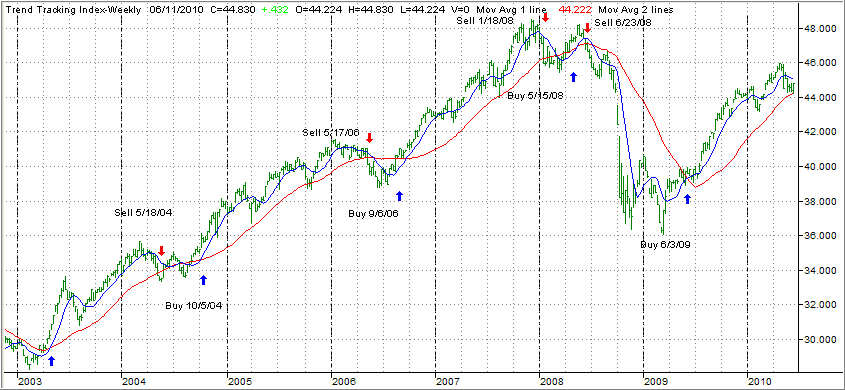
Our Trend Tracking Index (TTI) for domestic funds/ETFs has now crossed its trend line (red) to the upside by +4.15% keeping the current buy signal intact. The effective date was June 3, 2009.

The international index has now broken above its long-term trend line by +6.28%. A Buy signal was triggered effective May 11, 2009. We are holding our positions subject to a trailing stop loss.

[Click on charts to enlarge]
For more details, and the latest market commentary, as well as the updated No load Fund/ETF StatSheet, please see the above link.