No Load Fund/ETF Tracker updated through 6/24/2010

Ulli Uncategorized Contact

My latest No Load Fund/ETF Tracker has been posted at:

http://www.successful-investment.com/newsletter-archive.php

The bulls gave back last week’s hard fought gains and then some as the bears ruled.

Our Trend Tracking Index (TTI) for domestic funds/ETFs remains above its trend line (red) by +1.19% (last week +2.46%) keeping the current buy signal intact. The effective date was June 3, 2009.

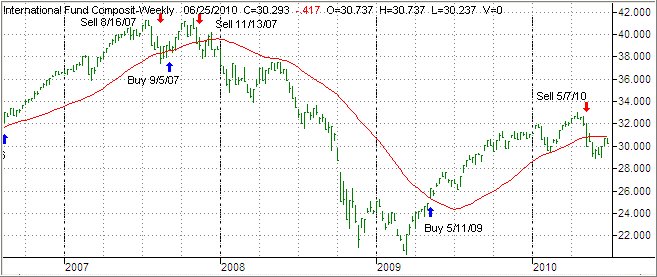
The international index has now broken below its long-term trend line by -1.84% (last week -0.49%). A Sell Signal was triggered effective May 7, 2010. We are no longer holding any positions in that arena.

[Click on charts to enlarge]

For more details, and the latest market commentary, as well as the updated No load Fund/ETF StatSheet, please see the above link.

Fed Keeps Rates Low

Ulli Uncategorized Contact

As expected, the Fed announced yesterday that interest rates would remain at their historic low levels. Normally, this should have cheered investors, but this time it was interpreted (correctly) that it was simply a sign of the economy struggling.

Fears have been increasing lately that we might slip back into a recession, which would postpone any rate increases for at least a year or so. Retail sales have been weakening with sluggish demand and no improvement for increased employment in sight.

Contributing to the initial selloff was the news that new-home sales plunged by more than one third in May to 300,000 units, the lowest since record keeping started in 1963. That should have come as no surprise as the home buyer tax credit expired at the end of April.

The markets more or less meandered aimlessly but managed to keep losses to a minimum as the chart above shows. Our domestic Trend Tracking Index (TTI) edged slightly higher and has now moved +1.87% above its long-term trend line.

The market appears to be stuck in this range with the S&P; 500 hovering around the 1,100 level. A breakout will occur sooner or later, and we will have to wait and see if it will be to the upside or if overwhelmingly negative economic news will pull the domestic TTI finally into bear market territory.

Recovery Doubts

Ulli Uncategorized Contact


Weak housing and worries about Europe proved to be too much for the market yesterday and, after a modest opening rebound to higher levels, the major indexes slid for the remainder of the session as the chart above (courtesy of MarketWatch.com) shows.

The S&P; 500 ended up below the 1,100 level and broke below its key technical indicator, the 200-day moving average. This could increase downward pressure if prices stay below that point, and it will eventually act as overhead resistance.

The market’s weakness arrived just in time for the 2-day Federal Reserve meeting on interest rates. We will find out the results on Wednesday, but expectations are that no changes are imminent with key interest to remain at current low levels.

Our domestic Trend Tracking Index (TTI) moved closer to its long-term trend line, but still hovers +1.80% above it, which means that there are no changes to our current positions.

Against popular opinion, I still believe that low interest rates are here to stay with us for quite a while longer as the expiration of stimulus programs will not bode well for the economy. That’s why reduced equity holdings and increased exposure to bonds (via bond ETFs) may make sense until such time that a change in trends proves otherwise.

The Rally That Wasn’t

Ulli Uncategorized Contact

In a repeat performance similar to what we’ve witnessed so many times over the past few months, the markets turned an early intraday 140 point gain of the Dow into a losing session starting the week on a negative note.

The losses were modest, so not much should be read into them. The driver for the morning rally was the Chinese announcement that it will loosen its currency peg to the dollar; not by a huge change, but at least it was interpreted as a step in the right direction after two years of being locked in a rigid position.

However, global debt problems surfaced later on in the day, the dollar rallied (supporting our long position) and south we went. Our domestic Trend Tracking Index (TTI) moved only slightly and remains +2.19% above its long-term trend line.

Upward momentum from last week’s rally seems to have stayed intact as all major indexes are remaining above their 200-day moving averages.

More ETF Price Cutting

Ulli Uncategorized Contact

I am all in favor of lower fees when it comes to investment products. Charles Schwab & Co. (my custodian) has again upped the ante in “ETF deals get even better as Schwab cuts prices in price war:”

Maybe the day will come when they will pay you to buy ETFs. That will be a great day, but don’t count on it.

Still, a price war between ETF — or exchange traded fund — providers is working in the individual investor’s favor. It is making ETF investing pretty cheap.

Schwab and Fidelity lets people buy some ETFs for free, without paying commissions — or the fee you get charged when you buy or sell a security. And Vanguard has made their full fleet of ETF’s commission-free. Now, competition is also extending to the fees you get charged day in and day out for the management of the ETF itself. Schwab announced that it has cut the fees — or expense ratios — in a handful of ETFs it has created.

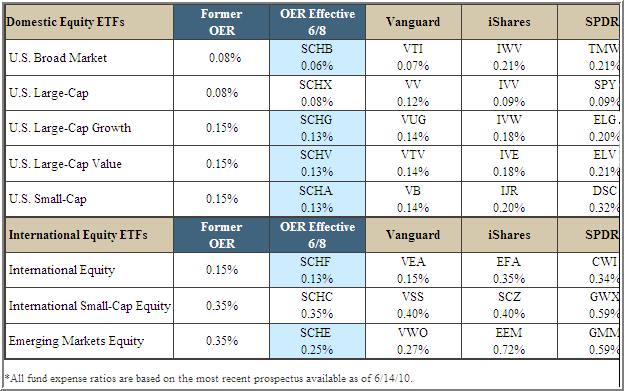
For example, Schwab has cut expenses in its broad market fund from .08 percent to .06 percent and in its emerging market fund from .35 percent to .25 percent.

Fees matter. They are the one thing an investor can control and over years of investing higher fees can reduce your return by thousands of dollars. Still, as you pick ETFs remember that it’s important to have a diversified portfolio — with bonds, for example, in addition to stocks. So don’t just limit yourself to the cheapest ETFs if that means skipping the full blend of funds you need. In addition, you want funds large enough to allow you to trade in and out easily without paying higher trading costs. And you want to notice what stocks or bonds are in the funds, because those with ETFs with similar names aren’t always similar.

Here’s the fee comparison chart:

While price reductions are always a step in the right direction, do not make this your main criteria when selecting ETFs. For example, while Schwab’s S&P; 500 equivalent (SCHX) has no commission and the lowest management fee (0.08%), the average daily volume is around $6 million, which makes it suitable only for small investors. Compare that to SPY, the largest ETF in the universe with over $25 billion being traded daily.

When the markets correct, and the exit doors get crowded, you do not want to get caught holding a low volume ETF. Commissions or no commissions, slightly higher annual fees or lower ones, it does not matter; when you need to exit in a hurry based on changes in the trend, or your sell stops being triggered, only volume matters.

Sunday Musings: A Personal View

Ulli Uncategorized Contact

Reader Mel emailed the following comment:

For some reason I was blocked from commenting on today’s blog. Here’s what I wanted to say, and you can feel free to post it:

As always, I’m grateful for your posts, including the ones that re- post something interesting from elsewhere, but in this case I was especially interested in your comments. I know you’ve been an American long since, but you do have a former insider’s view of Europe and especially Germany, and I hope you’ll write more about the mood and thoughts of Europeans, especially the ever-pivotal Germans, as this crisis unfolds for better or for worse. You can surely do this more authoritatively than most Americans.

I’d be particularly interested in your evolving views of the Euro- style welfare state–whether you were always a skeptic, whether you think it can survive in some form, how different we are if we have such a heavy burden of future obligations anyway, etc., etc.

First, as you may have noticed, a few weeks ago I disabled the anonymous posting function due to abuse and ever increasing spam attempts. While you can still post, you need to identify yourself.

A quick check of other blogs dealing with economic/investment issues confirmed that most do not offer anonymous posting—very likely for the same reasons. If you wish to remain anonymous, you can always email me with any questions, and I’ll address those in future posts.

Second, in regards to my view of Europe, or Germany in particular, I must admit that I have been gone for a long time (35 years) and at times feel like that I am on the outside looking in. Nevertheless, every time I visit, I seem to become reacquainted with their way of life fairly quickly.

The most obvious difference I notice every time is the much more conservative behavior of the consumer. Despite the fact that purse strings have been loosened quite a bit, the overriding desire and priority number one is still to save money first.

This was confirmed during my recent visit when it was announced on the business channel that the average German nowadays saves 15% of his net income every month. That’s truly an impressive number and certainly does not contribute to any reckless spending sprees such as are/were common here in the U.S.

Additionally, some frugality or new thinking seems to have even struck one of the most unlikely places, the German government. During the recent G-20 meeting, I read on Bloomberg that Chancellor Merkel uttered these words “we can only spend what we receive in income.” Certainly that is not an attitude that Treasury Secretary Geithner wanted to hear, since he seems to be operating more in line with ‘spend now and worry about pay backs later.’

My point is that Germany, along with most other European countries, is forced to initiate austerity programs to varying degrees, which will not bode well from a U.S. or Asian export point of view, since it will most certainly limit/reduce future consumption and not increase them. Subsequently, global economic output will suffer down the line, which eventually will affect stock markets around the world.

Future debt obligations are a problem in Europe just as they here and in most industrialized nations. For a comical view of how Europe got into this mess, hat tip goes to reader Robert, who sent in the video below. Enjoy!

[youtube=http://www.youtube.com/watch?v=brb8u0WV9ZA]