Heading To Higher Ground

Ulli Uncategorized Contact


Sometimes, Wall Street simply chooses to ignore good news. That was the case yesterday as the ADP National Employment Report estimated that 297,000 jobs were created, which was nearly triple of expectations. Another report showed that non-manufacturing expanded rapidly and at the fastest clip since 2006.

The markets sold off early but clawed back and managed a modest but steady climb above the unchanged line.

While the ADP report is a precursor to Friday’s unemployment and payroll numbers, it does not always translate into an exact match. Maybe that’s why the market reaction was more or less muted. Other reasons could have been the stronger dollar, and lagging energy and precious metals. More importantly, stocks are getting pricey with the S&P; now having moved some 11% above its 200-day average, which begs the question as to how much higher we can go without a meaningful correction.

As much as the Fed’s QE-2 program was cheered as a plan to stimulate the economy, fears are now surfacing that this program may we cut back if it appears that its need is no longer as crucial as it appeared a few months ago.

Right now, all eyes are on Friday’s jobs report which offers hope that job gains may have fared better than previously anticipated. Of course, with the major indexes hovering at these lofty levels, perfect jobs numbers may already have been priced in.

Pausing

Ulli Uncategorized Contact


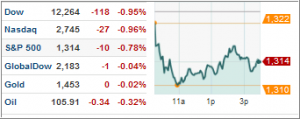
While equities sold off early morning yesterday, the damage was very much contained as the afternoon session brought in renewed buying and kept losses at a minimum as the chart above shows.

Commodity prices were pressured with gold and silver taking the brunt of the hit. Gold dropped below the 1,400 level while crude oil traded below the $90/barrel mark. Profit taking played a big role as commodities have been on a strong upward path.

The explanation for gold’s decline was improved expectations for a global recovery, which presumably reduces uncertainty and causes investors to prefer equities over hard assets. Let’s see what happens not if but when new signs of economic headwinds surface unexpectedly again. Additionally, beginning of the year portfolio rebalancing could have played a role as well.

Today we’ll be looking at non-manufacturing data and the ADP employment number, which is the precursor of the all important jobs report due out on Friday. Any positive surprises can easily move the markets towards their all-important 1,300 level of the S&P; 500.

Disappointment with any of these numbers could make investors question as to whether these lofty levels of the major indexes are actually justifiable.

Starting 2011 On A High

Ulli Uncategorized Contact


Picking up on the positive momentum from 2010, the markets welcomed 2011 yesterday with their biggest rally in nearly a month. For most of the day, it looked like a triple-digit pop in the Dow, but a last hour fade took back nearly a third of the gains.

Nevertheless, the rally was broad with most sectors participating. Commodities moved higher along with Crude oil, which topped $92/barrel for the first time since late 2008. Gold slipped slightly, the dollar was flat, and interest rates inched up causing bonds to slip just a bit.

Asia and Europe led the markets, and the domestic indexes followed along right after the opening bell as the chart above (courtesy of MarketWatch.com) shows.

Some economic reports, while not earth shattering, helped the bullish cause. Manufacturing strengthened in December, and better-than-expected construction spending in November cheered traders on Wall Street.

While this was a good start to a new year, we’ll have to wait and see if this upward momentum can be sustained once some of last year’s issues move back to the front page again. The market indexes are hovering around very lofty levels and have moved substantially above their respective long term trend lines.

Let’s hope that this picture does not end up in the “pop and drop” syndrome, which can be frequently observed once markets have moved up too far and too long without any correction.

Right now, however, we’re off to a good start, so let’s enjoy it for the time being.

Goldman Sachs Guru Forecast

Ulli Uncategorized Contact

Hat tip goes to reader Mal for pointing to this article “This Goldman Sachs Guru Sees 2011 as ‘the Year of the USA:’”

Jim O’Neill shot to fame by predicting the staggering rise of emerging-market economies. Now the head of Goldman Sachs (GS) Asset Management, O’Neill recommended investors buy into so called BRIC economies of Brazil, Russia, India and China a decade ago.

Few economic trends have been more consequential since, and O’Neill deserves plenty of credit for spotting it early on. Investors following his advice would have made handsome profits even as the developed world struggled. Indeed, O’Neill’s recommendation is often seen as the call of the decade.

So, what economy is he predicting will shine in the coming year? The U.S.

In a note to clients earlier this week, O’Neill wrote that he recently found himself “dubbing 2011 as the likely ‘year of the USA’ following a spate of stronger-than-expected economic data.

Even Employment Could Pick Up

O’Neill anticipates strong stock market gains of 20% in the year ahead. And while the jobs picture has continued to struggle even as the market surprised to the upside, that could change as well. “The growth is likely to be strong and robust enough to lead to declining unemployment which, if correct, should mean that the worst of the social consequences of the credit crisis should start to ease,” he wrote.

Bonds would get hit as yields rise in anticipation of growth, and the dollar could rally substantially, he predicted.

Of course, the U.S. economy continues to face problems like indebted consumers, low personal savings rates and big current account deficits. But 2011 “will be the beginning of a new phase in which the U.S. has strong GDP growth,” O’Neill wrote, led by exports an investments.

From “New Normal” to “Normal”

Bearish holdouts for much of the year, economists at Goldman Sachs recently threw in the towel and are now forecasting strong growth for the U.S. in the years ahead. While government statistics released Wednesday revised third-quarter growth up to an annualized 2.6% from the initial 2.5% estimate, Goldman now predicts a growth rate of 3.4% for 2011 and 3.8% for 2012.

During 2010, however, many in the U.S. worried about the prospects of a double-dip recession, while many emerging market juggernauts found themselves coping with strong growth. China and India raised interests rates to keep inflation in check, even as the Fed embarked on a second round of quantitative easing to try stimulating the economy and to avoid deflation.

Sour sentiment in the U.S. as high-profile investors predicted a long period of subpar growth under a “new normal” scenario weighed on financial markets. Investors huddled into safe assets like bonds despite meager yields even as corporate earnings boomed.

But brightening sentiment could change investor preferences and give stocks a boost. “All of this will result in a mood that the U.S. is returning to ‘normal,’ which will have predictable consequences for financial markets,” O’Neill wrote.

O’Neill’s predictions may seem farfetched to U.S. investors mired in years of pessimism following the financial crisis. But they should recall that his prescient call on the BRIC economies at a time when most investors were still focused on the aftermath of the dot-com bubble’s bursting seemed even less likely. You may not want to ignore him again.

There you have it—one man’s opinion. While I agree that the U.S. market may have more upside potential, it’s not because things are so hunky dory here, it’s because very likely they will be worse elsewhere.

Domestically, we certainly will have to deal with a host of issues. Real Estate is still tanking with no end in sight; unemployment is not showing any signs of improvement and gains in one area, like private payrolls, may be offset by losses in other areas, such as workforce reductions on all levels of government.

Budget shortfalls and red numbers wherever you look may result in a host of cities and municipalities filing bankruptcy in order to reduce debt and reorganize.

Nevertheless, as dire as that sounds, things may very well be worse in other parts of the world. Europe has its own debt issue to deal with, and it’s just a matter of time until one overburdened and debt ridden country is no longer willing to play musical chairs and ends up defaulting. It’s no question in my mind that a domino effect will be the consequence.

Other major global players are mired in their own real estate and debt bubbles, which could burst at some time during 2011. China, Canada and Australia come to mind with India’s economy reaching a critical boiling point.

In the end, when and if some of these issues turn into problems, the U.S. may not be such a bad place to invest after all. There’s a good chance that the dollar will be resuming its uptrend, especially if bad news from Europe prevails this year.

A good way to track the dollar’s progress, or lack thereof, is via the ETF UUP. While it’s still hovering below its long term trend line, watch for a break above, whenever that may occur.

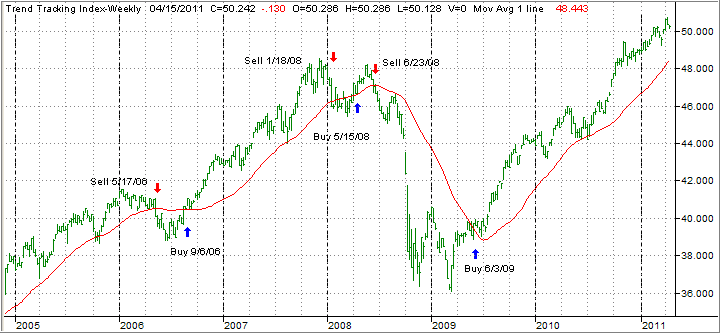
Again, my theme for this year will be to look for changes in trend direction via our Trend Tracking Indicators (TTIs) and by watching individual ETFs break above or below their respective trend lines. Using that in combination with our trailing sell stop points, should put you in a position of better controlling your downside risk.

After all, just because some predictions are rosy does not mean the market can’t fool the majority of investors again just as it did in 2008. It pays to always be prepared.

Disclosure: No holdings in UUP

Last Week In Review: ETF News And Blog Posts To 1/1/2012

Ulli Market Review Contact

In case you missed it, here’s a summary of the ETF topics and market reviews I posted to my blog during the week ending on 1/1/2012.

The major indexes inched slightly lower into the last trading day of the year with the S&P 500 ending 2011 just about unchanged.

Heading into 2012, the world’s excessive debt overhang will remain headline news, as most attempts to solve these thorny problems have focused on providing the liquidity when the real issue has been insolvency.

Traders will return well rested next Tuesday ready to push buy and sell buttons depending on not only the news du jour but also on a host of economic reports ending with the all important employment numbers on Friday.

This week, we covered the following:

Read More

Happy New Year

Ulli Uncategorized Contact

I hope you are enjoying the Holiday season, and I like to wish you a Happy New Year, good health and much success.

Ending an old year and starting a new one should always include some time of reflection. As I was thinking about that, I came across Todd Harrison’s article on Minyanville titled “Things I’ve learned.” It contains some great thoughts to ponder. Take a look.

Regular posting will resume on Monday.