Nowhere To Hide

Ulli Uncategorized Contact

Reality about a slowing economy not only hit Wall Street yesterday but also dragged global markets down as no region proved to be a safe haven from the selloff. Bonds were the beneficiary again as interest rates headed lower.

I was not about to wait around to see if that debacle would turn into a 500 point down day, so I sold some of our recently acquired country ETFs. Our international fund, which initially raced higher after we purchased it, headed sharply lower and actually dropped below its own respective long-term trend line. Barring a sharp reversal today, this fund will be sold as well.

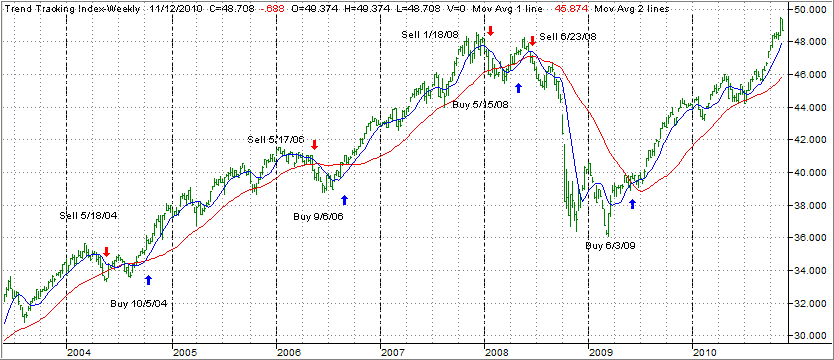
While all global markets were affected, the damage was far greater internationally than domestically. This was reflected in the sharp drop of our international Trend Tracking Index (TTI), which moved to within +0.09% of generating a sell signal. Its domestic cousin is still hovering above its own trend line by +2.89%.

Contributing to the market’s sudden demise were continued worries that the global economy will be heading in the wrong direction. Not helping matters was a 19% increase in the June U.S. trade deficit, which will result in a downward revision of the second quarter economic growth figures.

Additionally, after a night of thinking about Tuesday’s Fed move, it became clear that, while they are concerned about a slowdown, their intentions might be too little to right the sinking ship.

It seems like the markets have been moving in a vacuum for most of this year with no sustainable long-term trend in place; either up or down. The result has been whipsaw sideways action where neither the long nor the short side has produced any meaningful results.

Yesterday’s pullback violated some important technical levels. First, the S&P; 500 plunged below its all important 200-day moving average (1,115). Second, it has also moved to within shouting distance of breaking its 50-day moving average (1,081) which, if broken, could invite some serious selling.

The bottom-line is that we’re back to a level within the range where anything is possible. You could see another sharp move up, but given the economic backdrop, it’s questionable whether there will be any staying power.

The reality of globally slowing economies finally seems to have made its way to the stock exchanges of the world. Short of any incredibly good news to the contrary, it’s my opinion that over the next few months the path of least resistance will be to the downside.

Swinging Wildly

Ulli Uncategorized Contact


Even though yesterday’s closing prices did not reflect the intra-day activity, it was a wild day nevertheless. The chart above (courtesy of freestockcharts.com) represents Tuesday’s 5-minute interval moves of SPY.

It was waiting time until the Fed announcement, which occurred as indicated via the red arrow. Prior to that, the markets were down, then shot straight up and whip-sawed the remainder of the session but cut the losses for the day in half.

The Fed threw the market a bone by announcing that it was willing to expand its holdings of government debt thereby insuring that there are adequate supplies of cash in the economy.

The bone did not have much meat on it, which explains the continued uncertainty after the announcement displayed by the erratic market behavior in the chart.

Going this route is an admission, at least to my way of thinking, that economic conditions could worsen and that the Fed is willing to deploy any tool it has available. I am not an economist but, historically, none of the past actions have resulted in any long-term benefit and have proven to be of questionable duration and effect.

Nevertheless, if the markets decide to interpret this as a positive event by continuing to rally, I will not question this upward tendency and stay aboard until the trend comes to an end and our trailing sell stops issue the signal to step aside.

These are very difficult market conditions because not only does the Fed seem confused as to which next step to take, it also is slipping into unchartered territory with its decisions.

Waiting For The Fed

Ulli Uncategorized Contact


The markets meandered on low volume yesterday, however, with a positive bias, and we ended up closing about ½% higher.

The Fed watch is on; not as much in regards to the question as to whether higher interest rates are on the horizon, but more importantly if they will come up with any grand ideas to improve the sagging economy.

The bond market with its continuous rally and ever decreasing yields is as good of an indicator as you can find confirming that the economy is anything but robust. If the opposite were the case, we’d have higher yields and a falling bond market.

Nothing will surprise me as to what the Fed will throw at the markets next. Be prepared to deal with a relief rally, bitter disappointment, or anything in between.

Helpful Hints: Converting Mutual Funds To ETFs

Ulli Uncategorized Contact

MarketRiders features an interesting online mutual fund cost calculator. It allows you to input sever ticker symbols as well as the amount invested. The program then returns the yearly loss from mutual fund fees, which is a sobering number if you look at it over 20 years.

You are then prompted to input your email address for a detailed report on hidden mutual fund fees, the impact on your retirement over time and an alternative lower cost ETF portfolio.

The last feature is probably the most important one if you are currently considering converting some of your mutual funds into equivalent ETFs. Check it out and see if you find it useful.

Disclosure: No affiliation with MarketRiders

Sunday Musings: A New Imminent Rally?

Ulli Uncategorized Contact

Hat tip goes to reader Jeff for pointing to “Of babies and hammers:”

The stock market will get a major boost at the end of this week. That’s when Congress’ August recess begins, and it isn’t scheduled to go back in session until after Labor Day.

What’s that have to do with the market? Plenty, apparently. The stock market on average has performed much better when Congress was not in session.

Consider an academic study several years ago by professors Michael Ferguson of the University of Cincinnati and Hugh Douglas Witte of the University of Missouri at Columbia. Specifically, they found that “about 90% of the capital gains over the life of the Dow Jones Industrial Average have come on days when Congress is out of session.”

Specifically, according to the professors, the Dow between 1897 and 2004 produced an annualized return of 5.3% when Congress was out of session, in contrast to just 0.4% when it was in session.

It’s always possible, of course, that this so-called “Congressional Effect” is just a statistical fluke. Correlation is not the same as causation, after all.

But the professors don’t think it is just a fluke. Companies and investors face “a more uncertain tax and regulatory environment” when Congress is in session, which means risk is higher then than when Congress is on recess. As confirmation of this finding, the professors point out that the stock market has tended to exhibit significantly greater volatility when Congress is meeting. And volatility is a good proxy for uncertainty.

The professors quote from a famous speech of Will Rogers in 1930: “This country has come to feel the same when Congress is in session as we do when a baby gets hold of the hammer. It’s just a question of how much damage he can do with it before we take it away from him.”

Another reason why the professors don’t think their results are just a fluke: The pattern has tended to be strongest when Congress has a low approval rating in public opinion polls. For example, they found, the Congressional Effect has tended to be especially pronounced whenever Congress’ overall approval rating is below 39%.

This particular wrinkle in the data suggests the market may receive more than the usual boost during Congress’ upcoming recess. Among the several polls that PollingReport.com reports as having been conducted over the last six weeks, Congress’ current approval ratings range between just 19% and 24%.

One general investment lesson that can be drawn from this academic study is that the stock market is very sensitive to factors that we might not otherwise think have much to do with it. In this case, it means that, in order to understand the stock market, we have to also understand what’s going on in Washington.

[Emphasis added]

I must admit that Will Rogers’ quote gave me a big chuckle. In regards to congress being out of session, I feel the same in that at times it’s better/safer doing nothing than coming up with something stupid.

In terms of investments, the major trends just happen to be up, so if that theme continues, further market gains may very well coincide with congress resting, however, the absence of congressional sessions will not have been the cause of it.

Nevertheless, it’s interesting that this study ranging over 100 years has produced these types or results especially when considering that these gains have come during the stock market’s notoriously slow summer time as opposed to the traditional strong period from January through April.

Time will tell if this phenomenon will “assist” the markets this year. My focus will be obviously on trend direction along with our trailing sell stops. If congressional absence should lend a hand in the bullish cause, then I will take this simply as a bonus.

Competing With The Big Boys

Ulli Uncategorized Contact

Reader Dick had a general comment about what goes on in the markets:

How can anyone think that the markets are behaving “normally” now?

There’s High-Frequency Trading providing 80% of the market right now (from computers running in front of “regular” market computers); and ‘too-big to fail’ Investment Banks, including Goldman Sachs, able to pretty much borrow money for free, gamble in the market, keep their profits, and get bailed out if they lose.

How can trend-following and “the little guy” compete against that?

I think Las Vegas is now fairer to its customers.

I certainly can’t disagree with what you said; other readers have expressed similar opinions over the past couple of years.

You could add a host of other items to the menu like government stimulus and bailouts via the wide variety of programs we’ve seen since the crash of 2008. All have contributed in distorting the real economic picture causing the stock market to swing wildly depending on data interpretation.

However, when all is said and done, there is only one reality left at the end of the day. And that is the closing price of a fund/ETF and how it fits into a particular trend or lack thereof—nothing else matters.

To me, that supports the idea of unemotional trend tracking because it cuts out the intra-day market noise. Conditions over the past 7 months have created a sideways pattern, which has done nothing for any investment method focusing on a longer time frame; but it provided opportunities for those who trade short term.

Since the 80s, I have witnessed just about any market condition that you can imagine ranging from high and low interest rates, wars, acts of terrorism, bear markets and the eventual burst of the credit bubble resulting in the crash of 08.

Along the way, following trends has proven to be the only sane way to live with the disasters of the past 20 years. It has not always been a smooth ride, especially during those periods when the markets went sideways and were displaying a similar behavior as we are seeing right now. As I have mentioned before, that is a condition not unlike treading water with the result of going nowhere.

No market condition will last forever and this one will come to an end as well. The question remains as to who will win; the bulls or the bears. That is when the rubber meets the road. Let trend tracking be your guide to making the right investment decision so that you will not get caught on the wrong side of market direction as so many did in 2001 and 2008.