No Load Fund/ETF Tracker updated through 1/13/2011

Ulli Uncategorized Contact

My latest No Load Fund/ETF Tracker has been posted at:

http://www.successful-investment.com/newsletter-archive.php

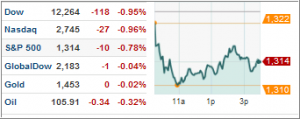
The major indexes slowly but surely moved higher again pushing the S&P; 500 within less than 1% of recapturing its 1,300 level.

Our Trend Tracking Index (TTI) for domestic funds/ETFs has moved above its trend line (red) by +5.60% (last week +4.82%) and remains in bullish mode.


The international index has broken above its long-term trend line by +9.25% (last week +6.90%). A new Buy signal was triggered effective 9/7/10. If you decided to participate, be sure to use my recommended sell stop discipline.


[Click on charts to enlarge]

For more details, and the latest market commentary, as well as the updated No Load Fund/ETF Tracker StatSheet, please see the above link.

Picking Up Steam

Ulli Uncategorized Contact


As a result of high demand for Portuguese bonds, the European debt crisis eased for the time being and got the market in rally mode early yesterday morning. The latest talk now is that Portugal may not need a bailout after all.

The Fed’s beige book confirmed that the economy was growing at a moderate pace with pockets of strength being present in consumer spending and manufacturing. Loan demand was still mixed with real estate continuing to be weak.

Bonds dropped slightly as interest rates rose, while gold, crude oil, energy and commodities headed higher. All in all, it was a nice rally with no news events providing any headwinds.

Good Start—Mediocre Ending

Ulli Uncategorized Contact


After a solid attempt to move to higher ground, the markets ran into unknown resistance yesterday, sold off, but managed to close on the positive side of the unchanged line.

The drivers for yesterday’s action turned out to be higher commodity, energy and metals prices. Crude oil pushed through $91/barrel while gold rallied some $10. Interest rates were higher while the dollar was mixed against the Euro.

The early rally attempt was not enough to reverse the slide of one our country ETF holdings (IDX), which was sold in accordance with our trailing sell stop rules.

Today, the market will take a look at Portugal, Spain and Italy and their results of the intended bond sales. Domestically, the focus will be on the auction of some $21 billion in 10-year U.S. Treasury notes.

Also on the menu is the Fed’s beige book report, which will be analyzed very much in detail as it represents a narrative look at the economy. Any surprises will definitively affect market direction.

European Debt Worries

Ulli Uncategorized Contact


Over the weekend, I talked about European debt concerns, which again moved to the front page yesterday and pushed the markets lower at the opening.

At issue were worries as to whether Portugal and Spain, and to some degree Italy, may need to be bailed out and if they were able to fund their borrowing needs later on this week. The dollar rallied and the Euro dropped taking the markets along.

A late rebound in the Euro reversed the early trend, and the major indexes slowly recovered but ended up short of the unchanged line. My theme from yesterday “Dollar Strength Equals Equity Weakness” still stands and has the potential for a whole new meaning not if but when the European crisis worsens.

What that means is that Europe is definitely the elephant in the room. Any default by a member country, which I consider a real possibility, will send the dollar soaring and equities tanking. The timing of it is the big unknown.

Again, the S&P; 500 held at its major resistance point of 1,260, which has repeatedly served as a springboard. The picture was very murky in the emerging arena as most country ETFs headed south, but to varying degrees. One of them clearly pierced its long term trend line and will be sold, unless a huge rally emerges by mid-day.

Dollar Strength Equals Equity Weakness

Ulli Uncategorized Contact


The dollar and the domestic stock market have been moving in opposite directions over the past couple of years. This relationship is clearly visible in the above 1-year chart.

However, lately there seems to have been some decoupling as the WSJ reports in “Dollar To Stocks: You Can Go Your Own Way?”

For much of the fall, after Fed chairman Ben Bernanke announced QE2, stocks rallied as the dollar sank in what felt like tit-for-tat mirror-image fashion, baffling a number of analysts and technicians. (We wrote about it here.)

Well, it’s over, some say.

More than one analyst has landed in our inbox, arguing that the autumnal dance between the U.S. dollar and the stock market has broken down with the wintry chills. As QE2 has receded into the back of investors’ minds, the dollar (DXY, the Dollar Index) and stocks (S&P; 500) have begun charting independent paths, with the negative correlation reverting to nearly zero, these analysts say.

The explanation, according to Macro Risk Advisors’ Dean Curnutt: the domestic economic recovery has strengthened, which helps both the dollar and stocks. And even though all signs seem to point to Chairman Bernanke following through on QE2 — further diluting the dollar’s strength — almost all of these expectations had been baked into the dollar’s price since the official $600 billion announcement in early November. “The fact that the SPX is able to ‘power through’ this decoupling seems pretty constructive,” he wrote.

Indeed, no sooner were we ready to shoot off this post than Mark Arbeter, S&P;’s technical analyst, crashed into our inbox, arguing that — nope! — the correlation hasn’t broken down at all, and any continued strength in the USD could hamstring the current stock-market rally. Here’s more from Mr. Arbeter:

“Over the last year or two, the stock market and the dollar have been linked very closely. Although, sometimes an early reversal to the upside by the dollar will be ignored by stocks, and with it, an outpouring of media attention that the link is no longer valid, it has been our experience that eventually dollar strength equals equity weakness.”

The dollar’s rally can easily continue, especially once the European debt crisis shifts into high gear meaning that one of the Euro zone countries goes into default. It may take some time for this to happen but, once it does, everyone will want to own dollars, which may then very well seal the fate of equities. Only time will tell, but I will revisit that thought once we get there.

In the meantime, let the trends be your guide to any new investment decisions you are trying to make.

Sunday Musings: A Scary World

Ulli Uncategorized Contact


Reader Mark has some justified concerns as to where we’re going economically and how we can prepare ourselves investment wise for an uncertain future. Here’s what he wrote:

I want to ask you about something that is beginning to worry me as it relates to the markets domestically and to a lesser degree internationally. Much of the world is pinned to the value of the dollar and transactions (such as oil) are based on the dollar.

There is a growing sentiment out there that the only thing that allows the U.S. to manage its overwhelming debt burden is its ability to print money – which it can only do because most of the world accepts the dollar as the pinning currency.

However, countries are starting to pull back on the dollar as the “benchmark” currency against which transactions are pinned. China for example is not going to base as many things on the dollar value and meetings between Japan, China, and others seem to indicate the dollar may not be able to hold its international currency strength. You probably heard Geithner saying that he will not devalue the dollar but he may not have a choice.

So I am concerned about what it means for investments in general going forward. Should there be a start to more investment in gold and silver?

What is going to happen when commodities start to go on an upward tear (like gasoline, precious metals, milk, etc.)?

I am interested in your thoughts. Some stories out there indicate that the time is now to prepare for what may be a looming, major financial crisis because of a dollar that will not have clout. I read that the U.S. debt burden could not be met even if every American was taxed 100%.

Pretty scary!

I have always referred to the dollar as being the world’s favorite whipping boy. There was much talk some six months ago for the dollar era coming to an end along with another currency to become the new benchmark, especially when it came to the pricing of crude oil. The obvious contender and number 1 pick for the job was the Euro.

Well, how fast things can change. The European debt crisis, far from being over, will have far reaching unintended and unknown consequences in the future with one being the much discussed question as to whether the Euro can even survive. Let’s wait and see what happens once the first country of the Euro zone reneges on their debt obligation. I believe that this is not a matter of if but when.

Those factors have pretty much sealed the dollar’s position as the remaining reserve currency. The dollar has rallied over the past few months, much to the chagrin of Geithner and company. Their official position is a strong dollar; but in reality they prefer a weaker one to gain export advantages. In fact, all industrialized nations want their currencies to be weaker for the same reason.

Looking around the global scene, we have real estate bubbles in Canada, Australia and China with the Chinese economy needing to be reined in because of inflationary concerns. Japan is continuing to have its own debt problems resulting from their real estate bust some 20 years ago and their futile attempts to fight deflationary forces with stimulus programs.

No matter where you look, things don’t look pretty, and a major financial crisis could develop anywhere. Rather than trying to make a wild guess as to where the first domino might fall, just focus on the long-term trends of various asset classes.

Precious metals, commodities, energy and stock markets in general are trending up. If a crisis erupts, precious metals will very likely be the primary beneficiary. If global economic expansion continues, or shortages arise, energy, oil and commodities will rally higher.

That’s why I have rebalanced our portfolios over the past few months to include the above asset classes since they appear to be firmly entrenched above their respective long-term trend lines.

While you can own precious metals outright via various ETFs, my preference has been to hold them in a more conservative way via PRPFX. It makes those $50 drops in the price of gold easier to handle, although for some clients we hold positions in GLD outright.

The chart above shows some of the other holdings we currently have exposure in covering the entire domestic stock market (VTI), the commodity index (DBC), energy (VDE) and gold (GLD). As you can see, after the market meltdown during May/June 09, all have resumed their previous uptrends.

No one knows what the future holds, but I believe that these asset classes are an important part of our portfolios to counteract whatever crisis might develop. Of course, this is my view right now, and I will change it not only when the facts change but when there is a clear directional trend reversal as well.

Uncertainty is here to stay with us, and it pays to be prepared should a black swan event develop in 2011, the likelihood of which seems to have increased quite a bit over the past year.